


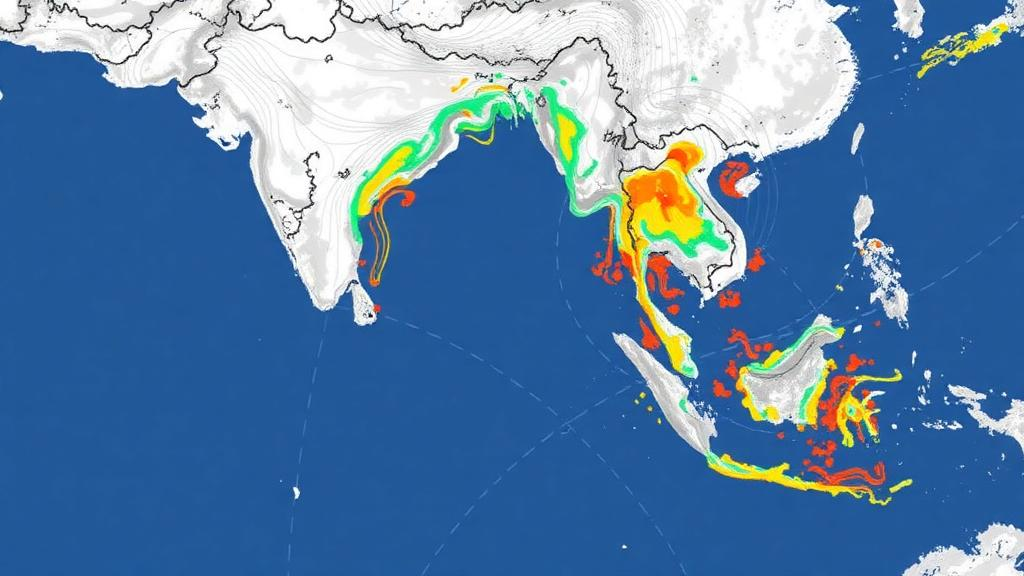
Every year, more than a billion people across South Asia plan their planting, harvesting, and water storage around a single, deceptively simple question: when will the monsoon arrive? The answer, it turns out, depends entirely on who you ask and what they measure. Rainfall specialists point to one date, pressure analysts to another, and temperature or humidity researchers to still others. A new study published in Theoretical and Applied Climatology by Md Rafiqul Islam of The University of Alabama and Scott C. Sheridan of Kent State University aims to end that ambiguity with a single, unified framework that declares the onset and withdrawal of all four South Asian seasons without relying on any arbitrary thresholds at all.
The core of the approach is a machine learning technique called a self-organizing map, or SOM, an unsupervised neural network first introduced by Teuvo Kohonen in the 1980s. SOMs have long been a workhorse of synoptic climatology, the branch of meteorology that classifies daily weather into recurring circulation patterns. Instead of asking whether a rainfall gauge has crossed some magic number, the method asks a more fundamental question: which large-scale atmospheric pattern is sitting over the region today? By grouping thousands of daily weather maps into a grid of representative patterns, the SOM turns the messy continuum of atmospheric states into an ordered catalogue of circulation regimes.
Islam and Sheridan trained separate 9 by 9 SOMs—one for each of five near-surface atmospheric variables drawn from the NCEP/NCAR Reanalysis, a widely used gridded reconstruction of historical weather. The five variables were sea-level pressure, 2-meter air temperature, 2-meter relative humidity, near-surface winds, and precipitation. Each of the 81 nodes in a given SOM represents a distinct, characteristic pattern of that variable across the South Asian domain. Every day in the reanalysis record is then mapped to the node whose pattern it most closely resembles, effectively assigning each day a circulation fingerprint.
The crucial innovation comes next. Rather than eyeballing the map grid to decide which patterns belong to which season, the researchers objectively assigned nodes to the four meteorological seasons recognized in the region—winter, pre-monsoon, monsoon, and post-monsoon. Once every node carries a seasonal label, the transition dates fall out naturally: the monsoon begins on the day the atmosphere settles into monsoon-labeled patterns and ends when it departs them. Because the assignment is systematic, the same procedure can be repeated for any variable, any region, or any sub-period, producing onset and withdrawal dates that are reproducible rather than dependent on the judgment of individual analysts.
The results reveal a striking and previously underappreciated picture of how differently the seasons announce themselves depending on what you measure. The study found no single, distinct correlation between the onset timings derived from the five variables, meaning that pressure, temperature, humidity, winds, and rainfall each tell their own story about when the seasons turn. Monsoon season, when defined by sea-level pressure, relative humidity, or temperature, tends to run longer than when it is defined by precipitation alone—a sign that the large-scale circulation reorganizes well before the rains become sustained.
That gap is not a curiosity; it is physically meaningful. The analysis shows that precipitation-based monsoon onset arrives roughly one week later than circulation-based onset, and precipitation-based withdrawal comes roughly one week earlier than the circulation suggests. In other words, the atmosphere shifts into its summer monsoon configuration before the rain fully commits, and it begins to relax out of that configuration before the rain fully quits. This is consistent with the well-established requirement for preconditioning: the large-scale flow must build up moisture convergence and low-level winds before sustained rainfall can develop, and it lingers in a summer-like state as the rains taper off.
The framework also captured a long-term trend in the winter season that will interest climate monitors. Winter length has increased over the record, driven by onset shifting earlier and withdrawal shifting later. Because the method is threshold-free, such trends emerge directly from the circulation record rather than from any chosen definition of what counts as a winter day, making them easier to compare across studies and across variables. The authors note that the same procedure can be applied regionally as well as across the whole domain, and their results demonstrate transferability across sub-regions within the same climate regime—meaning a forecaster in Bangladesh and one in northwestern India can apply the identical recipe and get internally consistent answers.
The technical elegance of the SOM approach lies in what it removes. Traditional monsoon onset definitions—such as the classic criteria for onset over Kerala used by the India Meteorological Department—typically hinge on thresholds: so many millimeters of rain at so many stations for so many consecutive days, or a specified reversal of the upper-level zonal winds. Those criteria are operationally useful but inherently arbitrary in their cutoffs, and different thresholds yield different dates. Hydrological definitions based on vertically integrated moisture transport, dynamical definitions based on wind reversals, and station-based rainfall definitions have all coexisted for decades, each defensible yet none mutually comparable. By anchoring the seasonal transition in the identity of the circulation pattern itself, the SOM framework sidesteps the threshold problem entirely and produces what the authors describe as a robust platform for multi-variable, circulation-informed seasonal dates.
Why does this matter beyond the academic literature? Monsoon onset timing is among the most consequential pieces of seasonal information in the world. An early or late onset can shift sowing windows for rice, wheat, and cotton, alter reservoir management decisions, and modulate the risk of flooding during the pre-monsoon and post-monsoon transition periods. Forecast systems have made real progress in predicting onset—the study’s reference list includes work on coupled seasonal forecast models and extended-range prediction built on SOMs—but verification of those forecasts still depends on having a consistent, objective definition of what onset actually is. A framework that yields the same answer whether applied to pressure, humidity, temperature, winds, or rainfall, and at both continental and regional scales, gives forecasters and agrometeorologists a common yardstick for the first time.
The study also carries a broader lesson for climate science: synoptic climatology, the tradition of classifying weather maps into regimes, remains a powerful and underused lens for diagnosing seasonal transitions, not just daily weather. By demonstrating that a single unsupervised learning method can harmonize five different atmospheric variables into one coherent seasonal calendar, Islam and Sheridan have offered the monsoon research community something it has long lacked—a uniform, reproducible, and threshold-free declaration of when the seasons begin and end. As the climate continues to warm and the stakes of getting the monsoon calendar right continue to rise, frameworks like this one may become the standard against which both observations and forecasts are judged.
Subject of Research: A threshold-free self-organizing map framework for determining uniform seasonal onset and withdrawal dates in the South Asian monsoon
Article Title: Uniform seasonal onset declaration in the South Asian monsoon: a SOM-based circulation framework
Article References: Islam, M. R., & Sheridan, S. C. (2026). Uniform seasonal onset declaration in the South Asian monsoon: a SOM-based circulation framework. Theoretical and Applied Climatology, 157(10), Article 660. https://doi.org/10.1007/s00704-026-06598-w
Image Credits: AI Generated
DOI: 10.1007/s00704-026-06598-w
Keywords: South Asian monsoon, monsoon onset, self-organizing maps, synoptic climatology, NCEP/NCAR Reanalysis, seasonal transitions, machine learning, precipitation, sea-level pressure, climate variability, monsoon withdrawal, meteorology
Cite Scienmag News
Cassandra Pierce. (October 4, 2026). Neural Maps Give Forecasters a Threshold-Free Way to Pin Down the Monsoon’s Start. Scienmag. https://scienmag.com/neural-maps-give-forecasters-a-threshold-free-way-to-pin-down-the-monsoons-start/
Cassandra Pierce. "Neural Maps Give Forecasters a Threshold-Free Way to Pin Down the Monsoon’s Start." Scienmag, 4 October 2026, https://scienmag.com/neural-maps-give-forecasters-a-threshold-free-way-to-pin-down-the-monsoons-start/. Accessed 4 October 2026.
Cassandra Pierce. "Neural Maps Give Forecasters a Threshold-Free Way to Pin Down the Monsoon’s Start." Scienmag. October 4, 2026. https://scienmag.com/neural-maps-give-forecasters-a-threshold-free-way-to-pin-down-the-monsoons-start/


