


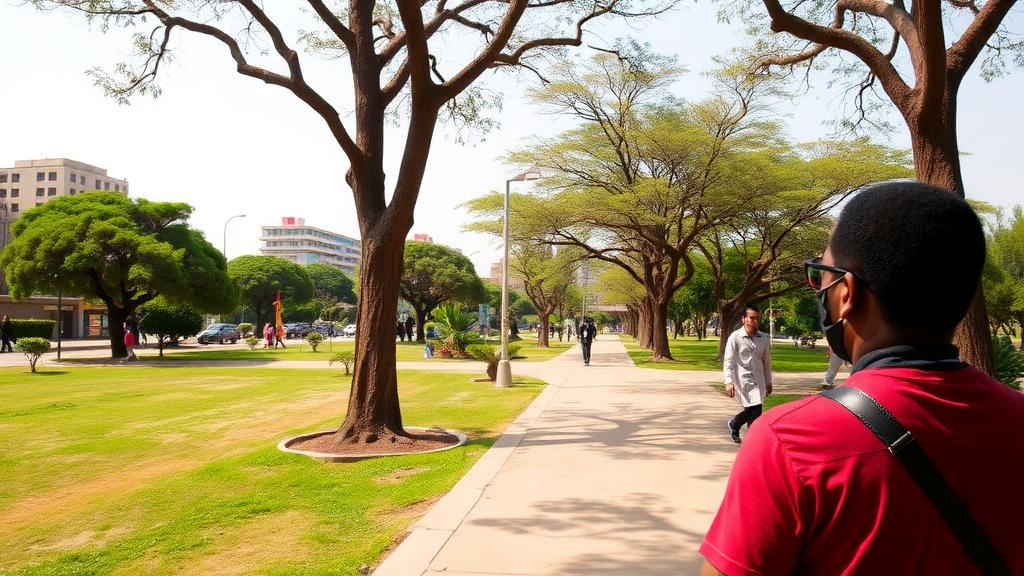
In the fast-growing town of Bishoftu, Ethiopia, residents know exactly what they love about their trees and parks: they are beautiful places to relax. What they know far less about, a new study finds, is the invisible work those green spaces do every day — cooling the streets, cleaning the air, absorbing floodwater, and building the soil. The gap between what urban dwellers see and what green infrastructure actually delivers could shape how one of Africa’s rapidly urbanizing regions plans its cities, according to research published in the journal Discover Sustainability.
The study, led by Tesfaye Abdeta and Yared Girma of Adama Science and Technology University together with Daniel Lirebo of Ethiopian Civil Service University, set out to fill a stubborn evidence gap. While large capitals such as Addis Ababa have attracted considerable research attention, secondary cities — the places absorbing much of Sub-Saharan Africa’s explosive urban growth — remain poorly documented. Bishoftu, a fast-expanding town in Ethiopia’s Oromia region, offered an ideal case: a settlement where pressure on green infrastructure is intensifying, yet where almost no empirical data existed on what residents actually understand about the ecosystem services around them.
Methodologically, the team took a mixed-methods approach. They surveyed 383 households selected through stratified random sampling, ensuring that respondents were drawn proportionally from different parts of the town rather than from a single convenient neighborhood. The questionnaire data were complemented by key informant interviews with local experts, and the results were analyzed using descriptive statistics, inferential tests, and thematic analysis of the qualitative material. The research protocol was reviewed by the Research Ethics Committee of Adama Science and Technology University, which granted a waiver of formal approval on the grounds that the study involved minimal risk and non-sensitive topics; informed verbal consent was obtained from all participants.
The headline finding is a striking hierarchy in environmental awareness. Respondents rated their awareness of different categories of ecosystem services on a scale, and cultural services — the recreational, aesthetic, and spiritual benefits of green space — scored highest, with a mean of 3.85. Regulating services, such as climate moderation and air purification, came second at 3.28. Provisioning services, the tangible products like food and raw materials, followed at 2.9. Supporting services — the slow, foundational processes that underpin all the others — trailed far behind at just 1.5. In other words, people see the park bench but not the soil beneath it.
Drilling down to individual services sharpened the picture. Recreation scored 4.6 and aesthetic value 4.3, the two most recognized benefits of urban green infrastructure in Bishoftu. At the opposite end of the spectrum, nutrient cycling registered a mean of just 1.2 and soil formation 1.4, making them the least understood services of all. The pattern repeated when residents were asked how important each category was to them: cultural services again topped the list at 3.8. Pairwise comparisons made the preference explicit — a strong majority of respondents favored cultural services over regulating services (82 percent), provisioning services (70 percent), and supporting services (85 percent).
That preference would be less concerning if the invisible services were thriving on their own, but residents reported the opposite. Most respondents perceived a decline in both the extent and the quality of urban green spaces in Bishoftu over the past decade. Alongside that physical shrinkage, they noted reductions in key regulating services: air quality improvement, flood regulation, and temperature moderation were all reported to have weakened. For a town expanding rapidly in a warming climate, the perceived erosion of cooling and flood-control functions is more than a statistical footnote — it is a warning that the benefits residents least notice may be the ones disappearing fastest.
The study also probed who is more aware of ecosystem services, and the answers carry practical weight for planners. Regression analysis identified education as a significant predictor of awareness, with a standardized coefficient of 0.18 and a p-value of .001. Physical proximity mattered too: people living closer to green spaces were significantly more aware of what those spaces provide, with a coefficient of 0.14 and a p-value of .011. Notably, gender and home ownership showed no significant relationship with awareness. The implication is twofold — environmental knowledge in Bishoftu is unevenly distributed along educational lines, and it is shaped by everyday contact with nature, meaning that access to green space is not just an amenity issue but an information issue.
Why does awareness matter so much for a town’s trees? The authors point toward the politics of urban land. Green infrastructure in fast-growing cities competes directly with housing, roads, and commerce, and when the services a park provides are invisible to the public, the constituency for defending that park shrinks. A community that values a lakeside grove mainly as a picnic spot may offer little resistance when it is cleared for construction, unaware that the same grove was moderating local temperatures, buffering stormwater, and regenerating soil. Awareness gaps, in this sense, translate directly into vulnerability for the least visible ecosystem functions.
The Bishoftu findings echo a broader challenge across Sub-Saharan Africa, where secondary cities are expanding faster than planning systems can adapt. The researchers argue that closing the awareness gap requires participatory, multifunctional, and policy-driven approaches to green infrastructure management. Participatory planning would bring residents into decisions about green space before it is lost; multifunctional design would deliberately bundle visible cultural benefits with the regulating and supporting services that currently go unnoticed; and policy-driven management would embed ecosystem service protection in the formal planning instruments of fast-growing municipalities rather than leaving green space to survive by accident.
For a town like Bishoftu, the study offers a clear diagnosis and an actionable prescription. Residents already care deeply about the beauty and recreational value of their green spaces — that enthusiasm is an asset. The task now, the researchers suggest, is to build on that visible appreciation and make the hidden economy of urban nature equally legible: to teach, plan, and design so that nutrient cycling and soil formation become as real to a city’s residents as a shady afternoon in the park. As Ethiopia’s secondary cities continue to grow, the difference between green infrastructure that endures and green infrastructure that vanishes may depend on exactly that shift in perception.
Subject of Research: Community awareness and perception of ecosystem services provided by urban green infrastructure in a rapidly urbanizing Ethiopian secondary city
Article Title: Community awareness and perceived ecosystem services of urban green infrastructure in Bishoftu, Ethiopia
Article References: Abdeta, T., Lirebo, D., & Girma, Y. (2026). Community awareness and perceived ecosystem services of urban green infrastructure in Bishoftu, Ethiopia. Discover Sustainability. https://doi.org/10.1007/s43621-026-04906-y
Image Credits: AI Generated
DOI: 10.1007/s43621-026-04906-y
Keywords: urban green infrastructure, ecosystem services, Bishoftu, Ethiopia, community awareness, urban ecology, cultural services, regulating services, participatory planning, secondary cities, Sub-Saharan Africa, environmental perception
Cite Scienmag News
Gavin Prescott. (October 4, 2026). Ethiopian City Residents Love Their Parks but Miss the Hidden Benefits of Green Space. Scienmag. https://scienmag.com/ethiopian-city-residents-love-their-parks-but-miss-the-hidden-benefits-of-green-space/
Gavin Prescott. "Ethiopian City Residents Love Their Parks but Miss the Hidden Benefits of Green Space." Scienmag, 4 October 2026, https://scienmag.com/ethiopian-city-residents-love-their-parks-but-miss-the-hidden-benefits-of-green-space/. Accessed 4 October 2026.
Gavin Prescott. "Ethiopian City Residents Love Their Parks but Miss the Hidden Benefits of Green Space." Scienmag. October 4, 2026. https://scienmag.com/ethiopian-city-residents-love-their-parks-but-miss-the-hidden-benefits-of-green-space/


