


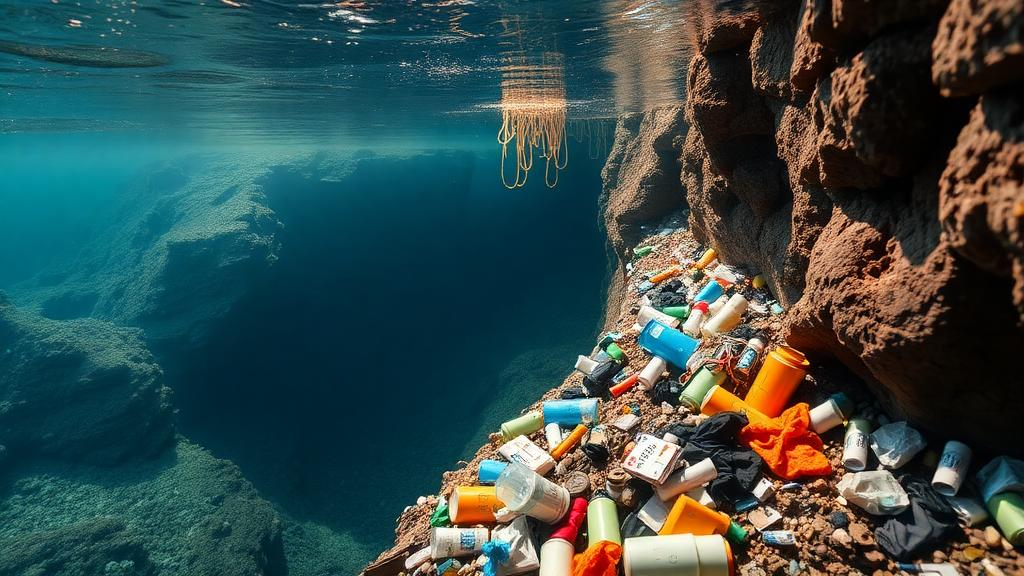
The deep sea has long occupied a special place in the human imagination as a realm beyond reach, a lightless wilderness so remote that human activity could not possibly leave a mark on it. A new study published on September 16, 2026 in the open access journal PLOS One dismantles that comforting assumption with unusual clarity. An international team led by Dr. Daniel Lauretta of Argentina’s natural science museum surveyed the Mar del Plata Submarine Canyon in the southwestern Atlantic and documented manmade debris scattered across a seafloor that no one had ever imaged before. The findings show that plastic bags, food wrappers, fishing gear and even a rubber boot have accumulated in one of the planet’s least explored environments, at depths approaching four kilometers.
The expedition, conducted in the summer of 2025 aboard a research cruise funded by the Schmidt Ocean Institute, marked the first time scientists had captured images of the seafloor within the Mar del Plata Submarine Canyon. Using a remotely operated submersible, the team carried out seventeen dives into the canyon system, revealing a landscape teeming with life as well as litter. Among the discoveries were approximately forty species that may be new to science, a reminder of how little is known about deep-sea biodiversity even as human refuse arrives there. The same dives that documented unfamiliar organisms also recorded twenty-nine identifiably manmade objects across ten of the dives, a striking proportion for a habitat so far from any coastline.
The technical details of the debris survey are sobering. The vast majority of the objects were plastic, accompanied by a smaller number of rubber items. The catalog ranged from fishing gear to plastic bags, food wrappers, snack wrappers, a tissue paper wrapper, a nylon cord with a hook, a white plastic cup, and a rubber boot. Depth records for individual items read like a descent into the abyss: a plastic wrapper at 2,109 meters, a food wrapper at 1,920 meters, a snack wrapper at 3,231 meters, a sediment-filled plastic bag at 3,739 meters, a highly degraded plastic fragment at 3,709 meters, and a plastic cup and bag at 3,243 meters. The boot, resting at 2,598 meters, offered perhaps the most vivid illustration of how ordinary consumer items can end up kilometers beneath the waves.
Equally significant was the spatial pattern the researchers observed. Litter was more abundant inside the canyon than in the surrounding seafloor, suggesting that the canyon’s topography and the currents flowing through it act as a funnel, concentrating drifting debris into the fissure. Submarine canyons are known to channel sediments and organic material from the continental shelf into the deep ocean, and the new evidence indicates that buoyant and neutrally buoyant trash follows the same routes. Items were found in a variety of states: some were partially buried in sediment, others were trapped among rocks, and a few were still drifting, indicating that debris continues to arrive rather than representing only a legacy of past pollution.
The study also recorded how deep-sea animals interact with the waste, and the picture is more complicated than simple avoidance. Mobile creatures such as crustaceans showed transient interactions with the debris, passing over or briefly investigating the foreign objects. More sedentary organisms, including starfish and corals, were observed attached to some items, with plastic packaging and fishing ropes often partially subsumed by the animals growing on them. To a filter-feeding coral or an anchored starfish, a length of sunken rope may present a surface resembling the hard substrate that is otherwise scarce on soft sediment plains. The researchers cautioned, however, that these observations should not be mistaken for evidence that the debris provides suitable habitat. The long-term consequences of colonization on plastic in the deep sea remain unknown.
The discovery in the Mar del Plata Submarine Canyon is not an isolated case. Just a few months before this expedition, a plastic bag was found in the Mariana Trench, the deepest fissure on the planet, demonstrating that no ocean depth is beyond the reach of human waste. The sinking of organic material from the surface is essential to sustaining life in the darkness below, where sunlight never penetrates and food must arrive from above. The new study adds to emerging evidence that this vertical rain of nutrients is not the only matter being pulled to the ocean floor. Debris generated on land and at sea follows the same gravitational and oceanographic pathways, settling into the very environments that depend on the steady delivery of material from the surface ocean.
For the scientists involved, the expedition carried a profound emotional weight alongside its technical achievements. The authors reflected on the experience of exploration in the deep: “Unveiling a species previously unknown to science in the endless darkness of the deep sea may be one of the most extraordinary experiences a marine biologist can have.” That sense of wonder makes the presence of trash all the more jarring. The same dives that revealed organisms never before seen by human eyes also revealed the unmistakable fingerprints of consumer culture, from snack wrappers to plastic cups, resting among creatures that evolved over hundreds of millions of years without any contact with synthetic materials.
The research was a genuinely international effort, with authors from Argentina, Ecuador and the United States, and it was supported by a broad coalition of funders including the Schmidt Ocean Institute, the Nippon Foundation-Nekton Ocean Census Programme, the CORDAP Coral Accelerator Program, the AZARA Foundation, Argentina’s Agencia I+D+I and CONICET, and Fundación ProyectoSub. The expedition designation FKt250712 will likely be remembered as a milestone in the documentation of the southwestern Atlantic’s deep-sea environments. All images of the litter were captured by the ROV SuBastian and released under a Creative Commons license, allowing the public to see for themselves what lies nearly four kilometers beneath the surface of the Atlantic.
What emerges from the study is a revised mental map of human influence on the ocean. On average, the oceans are only a few miles deep, and as the researchers note, the sea floor is not as distant from human activity as it may seem. Every wrapper, bag and fragment of fishing gear that escapes into the sea has a destination, and increasingly that destination is the deep. The Mar del Plata Submarine Canyon, with its newly documented species and its accumulated debris, offers a preview of what awaits other unexplored canyon systems around the world. The findings underscore that protecting deep-sea ecosystems requires addressing plastic pollution at its sources, because once trash reaches these environments, monitoring it is difficult and removing it may be impossible with current technology.
The open access publication of the study in PLOS One ensures that the evidence is freely available to researchers, policymakers and the public alike. As deep-sea exploration technology becomes more accessible and remotely operated vehicles descend into more canyons, trenches and abyssal plains, scientists expect that similar discoveries will follow. The deep ocean, it turns out, is not a separate world insulated from the one above. It is connected by currents, by sinking particles, and now demonstrably by our garbage. The question raised by the Mar del Plata survey is not whether human debris can reach the deepest corners of the sea, but how much is already there, unseen, in the darkness waiting to be explored.
Subject of Research: Marine litter accumulation in the deep-sea Mar del Plata Submarine Canyon
Article Title: The depths of the ocean aren’t immune to human debris
Article References: The depths of the ocean aren’t immune to human debris. (n.d.). Original publication
Image Credits: AI Generated
DOI: Not provided
Keywords: deep sea, marine litter, plastic pollution, submarine canyon, ROV survey, PLOS One, southwestern Atlantic, biodiversity, Mariana Trench, ocean currents, deep-sea ecosystems, Argentina
Cite Scienmag News
Violet Maxwell. (October 3, 2026). Plastic Waste Reaches the Seafloor of a Deep Atlantic Canyon. Scienmag. https://scienmag.com/plastic-waste-reaches-the-seafloor-of-a-deep-atlantic-canyon/
Violet Maxwell. "Plastic Waste Reaches the Seafloor of a Deep Atlantic Canyon." Scienmag, 3 October 2026, https://scienmag.com/plastic-waste-reaches-the-seafloor-of-a-deep-atlantic-canyon/. Accessed 3 October 2026.
Violet Maxwell. "Plastic Waste Reaches the Seafloor of a Deep Atlantic Canyon." Scienmag. October 3, 2026. https://scienmag.com/plastic-waste-reaches-the-seafloor-of-a-deep-atlantic-canyon/


