


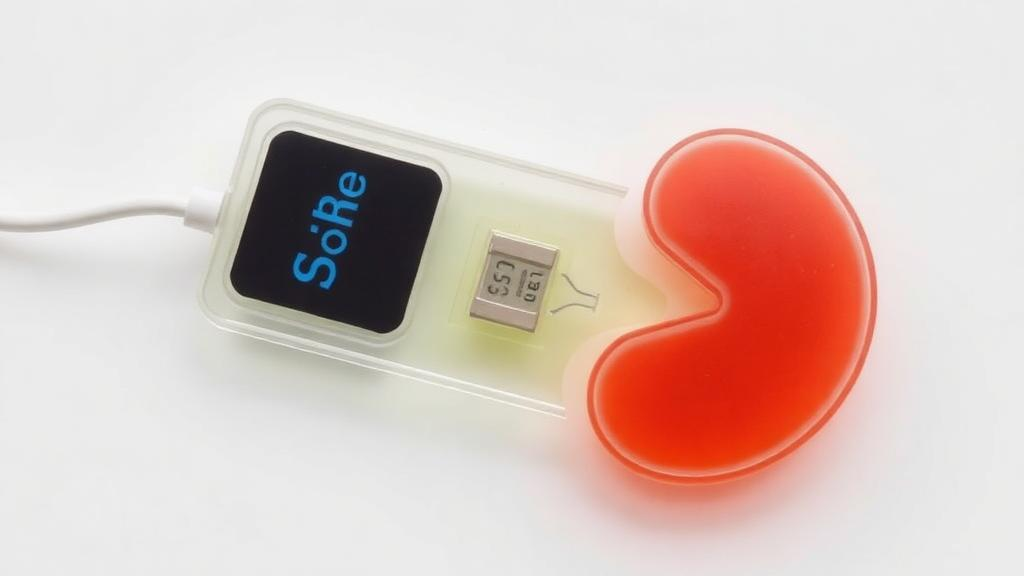
Acute kidney injury is one of the most deceptive conditions in modern medicine. It can strike suddenly in hospitalized patients, in those exposed to toxic drugs, or after severe dehydration and surgery, yet the standard diagnostic tool, serum creatinine, often lags hours or even days behind the actual damage. By the time creatinine levels climb in the blood, a critical window for intervention may already have closed. Now, researchers at Çanakkale Onsekiz Mart University in Turkey have built a low-cost, disposable electrochemical sensor that can detect a far earlier warning sign of kidney damage directly in urine, and they have done it using a flexible plastic electrode that costs pennies to manufacture. The work, published in Discover Electrochemistry, describes an immunosensor for kidney injury molecule-1, or KIM-1, a protein that the kidneys themselves broadcast into urine when their tubules come under attack.
KIM-1 is a transmembrane glycoprotein that sits quietly on the surface of healthy kidney cells, essentially invisible in the urine of a healthy person. When the proximal tubules, the kidney’s reabsorption workhorses, suffer ischemic or toxic injury, KIM-1 expression surges dramatically. In healthy individuals, urinary KIM-1 concentrations remain below one nanogram per milliliter, but after ischemic renal injury they can climb to three to seven nanograms per milliliter. That fold-change, combined with the molecule’s tight association with tubular damage, inflammation, and renal fibrosis, has earned KIM-1 recognition as a sensitive and specific urinary biomarker from both the U.S. Food and Drug Administration and the European Medicines Agency. Because kidney tissue has limited regenerative capacity once injured, catching that molecular distress signal early is not merely convenient; it can determine whether a patient’s kidneys recover or progress toward chronic failure.
The problem has been turning that biological promise into a practical measurement. Conventional laboratory assays for KIM-1 rely on instrumentation that is expensive, centralized, and slow, which is a poor fit for a condition whose clinical value depends on speed. The Turkish team, led by Meltem Afşar and Mustafa Kemal Sezgintürk, took a different route. They started with electrodes made of indium tin oxide coated onto polyethylene terephthalate, the same transparent conductive film used in touchscreens and flexible displays. ITO-PET electrodes are semiconductive, electrically conductive, mechanically flexible, and, crucially, disposable and cheap to fabricate. A sensor built on such a platform could, in principle, be used once and thrown away, eliminating the cross-contamination risks and cleaning burdens that plague reusable clinical electrodes.
The heart of the innovation lies in the surface chemistry. The researchers first treated the ITO-PET strips with a cleaning sequence and then with a solution of ammonium hydroxide, hydrogen peroxide, and water to blanket the surface with hydroxyl groups. Onto this activated surface they deposited carboxyethylsilanetriol, or CTES, a trifunctional silane whose silanol groups condense with the surface hydroxyls to form stable covalent silicon-oxygen-metal bonds. The result is a self-assembled monolayer that is densely packed, chemically robust, and negatively charged, with carboxyl groups left dangling and exposed like molecular Velcro. Those carboxyl groups were then activated with classic EDC/NHS carbodiimide chemistry, converting them into reactive esters that latch onto the amine groups of the anti-KIM-1 antibody, forming strong amide bonds. A final blocking step with bovine serum albumin sealed off any remaining sticky patches, ensuring that only genuine antibody-antigen binding would register as a signal.
Every step of this construction was tracked electrochemically using cyclic voltammetry and electrochemical impedance spectroscopy, a technique that measures how much the electrode resists the flow of electrons through a redox probe solution. The team fitted their impedance spectra to a modified Randles equivalent circuit and used the charge transfer resistance, Rct, as the analytical readout. The progression told a coherent story: hydroxylation lowered the resistance to 1100 ohms by boosting conductivity, the CTES monolayer dropped it further to 670 ohms, and then each added biomolecular layer, the EDC/NHS ester at 1383 ohms, the antibody at 1450 ohms, and the BSA block at 1485 ohms, progressively impeded electron transfer as insulating protein stacked up on the surface. When KIM-1 antigen bound to the antibody, resistance rose again in a concentration-dependent fashion, from 169 ohms at 0.01 nanograms per milliliter to 4846 ohms at 2.5 nanograms per milliliter. Each bound antigen molecule thickens the insulating biolayer, making it harder for the ferri/ferrocyanide probe to reach the electrode, and that growing barrier is the signal.
Atomic force microscopy provided an independent, visual confirmation of the story the electrochemistry told. Scanning five-by-five micrometer patches of the electrode in non-contact mode, the researchers watched the surface roughness rise after CTES modification and antibody immobilization, fall as BSA smoothed over the gaps, and rise once more when KIM-1 bound to the waiting antibodies. The morphological changes at each stage matched the impedance data, a satisfying convergence that strengthens confidence that the sensor works exactly as designed. The team also subjected their impedance measurements to Kramers-Kronig transformation, a mathematical consistency check that verifies the real and imaginary components of the impedance data belong to the same physical system, ensuring the measurements were internally reliable.
Optimization was exhaustive. The researchers systematically varied the CTES concentration, finding that 0.05 percent produced the best balance between too sparse a monolayer and one so dense it blocked antigen access. They tested EDC/NHS concentrations and settled on 0.04 millimolar EDC with 0.01 millimolar NHS, noting that higher concentrations caused signal distortion from random antibody binding. The activation chemistry worked best at neutral pH, consistent with the known reactivity window of NHS esters, and 45 minutes proved the sweet spot for both the crosslinking step and the antibody incubation. Antibody concentration mattered too: five nanograms per milliliter was too little, twenty caused steric hindrance, and ten nanograms per milliliter was just right. The final calibration equation, relating KIM-1 concentration to the change in charge transfer resistance, emerged from this painstaking tuning.
The analytical performance figures are impressive for such a simple platform. The sensor responds across a working range of 0.01 to 2.5 nanograms per milliliter, with a limit of detection of 0.22 nanograms per milliliter and a limit of quantification of 0.74 nanograms per milliliter, numbers that sit squarely in the clinically relevant zone given that healthy urinary KIM-1 stays below one nanogram per milliliter. Twenty identically fabricated electrodes tested against a 0.5 nanogram per milliliter KIM-1 solution returned a mean reading of 0.502 nanograms per milliliter with a coefficient of variation of just 0.073 percent, a repeatability figure that would flatter far more elaborate instruments. Reproducibility across ten separately built sensors showed a relative standard deviation of 19.62 percent in slope values, which the authors attribute to manual fabrication but judge acceptable for a hand-assembled platform. The electrodes held stable performance for eight weeks of refrigerated storage, could be regenerated up to four times with brief hydrochloric acid washes before surface degradation set in, and shrugged off interference from creatine kinase, D-glucose, prostate-specific antigen, and bovine serum albumin.
Real-sample testing provided the crucial proof of concept. The team spiked five commercially available bovine urine samples, diluted a hundredfold, with KIM-1 at 0.25 and 1 nanogram per milliliter and measured recovery using the standard addition method, obtaining accurate and reliable values in triplicate. The authors are candid about the limitation: bovine urine does not fully mimic human urine biochemistry, and the anti-KIM-1 antibody is specific to the human protein, so validation with genuine human clinical samples remains the necessary next step. Long-term storage behavior beyond eight weeks and adaptation to routine clinical workflows, including standardization and large-scale fabrication, also await further study. Still, compared with other reported KIM-1 platforms, from nanocomposite-enhanced electrochemical sensors built on covalent organic frameworks and gold nanoparticles to sophisticated optical fiber interferometers, the ITO-PET immunosensor achieves competitive sensitivity with a streamlined fabrication protocol of roughly five main steps and no exotic nanomaterials.
The broader significance of this work extends beyond one biomarker. Kidney diseases now rank as the seventh leading cause of mortality worldwide, and their global prevalence continues to climb, placing enormous strain on healthcare systems that still depend on delayed creatinine measurements. A disposable, flexible, inexpensive electrode that can be functionalized with a silane monolayer and an antibody in an afternoon offers a template for point-of-care diagnostics that could be deployed in emergency departments, intensive care units, and resource-limited clinics alike. If subsequent clinical validation confirms what the laboratory data suggest, the humble plastic strip at the center of this study could help shift kidney injury detection from a retrospective diagnosis to a real-time warning, giving clinicians the head start they have long needed to protect one of the body’s most irreplaceable organs.
Subject of Research: Electrochemical immunosensor for detecting the kidney injury biomarker KIM-1 using silane-modified disposable ITO-PET electrodes
Article Title: Sensitive impedimetric immunosensing of kidney injury molecule 1 using carboxyethylsilanetriol modified indium tin oxide polyethylene terephthalate electrodes
Article References: Sensitive impedimetric immunosensing of kidney injury molecule 1 using carboxyethylsilanetriol modified indium tin oxide polyethylene terephthalate electrodes. (n.d.). https://doi.org/10.1007/s44373-026-00129-y
Image Credits: AI Generated
DOI: 10.1007/s44373-026-00129-y
Keywords: KIM-1, acute kidney injury, biosensor, electrochemical impedance spectroscopy, ITO-PET electrode, immunosensor, carboxyethylsilanetriol, EDC/NHS chemistry, urinary biomarker, self-assembled monolayer, point-of-care diagnostics, kidney disease
Cite Scienmag News
Bethany Barker. (October 3, 2026). Disposable Plastic-Based Electrode Detects Early Kidney Injury Biomarker in Urine. Scienmag. https://scienmag.com/disposable-plastic-based-electrode-detects-early-kidney-injury-biomarker-in-urine/
Bethany Barker. "Disposable Plastic-Based Electrode Detects Early Kidney Injury Biomarker in Urine." Scienmag, 3 October 2026, https://scienmag.com/disposable-plastic-based-electrode-detects-early-kidney-injury-biomarker-in-urine/. Accessed 3 October 2026.
Bethany Barker. "Disposable Plastic-Based Electrode Detects Early Kidney Injury Biomarker in Urine." Scienmag. October 3, 2026. https://scienmag.com/disposable-plastic-based-electrode-detects-early-kidney-injury-biomarker-in-urine/


