


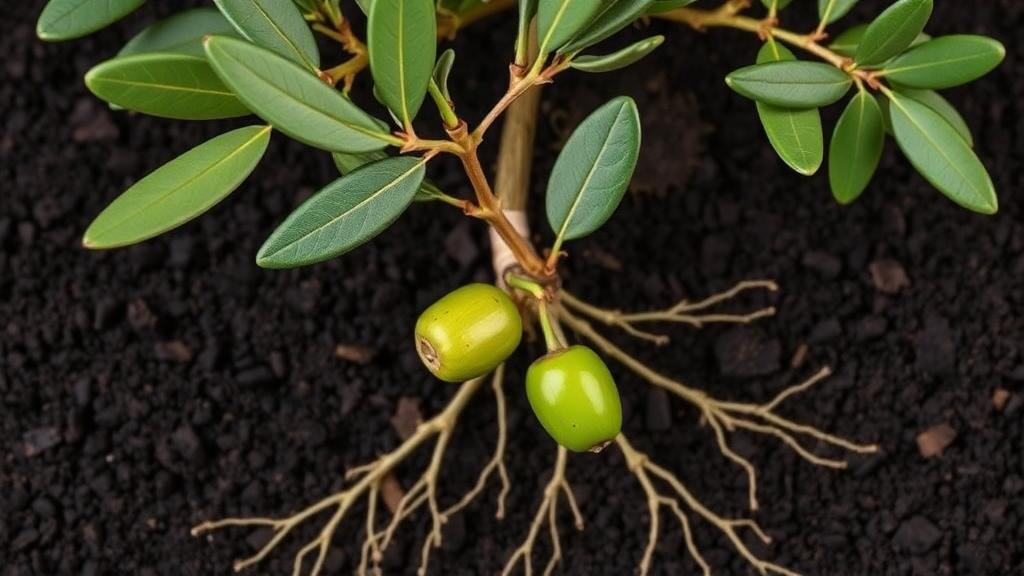
In a greenhouse in Pisa, young olive trees have been quietly revealing one of the most intimate conversations in biology: the chemical dialogue between plant roots and the soil microbes that colonize them. A team of Italian researchers at the Sant’Anna School of Advanced Studies, the University of Pisa, and the Centre for Climate Change Impact has shown that inoculating olive plants with two beneficial bacterial genera, Azospirillum and Methylobacterium, does far more than simply stimulate growth. It fundamentally rewires the chemistry of what roots release into the surrounding soil, according to a study published in the journal Microbial Ecology.
The research, led by Livia Pappalettere and corresponding author Susanna Bartolini, focused on Olea europaea L. cv. Leccino, one of the most economically important woody crops in the Mediterranean basin. Plant growth-promoting bacteria, often abbreviated as PGPB, are increasingly applied to perennial crops as a sustainable alternative to synthetic fertilizers, yet their chemical footprints at the root-soil interface have remained poorly characterized in species like olive. The new study set out to close that gap with an unusually direct analytical approach.
Over a 12-week greenhouse trial running from early March to late May, the team applied three soil treatments monthly, for a total of three applications: a single strain of Azospirillum known as Sp245, a microbial consortium combining Azospirillum species with Methylobacterium symbioticum SB0023/3T, and a water control. In addition, Methylobacterium symbioticum was applied separately as a foliar spray, allowing the researchers to compare the effects of delivering the same beneficial microbe through leaves rather than roots.
The growth results were striking. The consortium treatment, labeled MIX in the study, produced the strongest overall performance, dramatically enhancing both primary and secondary root growth and increasing the dry matter of organs above and below ground. Compared with untreated control plants, root dry weight rose by 70.2 percent, stem dry weight by 98.6 percent, and leaf dry weight by 65.3 percent. These are substantial gains for a woody perennial over a single season, and they suggest that the two bacterial genera work synergistically rather than simply adding their individual effects together.
The foliar application of Methylobacterium symbioticum produced a different and equally interesting signature. Plants receiving the leaf treatment showed a unique boost in leaf surface area and chlorophyll index, with increases of 83.8 percent and 33.3 percent respectively relative to the control. This indicates that the foliar route primarily enhances photosynthetic capacity and canopy development, while the soil-borne consortium acts more powerfully on root architecture and whole-plant biomass. For growers, the two delivery strategies may ultimately serve complementary purposes.
But the most novel part of the study lies beneath the soil surface. The researchers chemically profiled the root exudates, the suite of compounds that roots actively secrete into the rhizosphere, using thermal desorption gas chromatography-mass spectrometry, or TD-GC-MS. The samples were derivatized in situ with HMDS, a silylating reagent that stabilizes polar compounds so they can be detected by the instrument. This technique allowed the team to capture a chemically resolved snapshot of the exudate profile directly, without the losses and artifacts that can come from more elaborate extraction procedures.
The analysis revealed four consistent classes of metabolites across the samples: organic acids including glycolic, lactic, and hydroxybutyric acids; glycerol; carbohydrates such as glucose and aldonic acid gamma-lactones; and inositol, for which the researchers detected seven distinct isomers. Within each of these classes, the treatments produced significant differences. The consortium treatment induced the highest signals for organic acids, carbohydrates, and inositol, with organic acid signals reaching approximately 17-fold higher than the control. Most tellingly, inositol was entirely undetectable in the control samples, meaning that its appearance in inoculated plants represents a genuine chemical novelty induced by the bacterial partnership.
Why does this matter? Root exudates are the currency of the rhizosphere. Plants spend a significant fraction of their photosynthetically fixed carbon on these secretions, and the composition of the exudate cocktail determines which microbes are attracted, fed, or repelled at the root surface. By shifting exudate chemistry toward organic acids, sugars, and inositol, the inoculated plants appear to be creating a more hospitable chemical environment for their bacterial partners, potentially reinforcing the beneficial association in a feedback loop. Organic acids can also mobilize mineral nutrients in the soil, while sugars and inositols serve as readily metabolizable carbon sources for rhizosphere communities.
The authors emphasize that this is, to their knowledge, the first chemically resolved TD-GC-MS characterization of olive root exudates under plant growth-promoting bacterial treatments. That claim carries weight for a crop of global significance. Olive cultivation faces mounting pressures from climate change, water scarcity, and soil degradation across the Mediterranean, and microbial inoculants are widely promoted as a low-input path to more resilient orchards. Yet until now, growers and scientists have had little direct chemical evidence of what these inoculants actually change at the root-soil interface in olive.
The study is explicitly preliminary, and the authors are careful about the scope of their conclusions. The work was conducted on greenhouse-grown young plants over a single season, and field validation across mature trees, different cultivars, and variable soils remains an obvious next step. The researchers also note that the accepted version of the article is being shared early under open access terms and is subject to further editorial refinement. Still, the combination of robust morphological measurements and high-resolution metabolite profiling provides a template for how future studies might disentangle the mechanisms behind microbial inoculation benefits.
For the broader field of microbial ecology, the findings add olive to a growing list of crops whose exudate chemistry is demonstrably remodelled by beneficial bacteria. They also highlight the value of consortium-based inoculants, which outperformed the single-strain treatment across most growth parameters and produced the most dramatic exudate shifts. As agriculture searches for tools to reduce fertilizer dependence, understanding the chemical language that roots and microbes share may prove as important as the microbes themselves. In the humble root secretions of a potted olive tree, the researchers have captured an early glimpse of that conversation in remarkable chemical detail.
Subject of Research: Effects of plant growth-promoting bacterial inoculation on olive growth and root exudate chemistry
Article Title: Azospirillum–Methylobacterium Inoculation Enhances Olive Growth and Reshapes Root Exudate Chemistry: A Preliminary TD-GC-MS Characterization
Article References: Pappalettere, L., Mattonai, M., Degano, I., Toffanin, A., & Bartolini, S. (2026). Azospirillum–Methylobacterium Inoculation Enhances Olive Growth and Reshapes Root Exudate Chemistry: A Preliminary TD-GC-MS Characterization. Microbial Ecology. https://doi.org/10.1007/s00248-026-02901-4
Image Credits: AI Generated
DOI: 10.1007/s00248-026-02901-4
Keywords: plant growth-promoting bacteria, Azospirillum, Methylobacterium, olive, root exudates, TD-GC-MS, rhizosphere, inositol, organic acids, soil microbiology, microbial consortium, sustainable agriculture
Cite Scienmag News
Morgan Morrow. (October 3, 2026). Bacterial Duo Supercharges Olive Roots and Rewrites Their Chemical Signals. Scienmag. https://scienmag.com/bacterial-duo-supercharges-olive-roots-and-rewrites-their-chemical-signals/
Morgan Morrow. "Bacterial Duo Supercharges Olive Roots and Rewrites Their Chemical Signals." Scienmag, 3 October 2026, https://scienmag.com/bacterial-duo-supercharges-olive-roots-and-rewrites-their-chemical-signals/. Accessed 3 October 2026.
Morgan Morrow. "Bacterial Duo Supercharges Olive Roots and Rewrites Their Chemical Signals." Scienmag. October 3, 2026. https://scienmag.com/bacterial-duo-supercharges-olive-roots-and-rewrites-their-chemical-signals/


