


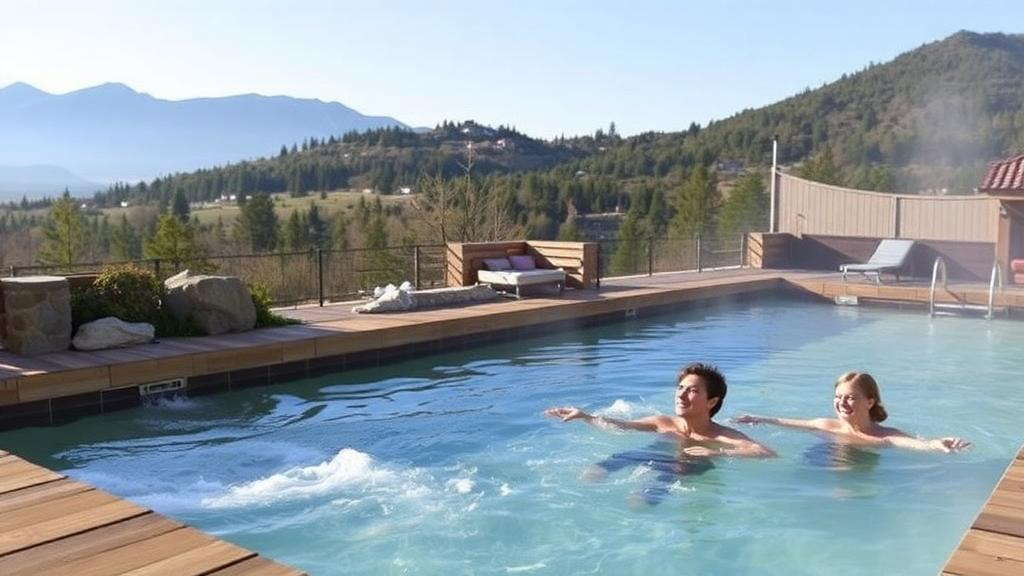
For millions of older adults living with chronic low back pain, the options are often frustratingly narrow. Painkillers can clash with the long list of medications many seniors already take, surgery carries serious risks, and exercise programs can be difficult to sustain when every movement hurts. Against that backdrop, one of the oldest therapies in medicine — soaking in naturally heated mineral waters — has just received one of its most careful scientific tests yet. A pilot randomized controlled trial conducted at a Portuguese thermal spa suggests that a structured two-week balneotherapy program may meaningfully reduce average pain intensity in people aged 65 and older, without a single recorded adverse event.
The study, published in BMC Complementary Medicine and Therapies by a team led by Nelson Albuquerque of the University of Porto, was carried out at Termalistur — Termas de São Pedro do Sul, a thermal spa in northern Portugal. Thirty-two participants with chronic low back pain were randomly assigned either to a balneotherapy group of nineteen people or to an untreated control group of thirteen. The trial was registered with ClinicalTrials.gov as NCT05078008 and received ethical approval from the Joint Ethics Committee of the Abel Salazar Institute of Biomedical Sciences, with all participants providing written informed consent before enrollment.
The intervention itself was far more regimented than a casual dip in a hot spring. For fourteen consecutive days, participants in the treatment group received two sessions daily. Each session began with immersion in a thermal pool equipped with hydromassage, followed by spinal flexibility exercises performed in the water. Participants then alternated between partial spinal steam application and a localized massage shower directed at the painful region. This standardized protocol was designed to ensure that every participant received the same dose of thermal exposure, mechanical stimulation, and guided movement — a level of consistency that many earlier observational studies of spa therapy lacked.
The primary outcome was deliberately simple: average pain over the previous seven days, rated on an eleven-point numeric scale from zero to ten. After two weeks, the balneotherapy group showed a greater reduction in mean pain intensity than the controls, with an adjusted between-group difference of −1.51 points (95 percent confidence interval −2.84 to −0.17; p = 0.028). The effect size, expressed as Cohen’s d, was −0.83, which in conventional terms falls into the large range for a pain intervention. Crucially, the researchers ran six separate sensitivity analyses, and the finding held across all of them — a robustness check that lends credibility to a result from a small pilot sample.
Not everyone responded dramatically. At least a 30 percent reduction in pain — a threshold often used in pain research to define a clinically meaningful response — was achieved by 44 percent of the balneotherapy group compared with 17 percent of controls. That difference of 27.8 percentage points came with a confidence interval stretching from −6.7 to +52.7, meaning it could plausibly be due to chance. Still, the pattern is intriguing: nearly half of the treated seniors experienced a substantial improvement in a condition that often resists standard care, while the untreated group improved at a much lower rate.
Perhaps the most scientifically interesting part of the trial is what did not change. The researchers measured a battery of secondary outcomes: pain at rest and on movement, disability as scored by the Oswestry Disability Index, fatigue via the Fatigue Assessment Scale, spinal mobility, pressure pain thresholds in the lumbar region, and lumbar skin temperature captured at seven anatomical regions using infrared thermography. None of these differed significantly between the two groups, and none survived correction for multiple comparisons using the Benjamini–Hochberg procedure. The thermography results were particularly notable, because one proposed mechanism for thermal water therapy is a local warming effect that alters blood flow and tissue metabolism — yet the skin temperature readings over the lower back showed no detectable between-group differences.
The pressure pain threshold data came with an important caveat. Baseline values were not balanced between the groups before treatment began, a common hazard in small randomized trials, and the authors explicitly declined to draw any conclusions from that outcome. This kind of transparency matters. Pilot trials are frequently over-interpreted, with preliminary numbers splashed across headlines as proof of efficacy. The Porto team took the opposite approach, stating plainly that their trial was not designed or powered to establish efficacy, and that the results require confirmation in a properly powered study with an active comparator — for example, another established non-drug therapy rather than no treatment at all.
Why does this matter for older adults specifically? Chronic low back pain is among the most common and disabling conditions of later life, yet the pharmacological toolkit shrinks dramatically with age. Nonsteroidal anti-inflammatory drugs raise the risk of gastrointestinal bleeding, kidney injury, and cardiovascular events; opioids carry dependence and fall risks; and polypharmacy means every new prescription must be weighed against a fragile balance of existing medications. A non-pharmacological option that is well tolerated, structured, and potentially deliverable in existing spa infrastructure could fill a genuine gap. The zero adverse events recorded in this trial, while reassuring, will need to be confirmed in larger and more diverse populations.
The study also contributes something often missing from the balneotherapy literature: concrete effect estimates. By reporting an adjusted difference of −1.51 points on an eleven-point pain scale with a confidence interval and effect size, the researchers have given future trial designers the numbers they need to calculate sample sizes and choose meaningful endpoints. That is precisely the function of a good pilot study — not to declare victory, but to establish feasibility, refine protocols, and quantify the signal that a definitive trial should be built to detect. The authors frame their findings in exactly those terms, describing the program as a feasible complementary option while cautioning that efficacy remains unproven.
There are, of course, limitations worth keeping in view. The control group received no treatment, so placebo effects, the restorative value of a spa environment, social contact, and the simple expectation of improvement cannot be separated from any specific effect of thermal water. Two of the authors are employed by the spa where the study took place, a potential conflict of interest the researchers disclosed openly, and the research received no external funding. The sample was small, the follow-up was short, and differences between the registered trial record and the trial as conducted are documented in the paper’s methods and limitations sections. None of these caveats erases the core result, but they define the boundary of what can honestly be claimed.
Even so, the image of science validating an ancient remedy is a compelling one, and this trial approaches it with unusual rigor — randomization, a registered protocol, multiplicity correction, sensitivity analyses, and objective thermographic measurement. If larger trials with active comparators bear out the pain reduction seen here, two weeks of structured thermal water therapy could earn a legitimate place alongside exercise and physical therapy in the care of older adults whose backs hurt and whose medication lists are already full. Until then, the hot springs of São Pedro do Sul offer a promising, carefully measured hint — not a prescription.
Subject of Research: Balneotherapy for chronic low back pain in older adults
Article Title: Two-week balneotherapy in a spa setting for chronic low back pain in older adults: a pilot randomized controlled trial
Article References: Two-week balneotherapy in a spa setting for chronic low back pain in older adults: a pilot randomized controlled trial. (n.d.). https://doi.org/10.1186/s12906-026-05621-x
Image Credits: AI Generated
DOI: 10.1186/s12906-026-05621-x
Keywords: balneotherapy, chronic low back pain, older adults, randomized controlled trial, thermal spa, pain management, infrared thermography, hydrotherapy, complementary medicine, Oswestry Disability Index, geriatrics, Portugal
Cite Scienmag News
Ophelia Keating. (October 3, 2026). Hot Springs Show Early Promise for Easing Chronic Back Pain in Older Adults. Scienmag. https://scienmag.com/hot-springs-show-early-promise-for-easing-chronic-back-pain-in-older-adults/
Ophelia Keating. "Hot Springs Show Early Promise for Easing Chronic Back Pain in Older Adults." Scienmag, 3 October 2026, https://scienmag.com/hot-springs-show-early-promise-for-easing-chronic-back-pain-in-older-adults/. Accessed 3 October 2026.
Ophelia Keating. "Hot Springs Show Early Promise for Easing Chronic Back Pain in Older Adults." Scienmag. October 3, 2026. https://scienmag.com/hot-springs-show-early-promise-for-easing-chronic-back-pain-in-older-adults/


