


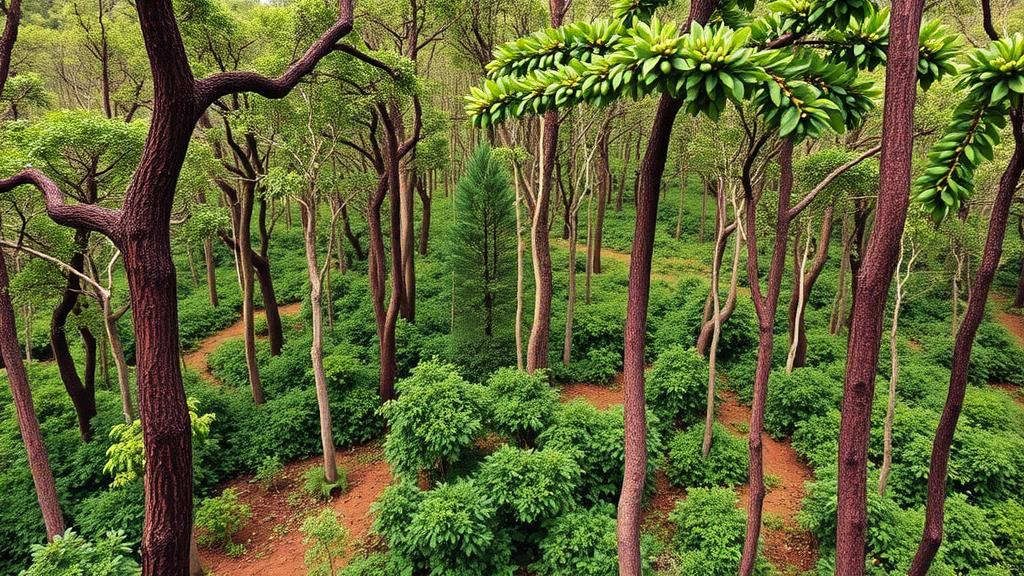
Deep in the highlands of southwestern Ethiopia, in the mist-shrouded Belete-Gera Forest where wild Arabica coffee still grows beneath the canopy, researchers have uncovered a finding that could reshape how the world thinks about saving forests: the single most powerful force driving villagers to protect trees is not money, not law enforcement, and not even environmental awareness, but whether they believe their forest is being governed fairly. A new study, published in the journal Environmental Management, surveyed 384 forest-dependent households, interviewed 24 key informants, and held 10 focus group discussions to quantify, for the first time in this landscape, how perceptions of governance quality translate into real conservation behavior.
The research team, led by Geremew Motuma Jebessa of Jimma University together with Adugna Eneyew Bekele and Teferi Tolera, anchored their work in the Social-Ecological Systems framework pioneered by Elinor Ostrom, which treats forests and the communities that depend on them as an inseparable whole. To measure governance, they adopted the widely used assessment framework developed by the Program on Forests and the Food and Agriculture Organization, which evaluates six principles: participation, transparency, accountability, effectiveness, equity, and efficiency. Each principle was scored through dozens of indicators rated by residents on five-point scales, and the resulting data were distilled using a weighted average index before being fed into a Structural Equation Model, a statistical technique that can simultaneously test how multiple hidden factors influence one another along hypothesized causal pathways.
The headline result is stark. Overall forest governance in the Belete-Gera landscape scored a weighted average of 2.84 on a five-point scale, a rating the authors describe as moderate at best. Transparency fared relatively well at 3.22, and participation at 3.13, but accountability sank to 2.57 and efficiency to 2.45, the two weakest links in the governance chain. Residents reported that while they attend invited meetings and plant trees, the day-to-day monitoring and evaluation of the forest is monopolized by committees and experts, with youth and women almost entirely excluded. One key informant told the researchers that community members understand the importance of conservation and their own roles, but complain of a lack of transparency about forest benefits, weak rule enforcement, and persistent corruption.
The gender gap in these perceptions is one of the study’s most striking discoveries. Male household heads rated overall governance at 3.1, while female household heads rated it at only 2.64, a chasm that reflects women’s marginalization from forest decision-making despite their deep daily reliance on forest products. Women scored particularly low on perceptions of transparency in decisions about forest use and on the fairness of access to forest benefits. Given that rural women across the region gather firewood, wild coffee, honey, and spices that sustain their families, their exclusion from governance is not merely a matter of representation; the authors argue it undermines the very conservation commitments that the forest’s future depends on.
When the researchers ran the Structural Equation Model, the statistical architecture of community conservation came into focus. Perceived forest governance effectiveness had no significant direct effect on conservation behavior, an unexpected result the authors attribute to poor accountability among forest officers and the illegal leasing of demarcated forest land to private coffee investors, which has severely discouraged collective action. But governance effectiveness did something arguably more important: it strongly predicted community satisfaction with forest management, with a path coefficient of 0.232. That satisfaction, in turn, fed directly into conservation behavior. The indirect pathway, in which good governance builds satisfaction that then drives conservation, was significant with a coefficient of 0.33, the strongest indirect effect in the model.
The other major driver proved to be forest resource use itself, which predicted conservation behavior with a path coefficient of 0.29, the largest direct effect in the entire model. This finding challenges a persistent assumption that people protect forests best when kept away from them. In Belete-Gera, the opposite appears true: households that collect wild coffee, honey, spices, and firewood, and that sell forest products to meet basic needs, are the ones most motivated to patrol, prevent illegal logging, replant, and share knowledge. The community’s motivation for conservation scored a remarkable 4.08 out of 5, among the highest values recorded in the study. Dependence, in this landscape, breeds stewardship rather than destruction.
The model’s fit statistics lend the findings credibility. The comparative fit index reached 0.935 and the Tucker-Lewis index 0.915, both above conventional thresholds, while the root mean square error of approximation stood at 0.071 and the standardized root mean square residual at 0.05. Confirmatory factor analysis confirmed that all latent variable indicators loaded significantly above 0.5, and reliability checks through Cronbach’s alpha and composite reliability exceeded accepted benchmarks. In plain terms, the statistical machinery linking governance perceptions, satisfaction, and behavior is robust, not a statistical accident.
Beneath the numbers lies a story of land and livelihood under pressure. The Belete-Gera Forest is a recognized biodiversity hotspot and the birthplace of Arabica coffee, yet it faces rapid degradation from coffee plantation investments, resettlement, grazing, and logging. Key informants described how land transfers from the forest to private coffee companies do not serve the interests of forest-dependent communities, and that the jobs created by commercial investors fall far short of replacing the economic benefits families once drew from the wild forest. When access to wild coffee, honey, and traditional spices is cut off, the authors warn, residents may be pushed toward over-extracting what remains, a feedback loop in which inequitable governance actively accelerates deforestation.
Ethiopia has not lacked for policy ambition. The country has rolled out the Ethiopian Forestry Action Plan, successive forest policies in 1997 and 2007, Participatory Forest Management, the Climate Resilient Green Economy strategy, and the mass-tree-planting Green Legacy initiative. Yet the study confirms what earlier research has suggested: a persistent gap between policy design and local implementation, marked by inequitable benefit sharing, elite capture of decision-making, weak institutional capacity, and chronic underfunding of monitoring. Local forest committees exist and even track illegal activity, but financial constraints and poor coordination among actors hobble their effectiveness. Previous assessments of Ethiopian forest governance relied heavily on the views of forestry experts and committee members, people with an incentive to present favorable pictures; this study’s insistence on hearing directly from ordinary forest dwellers, and from women in particular, is what exposes the gap.
The implications reach far beyond one Ethiopian landscape. If satisfaction, born of fair and transparent governance, is the bridge between institutions and conservation action, then the cheapest and most effective conservation investment may not be fences or fines but inclusive decision-making, honest benefit-sharing mechanisms, and genuine power for women and youth. The authors recommend that stakeholders strengthen local governance, promote sustainable resource use, track forest revenues transparently, and design livelihood strategies that keep communities invested in the forest’s survival. In the birthplace of coffee, the message is as simple as it is urgent: people will fight for a forest that they believe belongs, in every sense, to them.
Subject of Research: Community perceptions of forest governance effectiveness and their influence on conservation behavior in southwest Ethiopia
Article Title: Community Perspectives on Effectiveness of Forest Governance and Conservation Behavior in Southwest Ethiopia: A Structural Equation Modelling and Qualitative Insights Approach
Article References: Jebessa, G. M., Bekele, A. E., & Tolera, T. (2026). Community Perspectives on Effectiveness of Forest Governance and Conservation Behavior in Southwest Ethiopia: A Structural Equation Modelling and Qualitative Insights Approach. Environmental Management, 76(9), Article 297. https://doi.org/10.1007/s00267-026-02611-0
Image Credits: AI Generated
DOI: 10.1007/s00267-026-02611-0
Keywords: forest governance, Ethiopia, Belete-Gera Forest, conservation behavior, structural equation modeling, community satisfaction, participatory forest management, gender gap, Arabica coffee, deforestation, social-ecological systems, non-timber forest products
Cite Scienmag News
Courtney Benton. (October 3, 2026). In Ethiopia’s Coffee Forests, Fair Governance Decides Whether Communities Protect the Trees. Scienmag. https://scienmag.com/in-ethiopias-coffee-forests-fair-governance-decides-whether-communities-protect-the-trees/
Courtney Benton. "In Ethiopia’s Coffee Forests, Fair Governance Decides Whether Communities Protect the Trees." Scienmag, 3 October 2026, https://scienmag.com/in-ethiopias-coffee-forests-fair-governance-decides-whether-communities-protect-the-trees/. Accessed 3 October 2026.
Courtney Benton. "In Ethiopia’s Coffee Forests, Fair Governance Decides Whether Communities Protect the Trees." Scienmag. October 3, 2026. https://scienmag.com/in-ethiopias-coffee-forests-fair-governance-decides-whether-communities-protect-the-trees/


