


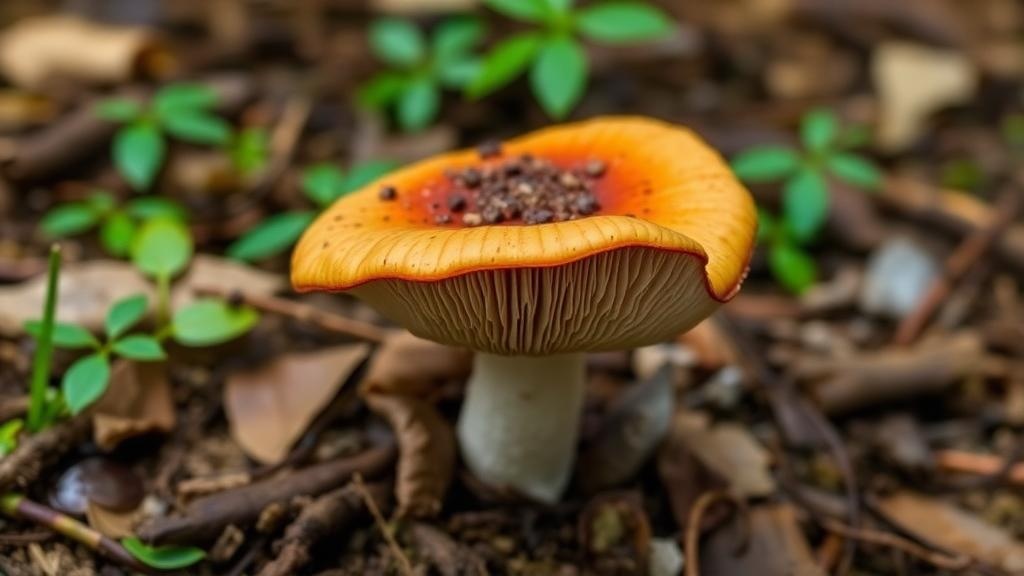
Deep in the mountain forests of central Argentina grows one of the country’s most prized edible fungi, a hefty bolete known locally as the hongo del coco. Now, a team of researchers has produced the most detailed map yet of where that mushroom can survive, and the picture is sobering. Phlebopus bruchii, a species found nowhere else on Earth, has been formally listed as Critically Endangered by the International Union for Conservation of Nature, largely because the forests it depends on have been decimated by agriculture, urban sprawl and recurrent wildfires. In a study published in Discover Conservation, Lara Thornton of the Universidad Nacional de Córdoba and her colleagues combined species distribution modeling with an unusual data source: ordinary people posting mushroom photographs on social media. The result is both a technical achievement and a demonstration of how citizen science can rescue the conservation of organisms that science has barely begun to document.
Phlebopus bruchii is a striking fungus. Its fruiting bodies are robust, with a dark brown cap and white flesh that turns an intense blue-green when exposed to air. It occurs exclusively in the Montane Chaco forests of the Sierras Chicas and Sierras Grandes in Córdoba and San Luis provinces, at elevations between 600 and 1,400 meters above sea level. The species is the only native edible mushroom of high culinary value documented for use and trade in central Argentina, and local collectors have long associated it with groves of two tree species, the coco tree Zanthoxylum coco and the molle Lithraea molleoides. Curiously, despite these strong ecological associations and its large, ectomycorrhizal-like fruiting bodies, the fungus does not form ectomycorrhizal partnerships with those trees, and its true nutritional mode remains an open question. What is certain is that its habitat has collapsed: more than 90 percent of the Montane Chaco forest was lost between 1969 and 1999, and what remains is fragmented and under continuous pressure.
The central challenge for conserving any rare species is knowing where it actually lives, and for P. bruchii that information was almost entirely missing. The original Red List assessment relied on just 41 high-quality records. To expand the evidence base, the researchers turned to the communities who know the mushroom best. They distributed a promotional flyer from January 2023 through Facebook mycological groups and WhatsApp, and created a dedicated Instagram profile offering identification guidance and explaining why geolocated records mattered. The approach was carefully designed. Because many collectors sell the fungus as a source of income, sharing harvest locations is sensitive, so the team used a structured protocol of introductory questions to build trust and confirm that participants understood the data would be used for research. Photographs allowed reliable remote identification, since the few similar boletes in the region grow with exotic plants and are rare in the Montane Chaco.
The campaign worked remarkably well. Of 84 occurrence records compiled from Córdoba and San Luis, 63 came through citizen science: 28 during the 2023 fruiting season and 35 in 2024. Sixteen records came from the authors’ own fieldwork, two from published papers and three from local mycologists. After removing duplicates that fell within the same raster cell, 70 unique records remained for modeling. A Moran’s Index test revealed strong spatial autocorrelation among the presence points, indicating sampling bias, so the team generated a bias file using a Gaussian kernel density estimate of the occurrence points. During model calibration, this file caused background points to be drawn preferentially from areas with higher sampling probability, reducing the influence of clustered records.
The modeling itself used MaxEnt, a maximum entropy algorithm well suited to presence-only data and known to perform better than alternatives when records are scarce. The study area spanned the Dry Chaco ecoregion plus neighboring ecoregions, including the Yungas along the Andean eastern slopes, where the species had been speculated to occur. Environmental predictors included nineteen bioclimatic variables from WorldClim2 at 30 arc-second resolution and four soil variables from SoilGrids 2.0, covering soil organic carbon, cation exchange capacity, pH and total nitrogen. Variables with variance inflation factors above 10 were removed to control multicollinearity. The team built two models: Map 1 using the 35 records from the 2023 season, and Map 2 using all 70 records. Model complexity was optimized with the ENMeval package, testing 70 parameter combinations of feature classes and regularization multipliers evaluated by delta AICc.
Both models performed strongly. Map 1 achieved an average test AUC of 0.994 with a True Skill Statistic of 0.98, while Map 2 reached an AUC of 0.993 and a TSS of 0.90 at a conservative threshold of 0.2. But the researchers went a step further than most distribution modeling studies: they validated the initial map experimentally. The 35 new records collected during the 2024 season were compared against the suitability categories predicted by Map 1, and 74.29 percent fell within the medium, high or very high suitability classes. That figure is notably lower than the internal calibration metrics, a gap the authors interpret as a cautionary lesson. Internal statistics like AUC, they note, tend to overestimate predictive performance, particularly for rare species where pseudo-absence inflation is a problem, and external validation with real-world data remains essential.
The environmental drivers of the model were revealing. Mean temperature of the driest quarter, variable Bio9, dominated both models, explaining 36.1 percent of the contribution in Map 1 and rising to 50.6 percent in Map 2, with permutation importance reaching 73.4 percent. Soil pH emerged as a consistent secondary driver, increasing in importance with the larger dataset. In contrast, soil organic carbon, which the team had hypothesized would matter given the fungus’s large fruiting bodies, contributed minimally, contradicting their initial expectation. The authors attribute the temperature signal to the climate of the Chaco Serrano, where dry, cold winters with temperatures dropping below freezing at higher elevations likely limit the fungus’s survival, while summer convective storms from December to March coincide with fruiting.
Overlaying the final model onto current land cover and recent disturbance data sharpened the conservation picture. The total area with suitability above 0.5 amounted to roughly 3,345 square kilometers within Córdoba province. Forests and shrublands, the land covers most plausibly suitable for the species, accounted for 61 percent of that area, about 2,040 square kilometers, while 13 percent fell within urban zones. The predicted habitat overlapped overwhelmingly, 68.75 percent, with the Xerophytic Forest with Schinopsis marginata vegetation unit, the classic Chaco Serrano, particularly on southern slopes where coco and molle trees dominate. Fires dealt a further blow: Sentinel-2 satellite imagery showed that 127 square kilometers, 7.5 percent of the moderate to highly suitable area, burned in 2024 alone, including two megafires exceeding 100 square kilometers. Some burned zones had caught fire up to ten times between 1986 and 2023.
The expanded dataset also forced a reassessment of the species’ range and status. Despite suggestions that P. bruchii might extend northward through Argentina into southern Bolivia, the models predicted little suitable habitat beyond Córdoba and San Luis, and a specimen from Tucumán province proved by molecular analysis to be a different Phlebopus species. Combining model predictions with field estimates of two to eight mature individuals per site, the team concluded the species persists in roughly 50 to 100 sites, corresponding to a global population of 200 to 1,600 mature individuals. Together with the inferred 80 to 90 percent population decline over the past 50 years, driven by logging and fire, the species continues to qualify as Critically Endangered under IUCN criteria A2cd and C2a(ii). Culture collections established during the study now safeguard part of the genetic diversity and could support future cultivation and reintroduction efforts.
The study closes with a concrete roadmap: prioritizing remnant Montane Chaco forest patches for monitoring and protection, negotiating with private landowners to reduce grazing and prevent forest conversion, developing sustainable harvesting guidelines that leave mature sporocarps intact, and targeting degraded but climatically suitable sites for restoration and experimental inoculation. It also stands as a template for fungal conservation more broadly. Fungi remain dramatically under-researched relative to plants and animals, and global citizen science platforms are little used in the rural communities where this species lives. By meeting people on the platforms they already use, WhatsApp and Facebook rather than iNaturalist, and by treating collectors as partners rather than merely data sources, the researchers more than doubled the known records for one of South America’s most threatened mushrooms while educating the very communities whose choices will determine whether it survives.
Subject of Research: Habitat suitability modeling and conservation of the critically endangered endemic fungus Phlebopus bruchii in the Montane Chaco forests of central Argentina
Article Title: Mapping suitable habitat for the ‘Coco mushroom’, Phlebopus bruchii (Speg.) Heinem. & Rammeloo (Basidiomycota) in central Argentina: a case study integrating citizen science in fungal conservation
Article References: Thornton, L., da Cunha, K. M., Drechsler-Santos, E. R., Cristaldo, E., Ortiz, A., Urcelay, C., & Robledo, G. (2025). Mapping suitable habitat for the ‘Coco mushroom’, Phlebopus bruchii (Speg.) Heinem. & Rammeloo (Basidiomycota) in central Argentina: a case study integrating citizen science in fungal conservation. Discover Conservation, 2(1), Article 48. https://doi.org/10.1007/s44353-025-00068-6
Image Credits: AI Generated
DOI: 10.1007/s44353-025-00068-6
Keywords: Phlebopus bruchii, fungal conservation, citizen science, species distribution models, MaxEnt, Montane Chaco, Argentina, IUCN Red List, habitat suitability, wildfires, endemic fungi, edible mushrooms
Cite Scienmag News
Margaret Porter. (October 2, 2026). Citizen Scientists Help Map the Shrinking Home of Argentina’s Critically Endangered Coco Mushroom. Scienmag. https://scienmag.com/citizen-scientists-help-map-the-shrinking-home-of-argentinas-critically-endangered-coco-mushroom/
Margaret Porter. "Citizen Scientists Help Map the Shrinking Home of Argentina’s Critically Endangered Coco Mushroom." Scienmag, 2 October 2026, https://scienmag.com/citizen-scientists-help-map-the-shrinking-home-of-argentinas-critically-endangered-coco-mushroom/. Accessed 4 October 2026.
Margaret Porter. "Citizen Scientists Help Map the Shrinking Home of Argentina’s Critically Endangered Coco Mushroom." Scienmag. October 2, 2026. https://scienmag.com/citizen-scientists-help-map-the-shrinking-home-of-argentinas-critically-endangered-coco-mushroom/


