


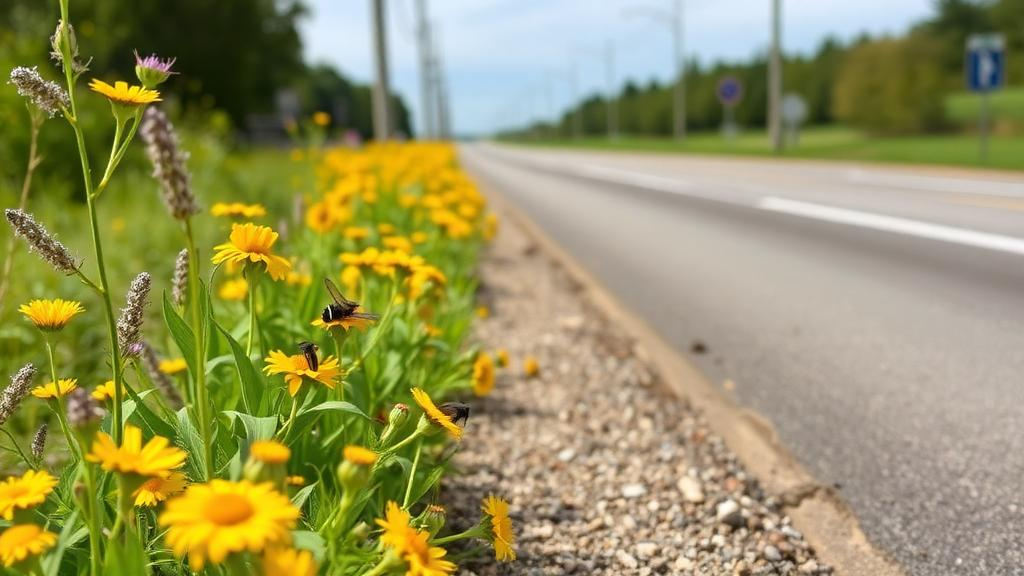
Rural roadsides are among the most overlooked habitats on the North American landscape. Strips of grass and wildflowers running alongside pavement rarely register as conservation territory, yet together they add up to an enormous share of the land managed by municipalities and counties. A new study from the University of Ottawa suggests that these linear corridors could become a lifeline for bees and flower flies with nothing more than a change in maintenance habits. The research, published in the journal Insect Conservation and Diversity, found that simply mowing less often and applying herbicide more precisely increased pollinator abundance by 45 percent and species diversity by 23 percent compared with conventionally managed roadsides.
The study was led by Jessica Forrest, full professor in the Department of Biology at uOttawa’s Faculty of Science, with lead author Gil Miranda, a former postdoctoral researcher in her laboratory who is now with Agriculture and Agri-Food Canada. Over two summers, the team surveyed rural roadsides in neighbouring jurisdictions around Ottawa, Ontario, where different levels of government maintain vegetation under visibly different regimes. The work was funded through an NSERC Alliance grant and carried out in partnership with Agriculture and Agri-Food Canada and the Canadian Wildlife Federation, whose staff helped conceive and fund the study as part of its Rights-of-Way as Habitat program.
The comparison hinged on a natural experiment created by administrative boundaries. Lanark County mows its roadsides twice a year and spot-treats only invasive plants such as wild parsnip. The City of Ottawa and the United Counties of Leeds and Grenville, by contrast, mow up to four times a year and apply herbicide more broadly across the right-of-way. Because these jurisdictions sit side by side and share similar soils, climate, and surrounding farmland, the researchers could compare otherwise similar roadside sites and isolate the effect of management alone. The Canadian Wildlife Federation helped pinpoint site pairs that shared comparable surrounding landscapes but fell under different mowing regimes, strengthening the design.
The fieldwork was exhaustive. Miranda netted and identified 3,773 pollinator specimens across 31 sites, a collection that ultimately totaled 153 species: 100 bee species and 53 flower fly species. Species identifications were confirmed through DNA barcoding led by Sophie Cardinal of Agriculture and Agri-Food Canada, a step that matters enormously in pollinator research, where many species are morphologically similar and easily confused in the field. The numbers told a consistent story. Low-intensity roadsides averaged 27 species per site across the study, while conventionally managed roadsides averaged 22. Abundance followed the same pattern, with far more bees and flower flies recorded along the less intensively maintained corridors.
For Forrest, the magnitude of the effect was the striking part. “Roadsides aren’t places most people think of as wildlife habitat, but they add up to a huge amount of land across the country,” she explained. “What surprised us wasn’t that management mattered; it was how much difference two modest changes made.” The finding reframes roadside vegetation from a liability to be kept tidy into an asset that can be managed cheaply for biodiversity. In agricultural regions, where natural habitat has been largely converted to cropland, these unmowed strips may represent some of the last reliable patches of nesting substrate and forage available to wild bees and hoverflies.
The mechanism behind the result is straightforward ecology. Frequent mowing removes flowering plants before they can bloom, eliminating the nectar and pollen resources that adult pollinators depend on throughout the growing season. It also destroys nest sites for ground-nesting bees and can kill larvae developing in stems. Broad herbicide spraying compounds the damage by suppressing the very flowering forbs, including many native species, that pollinators feed on. Reducing mowing to twice a year allows a community of flowering plants to establish and complete their life cycles, while targeted spot treatment of invasive species such as wild parsnip controls problem plants without stripping out the rest of the vegetation community.
Importantly, the researchers are not arguing that roadsides should be abandoned altogether. “Roads still need to be safe to drive, and invasive species still need to be managed,” Forrest noted. “But our results suggest land managers don’t have to choose between that and supporting pollinators. Mowing less often and spraying herbicide only where it’s actually needed rather than across a whole roadside, gets you most of the way there.” Safety sightlines, drainage, and invasive plant control can all be preserved under a low-intensity regime; the key insight is that blanket maintenance across an entire right-of-way delivers little extra benefit for road safety while imposing a substantial cost on insect communities.
The timing of the findings could hardly be more relevant. Bee and flower fly populations face mounting pressure across North America, squeezed by habitat loss, pesticide exposure, disease, and climate change. A recent continental assessment found that more than one-fifth of native pollinator species are now at elevated risk of extinction. Pollinators underpin the reproduction of a large share of flowering plants and contribute substantially to the yields of many fruit, vegetable, and seed crops, so their decline carries consequences well beyond entomology. Against that backdrop, the Ottawa-area results offer what Forrest describes as a rare bit of good news: a low-cost intervention within reach of virtually any municipality or county that maintains rights-of-way.
That accessibility is arguably the study’s most powerful message. “You don’t need to plant anything new or spend more money to see a benefit,” Forrest concluded. “You just need to let the roadside be a little less tidy.” Unlike pollinator initiatives that require seed mixes, planting programs, or expensive restoration, the changes tested here are essentially cost-saving: fewer mowing passes mean less fuel, labour, and equipment wear, and precision spraying means less herbicide purchased and applied. The study, titled “Roadside pollinator populations and the negative impact of intensive roadside vegetation maintenance,” was authored by Gil Miranda, Tracey Etwell, Vincent Fyson, Sophie Cardinal, Carolyn Callaghan, and Jessica Forrest, and was conducted with the support and cooperation of the City of Ottawa, Lanark County, and the United Counties of Leeds and Grenville.
For the thousands of kilometres of rural road crisscrossing farmland and forest across Canada and the United States, the implications are hard to ignore. A modest revision to maintenance schedules and spray protocols, decided at the level of a county public works department, could convert an entire network of roadside strips into connected habitat threads running through otherwise intensively used landscapes. As researchers and conservation groups continue to search for scalable responses to pollinator decline, the Ottawa study suggests that one of the most effective tools available may already be parked in the municipal maintenance shed, waiting to be deployed a little less often.
Subject of Research: Effects of roadside vegetation maintenance intensity on pollinator abundance and diversity
Article Title: Mowing less, spraying smarter gives pollinators a boost
Article References: Mowing less, spraying smarter gives pollinators a boost. (n.d.). Original publication
Image Credits: AI Generated
DOI: Not provided
Keywords: pollinators, roadsides, bees, flower flies, mowing, herbicide, biodiversity, habitat management, Insect Conservation and Diversity, University of Ottawa, conservation, rights-of-way
Cite Scienmag News
Julie Wynn. (October 2, 2026). Roadsides Become Pollinator Havens When Mowing Slows and Herbicide Use Narrows. Scienmag. https://scienmag.com/roadsides-become-pollinator-havens-when-mowing-slows-and-herbicide-use-narrows/
Julie Wynn. "Roadsides Become Pollinator Havens When Mowing Slows and Herbicide Use Narrows." Scienmag, 2 October 2026, https://scienmag.com/roadsides-become-pollinator-havens-when-mowing-slows-and-herbicide-use-narrows/. Accessed 2 October 2026.
Julie Wynn. "Roadsides Become Pollinator Havens When Mowing Slows and Herbicide Use Narrows." Scienmag. October 2, 2026. https://scienmag.com/roadsides-become-pollinator-havens-when-mowing-slows-and-herbicide-use-narrows/


