


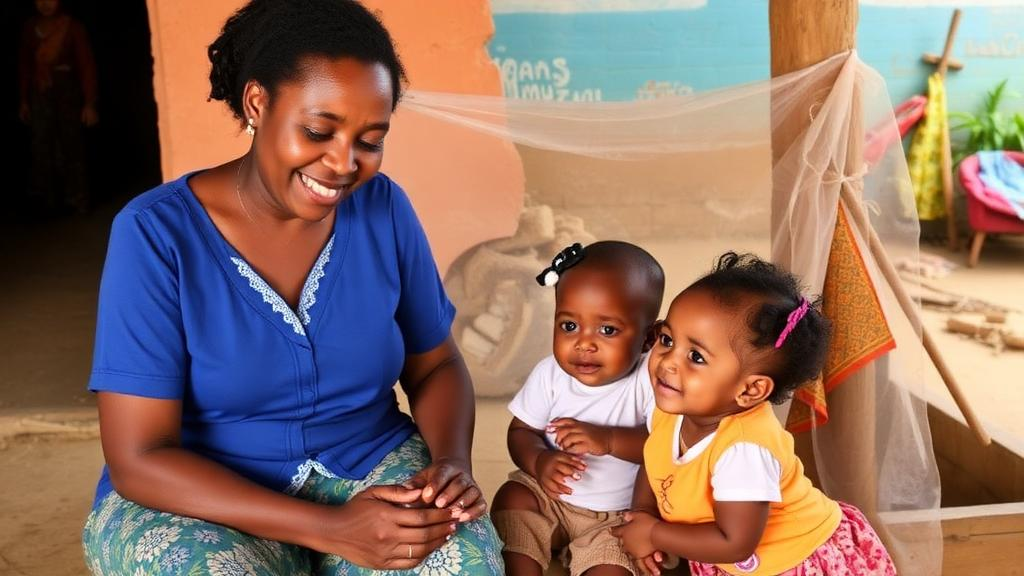
In the historic municipality of Alcântara, in the northeastern Brazilian state of Maranhão, a low-cost educational experiment has delivered some of the clearest evidence yet that teaching frontline health workers about the rights of women and children can measurably transform care in some of the country’s most vulnerable communities. A team of Brazilian and British researchers reports in the International Journal for Equity in Health that a rights-focused training program, delivered through active learning techniques, was followed by sharp increases in antenatal visits by community health agents, complementary breastfeeding, and full vaccination coverage among children under two years of age. The findings arrive at a moment when Brazil, despite its upper-middle-income status, continues to register maternal and child health indicators that fall below expectations and vary dramatically across population groups.
The communities at the heart of the study are quilombola communities, settlements founded by Afro-Brazilian descendants of enslaved people, many of which retain distinct cultural identities and deep historical ties to their territories. Across Brazil, these communities face persistent barriers to accessing and using health services, including geographic isolation, socioeconomic disadvantage, and structural inequities that have proven resistant to broad national policies. The researchers argue that the first 1,000 days of life, spanning conception through a child’s second birthday, represent a critical window during which targeted, inexpensive interventions can yield lifelong benefits. Training the primary healthcare professionals who serve these communities on the legal and human rights of women and children, they hypothesized, offered a cost-effective and scalable strategy to improve outcomes precisely where the need is greatest.
To test that hypothesis rigorously, the team designed a quasi-experimental, controlled interrupted time-series study comparing two neighboring municipalities: Alcântara, which received the intervention, and Guimarães, which served as the control. Interrupted time-series designs are among the strongest observational methods available for evaluating policy and program effects, because they track outcomes over long stretches of time before and after an intervention, allowing researchers to distinguish genuine changes in trend from ordinary fluctuation. By including a control municipality, the researchers could further account for broader secular trends, such as national vaccination campaigns or economic shifts, that might otherwise be mistaken for effects of the training program.
The intervention itself was built around an educational program known within the broader EUQUERO project, whose full name, Engaging Users for Quality Enhancement and Rights: Strengthening the maternal and child healthcare system over the first 1000 days in Brazil, signals its dual emphasis on user engagement and rights. Rather than relying on passive lectures, the program employed active learning methods, an approach that requires participants to engage directly with material through discussion, problem-solving, and application to their daily practice. The content focused specifically on the rights of women and children in maternal and child healthcare, aiming to equip community health agents and other primary care professionals with both the knowledge and the confidence to act on those rights in their routine work.
For the evaluation, the researchers drew on monthly data from SISAB, Brazil’s national Health Information System for Primary Care, covering the period from 2014 to 2023. Ten maternal and child health indicators were analyzed, providing a decade-long window on service delivery in both municipalities. The statistical toolkit was correspondingly sophisticated: Prais-Winsten regression, which corrects for the autocorrelation that plagues time-series data, was used to estimate trends and level changes, while ARIMA and seasonal ARIMA models offered complementary estimates of the intervention’s impact. Model selection relied on standard diagnostic criteria including the Akaike and Bayesian Information Criteria, root mean square error, and autocorrelation tests at lag one, ensuring that the reported effects were not artifacts of poorly specified models.
The results, measured twelve months after the intervention, were striking. In Alcântara, antenatal visits carried out by community health agents rose dramatically, with a regression coefficient of 64.92 and a 95 percent confidence interval spanning 34.33 to 95.51, a result with a p-value below 0.001. Complementary breastfeeding also increased significantly, with a coefficient of 10.62 and a confidence interval of 5.01 to 16.23, again with p below 0.001. Full vaccination coverage in children under two climbed as well, with a coefficient of 30.33 and a confidence interval of 8.61 to 52.04, corresponding to a p-value of 0.006. These three indicators, spanning pregnancy care, infant nutrition, and immunization, represent core pillars of the first 1,000 days agenda, and their simultaneous improvement suggests the intervention touched multiple points along the continuum of maternal and child care.
The contrast with the control municipality sharpened the picture considerably. In Guimarães, all ten indicators declined over the same period, a pattern that makes the gains in Alcântara all the more remarkable and argues strongly that the training program, rather than some region-wide improvement, drove the changes. The interrupted time-series framework also captured a less flattering result: health education activities directed at pregnant women in Alcântara actually decreased, with a coefficient of negative 3.25 and a confidence interval of negative 5.94 to negative 0.56, p equal to 0.01. The authors report this decline transparently, and it serves as a reminder that even successful interventions can redistribute effort in unexpected ways, perhaps as trained workers shifted time toward direct antenatal visits and other hands-on services.
What makes the study especially compelling is the combination of methodological rigor and modest cost. The intervention involved no new clinics, no additional pharmaceutical supplies, and no large-scale infrastructure investment. It consisted of educating the people already embedded in the community, the community health agents who form the backbone of Brazil’s Family Health Strategy and who are often the only regular point of contact between the health system and remote or marginalized populations. If a relatively brief, rights-based training can shift indicators as consequential as vaccination coverage and breastfeeding by the margins observed here, the implications for health policy in Brazil and beyond are substantial. The approach is, as the authors emphasize, both cost-effective and scalable, qualities that matter enormously in resource-constrained settings.
The study also contributes to a growing body of evidence that health equity is not achieved through services alone but through the realization of rights. Quilombola populations, like many Indigenous and traditional communities in Brazil, hold specific legal entitlements to healthcare, yet those entitlements frequently go unrealized because frontline workers are unaware of them or lack the practical tools to act. By centering the training on rights rather than solely on clinical protocols, the EUQUERO program addressed a structural root of inequity: the gap between what the law promises and what the health system delivers. The measured improvements in Alcântara suggest that closing that gap, even partially, translates directly into more antenatal contact, better infant feeding practices, and more fully immunized children.
Caveats remain, as they do in any quasi-experimental study. The design compared a single intervention municipality with a single control, and while the decade of monthly data and the dual modeling strategy lend confidence to the findings, the generalizability to other quilombola territories and other countries will require replication. The observed decline in health education activities for pregnant women also warrants follow-up to understand whether it reflects beneficial reallocation of effort or a genuine service gap. Nevertheless, the study, funded by the United Kingdom’s Medical Research Council and the Maranhão research foundation FAPEMA, with additional support from Brazil’s CNPq and CAPES, stands as a rigorous demonstration that knowledge is an intervention in its own right. For the families of Alcântara, the first 1,000 days of life now look measurably better protected, and for policymakers searching for affordable levers against entrenched health inequity, the message is clear: train the workforce, teach the rights, and the indicators will follow.
Subject of Research: A rights-based professional training intervention to improve maternal and child health indicators in quilombola communities in Maranhão, Brazil
Article Title: Improving maternal and child healthcare through professional training in quilombola communities, Brazil: a controlled interrupted time-series study
Article References: de Sousa, F. S., Costa, E. M., Prado, I. A., Batista, R. F. L., Lamy, Z. C., Channon, A. A., & Thomaz, E. B. A. F. (2026). Improving maternal and child healthcare through professional training in quilombola communities, Brazil: a controlled interrupted time-series study. International Journal for Equity in Health. https://doi.org/10.1186/s12939-026-02996-8
Image Credits: AI Generated
DOI: 10.1186/s12939-026-02996-8
Keywords: maternal and child health, quilombola communities, Brazil, primary health care, community health agents, professional training, health equity, interrupted time series, vaccination coverage, breastfeeding, antenatal care, human rights
Cite Scienmag News
Courtney Benton. (October 2, 2026). Rights-Based Training for Health Workers Boosts Maternal and Child Care in Brazil’s Quilombola Communities. Scienmag. https://scienmag.com/rights-based-training-for-health-workers-boosts-maternal-and-child-care-in-brazils-quilombola-communities/
Courtney Benton. "Rights-Based Training for Health Workers Boosts Maternal and Child Care in Brazil’s Quilombola Communities." Scienmag, 2 October 2026, https://scienmag.com/rights-based-training-for-health-workers-boosts-maternal-and-child-care-in-brazils-quilombola-communities/. Accessed 2 October 2026.
Courtney Benton. "Rights-Based Training for Health Workers Boosts Maternal and Child Care in Brazil’s Quilombola Communities." Scienmag. October 2, 2026. https://scienmag.com/rights-based-training-for-health-workers-boosts-maternal-and-child-care-in-brazils-quilombola-communities/


