


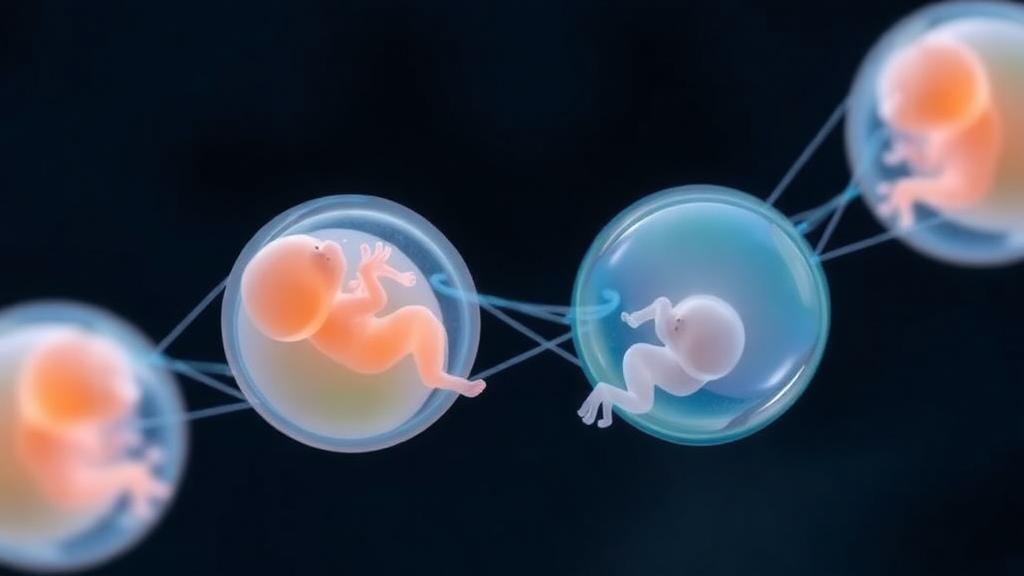
For years, scientists have grown ball-like structures from human stem cells that mimic some of the earliest stages of embryonic life, hoping to unlock the secrets of fertility, pregnancy loss and developmental disease without relying on donated human embryos. These structures, known as blastoids, have become one of the most promising and most debated tools in modern developmental biology. Yet a fundamental question has lingered beneath the excitement: just because a lab-grown model looks like an embryo under a microscope, is it actually behaving like one at the molecular level? A team at the University of Sydney has now built what amounts to a rigorous reality check for the field, and its verdict is nuanced. Some models perform impressively well, but none yet fully captures the complexity of real early human development.
The research, published in Cell Systems, introduces a computational framework that systematically evaluates how faithfully different blastoid-generation methods reproduce the cell types and developmental processes seen in natural human embryos. Led by Associate Professor Pengyi Yang, an ARC Future Fellow in the School of Mathematics and Statistics and Unit Head of Computational Systems Biology at the Children’s Medical Research Institute, the study set out to solve a problem that has hampered the field since its inception. According to Yang, human embryo models hold enormous potential for studying the earliest days of development, but until now there has been no consistent way to assess how accurately these models reflect genuine human biology. The new framework gives researchers an objective yardstick against which every future model can be measured.
At the heart of the work lies one of the most comprehensive reference maps of early human embryo development ever assembled. The team combined and harmonised more than 14,000 single-cell transcriptomes, the complete sets of RNA molecules within individual cells, drawn from human embryos spanning key stages of development. Single-cell transcriptomics allows scientists to read out, cell by cell, which genes are active at any given moment, effectively providing a molecular fingerprint of cellular identity. By integrating thousands of these profiles, the researchers constructed a detailed atlas of how cells normally differentiate and organise themselves during the days immediately before and after implantation, the critical window when the embryo attaches to the uterine wall and its foundational lineages take shape.
With this reference map in hand, the team turned to the models themselves. They evaluated four widely used blastoid-generation protocols developed by international research groups, comparing each against the natural benchmark. Crucially, the evaluation went far beyond morphology. Rather than asking whether the models simply resembled embryos under a microscope, the researchers examined their molecular identities, developmental timing, lineage structure and other biological characteristics. This distinction matters because appearance can be deceptive. A structure may adopt the right shape while its constituent cells follow molecular programmes that diverge substantially from those of a genuine blastocyst, the hollow ball of cells that forms roughly five to seven days after fertilisation.
The results revealed striking differences between the four approaches. Some blastoid models reproduced all three major cell lineages of a natural human blastocyst relatively well, capturing the essential cellular cast of early development. Others failed to accurately represent certain cell types or contained large numbers of cells that could not be confidently matched to any known embryonic state, suggesting that the models were producing cells whose identities were unclear or possibly artefactual. Notably, no single model perfectly replicated a natural human blastocyst. The finding does not diminish the value of the models, Yang emphasised, but it does impose discipline on how they are used. The encouraging news, he noted, is that some models capture important aspects of early embryonic development relatively well, although each has limitations.
The cautionary side of the message is equally important. Yang stressed that current models are not biologically equivalent to real human embryos, and that researchers need to be careful about the conclusions they draw from them. This warning carries real weight for a field in which blastoids are increasingly used to probe questions about implantation, early lineage specification and the origins of developmental disorders. If a model misrepresents a particular cell type or mis-times a developmental transition, findings built on that model could mislead rather than illuminate. The benchmark provides a way to distinguish which claims a given model can legitimately support and which lie beyond its current fidelity, helping to keep scientific claims grounded in what the systems can actually deliver.
The significance of the work extends beyond the immediate findings. Blastoids exist precisely because studying natural human embryos is constrained by both technical hurdles and ethical limits. International guidelines restrict the culture of human embryos beyond fourteen days, and the supply of donated embryos for research is limited. Stem-cell-derived models offer a scalable alternative, but their legitimacy depends entirely on how well they mirror the real thing. By providing a standardised, quantitative benchmark, the Sydney framework transforms what has often been a qualitative and contested judgement into a measurable comparison. The researchers hope this will allow future models to be improved more rapidly and evaluated more rigorously, accelerating a cycle of refinement across laboratories worldwide.
In a move likely to shape the field’s trajectory, the team has made its reference datasets and benchmarking tools publicly available. Any laboratory developing a new blastoid protocol can now test its products against the same molecular standards used in the study, creating a common language for model quality across the international research community. This kind of shared infrastructure is often what turns a promising technique into a reliable one, and it echoes the impact of earlier reference atlases that transformed fields such as genomics and single-cell biology. If we are going to use these systems to answer important biological questions, Yang said, we first need to know what they can reliably tell us. His team’s work, he added, provides a roadmap for improving embryo models and ensuring that scientific claims remain grounded in what the models can actually support.
The study, authored by Long, S. and colleagues under the title Systematic transcriptomic evaluation of blastoid models of early human development, was supported by a National Health and Medical Research Council Investigator Grant and a Metcalf Prize for Stem Cell Research awarded to Yang, while collaborator Raja Jothi was supported by the Intramural Research Program of the National Institutes of Health and the National Institute of Environmental Health Sciences in the United States. The authors declare no competing interests. As embryo models continue to evolve, the framework offers the field something it has long lacked: a way to tell, with molecular precision, how close lab-grown versions of early human life have come to the genuine article, and how much further they still have to go.
Subject of Research: Computational benchmarking of stem-cell-derived blastoid models against natural early human embryo development
Article Title: Scientists develop ‘reality check’ for lab-grown human embryo models
Article References: Scientists develop ‘reality check’ for lab-grown human embryo models. (n.d.). Original publication
Image Credits: AI Generated
DOI: Not provided
Keywords: blastoids, embryo models, stem cells, single-cell transcriptomics, early human development, benchmarking, University of Sydney, Cell Systems, developmental biology, reference map, implantation, research ethics
Cite Scienmag News
Drew Townsend. (October 2, 2026). New computational benchmark reveals how closely lab-grown embryo models match real human development. Scienmag. https://scienmag.com/new-computational-benchmark-reveals-how-closely-lab-grown-embryo-models-match-real-human-development/
Drew Townsend. "New computational benchmark reveals how closely lab-grown embryo models match real human development." Scienmag, 2 October 2026, https://scienmag.com/new-computational-benchmark-reveals-how-closely-lab-grown-embryo-models-match-real-human-development/. Accessed 2 October 2026.
Drew Townsend. "New computational benchmark reveals how closely lab-grown embryo models match real human development." Scienmag. October 2, 2026. https://scienmag.com/new-computational-benchmark-reveals-how-closely-lab-grown-embryo-models-match-real-human-development/


