


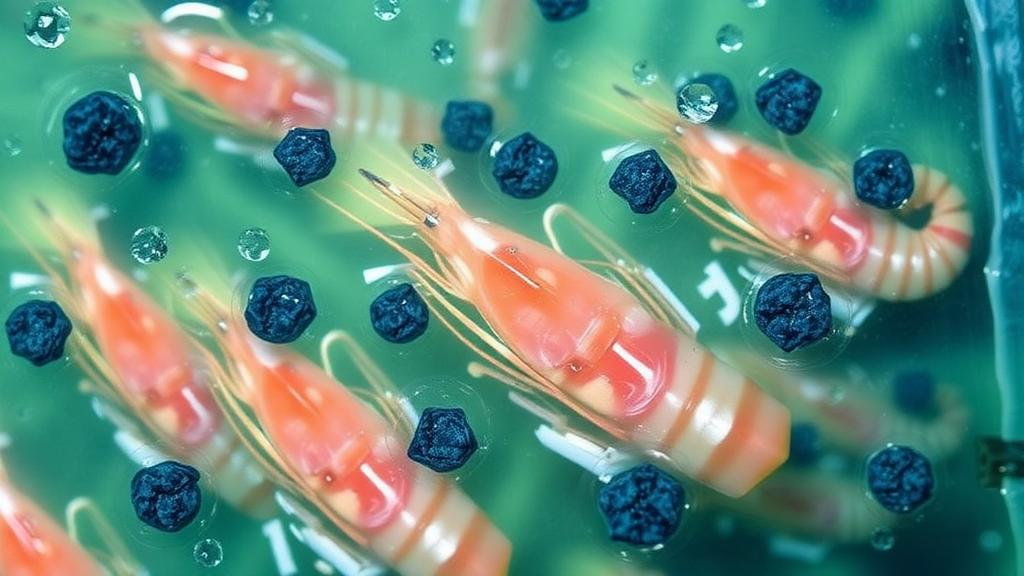
In the crowded world of sustainable aquaculture, few techniques have generated as much enthusiasm as biofloc technology, a system that turns microbial communities into a living engine for water purification and free nutrition. Now a team of researchers from Universiti Putra Malaysia, the National Institute of Biotechnology in Bangladesh, Curtin University, the University of Dhaka and Pukyong National University has delivered a finding that could reshape how hatcheries manage one of the world’s most valuable farmed crustaceans: the giant river prawn, Macrobrachium rosenbergii. Their study, published in the journal Blue Biotechnology, shows that when it comes to the volume of suspended microbial flocs in the water, less is genuinely more.
The giant river prawn is a culinary staple across South and Southeast Asia, supporting millions of livelihoods from Bangladesh to Vietnam. Although the species naturally lives in freshwater, berried females migrate to brackish water to spawn, and the larvae pass through eleven developmental stages before becoming postlarvae. Hatcheries typically rear these postlarvae in brackish water at salinities of around 10 to 12 parts per thousand before they migrate back toward freshwater. This nursery phase is a critical bottleneck: postlarvae are small, fragile, and highly sensitive to water quality, so any management tool that improves survival at this stage carries enormous economic weight.
Biofloc technology works by adding a carbon source, in this case maize starch, to culture water at a controlled carbon-to-nitrogen ratio. This fuels heterotrophic bacteria that convert toxic nitrogenous wastes such as ammonia into microbial biomass. The resulting flocs, aggregates of bacteria, algae, protozoa, organic particles and microscopic animals, are then grazed by the cultured animals, supplementing their formulated feed. The system recycles waste into food, reduces water exchange, and has been hailed as an environmentally friendly component of the so-called blue revolution. But the technology has a dark side: when floc volume climbs too high, the suspended solids can clog delicate gills, depress dissolved oxygen, block light penetration, and ultimately stunt growth or kill the animals outright.
Previous work had hinted at these dangers. In pink shrimp Farfantepenaeus duorarum, floc volumes reaching 17 milliliters per liter were associated with mortality from gill clogging. Researchers studying whiteleg shrimp found that low and medium total suspended solids levels improved water quality and performance, while high solids levels reduced productivity and survival. Yet for the giant river prawn, one of Asia’s most important aquaculture commodities, no published study had systematically tested how different floc volumes affect water quality, microbial communities, zooplankton abundance, growth, survival, body composition and profitability during the nursery phase. The new study set out to fill exactly that gap.
The experiment was elegantly simple in design. Over four weeks, the team reared giant river prawn postlarvae, each starting at an average weight of just 21.8 milligrams, in twelve 125-liter tanks holding 100 liters of brackish water at 15 parts per thousand salinity. Each tank was stocked with 500 postlarvae at a density of five individuals per liter. The tanks were assigned to four treatments in triplicate: three biofloc volume levels maintained by periodic solids removal, at 2 to 5, 7 to 10, and 12 to 15 milliliters per liter, and a zero-exchange biofloc system in which no solids were ever removed, allowing floc volume to climb unchecked. Floc volume was measured daily using Imhoff cones, and precise equations guided how much water should be drained and replaced to hold each target level.
The water chemistry results revealed a system under strain in the zero-exchange treatment. Temperature, pH, nitrite and nitrate remained statistically similar across all four groups, but dissolved oxygen dropped significantly in the zero-exchange tanks by weeks three and four, likely because the accumulating microbial and zooplankton biomass drove up biological oxygen demand. Total suspended solids and floc volume rose steadily in the zero-exchange system, while the managed treatments stayed within ranges considered safe for prawn and shrimp culture. Ammonia was briefly higher in the lowest floc volume group during the first week but fell within safe limits and declined thereafter, suggesting that nitrifying bacteria were functioning effectively in all systems.
The microbial story proved equally revealing. Sixteen genera of zooplankton were identified across the tanks, including six genera of ciliates, nine of rotifers and one of nematodes. Ciliates, rotifers and nematodes were all significantly more abundant in the zero-exchange system, apparently because zooplankton assemblages require suspended solids as substrate. But abundance of these live foods did not translate into better prawn performance. More importantly, the density of Vibrio species, bacteria widely regarded as a serious nuisance in prawn hatcheries, was significantly lower in the 2 to 5 milliliter per liter treatment than in the 12 to 15 and zero-exchange groups. Meanwhile, Lactobacillus species, considered beneficial for gut health and water quality, were significantly more abundant in all three solids-removal treatments than in the zero-exchange system, a microbial shift the authors interpret as evidence of a healthier culture environment.
When it came to the prawns themselves, growth told a surprisingly flat story: final weight, weight gain and specific growth rate were statistically indistinguishable across all four treatments, indicating that the animals could grow at similar rates regardless of floc management. Survival, however, was a different matter. The 2 to 5 milliliter per liter treatment produced significantly higher survival, reaching 82.33 percent, along with the best feed conversion ratio of 1.52, compared with a dismal 8.63 in the zero-exchange system. The feed conversion ratios in the three managed treatments, at 1.52, 1.60 and 2.07, also compared favorably with values reported previously for prawn culture in biofloc systems. Because survival and feed efficiency drive nursery economics, the lowest floc volume group delivered significantly higher gross returns, net returns and benefit-cost ratios than the other treatments.
Proximate analysis added a nutritional dimension to the findings. The whole-body dry matter, protein, lipid, ash and carbohydrate content of the postlarvae did not differ significantly among treatments, suggesting that floc volume did not alter the prawns’ fundamental nutritional profile. The bioflocs themselves showed similar protein and lipid content across groups, though ash was higher in the 12 to 15 and zero-exchange treatments and carbohydrate was higher in the two lowest floc volume groups. The authors note that the relatively low lipid content of the postlarvae likely reflects young animals channeling energy into growth rather than storage, and that the protein levels observed are consistent with those of postlarvae fed premium live foods such as adult Artemia, Tubifex worms and Moina.
The practical message for hatchery operators is strikingly clear. Maintaining floc volume at 2 to 5 milliliters per liter, corresponding to a total suspended solids level of roughly 294 milligrams per liter, through periodic solids removal produced the highest survival, the best feed conversion, a healthier microbial balance with fewer Vibrio and more Lactobacillus, and the strongest economic returns. The authors recommend that commercial prawn nurseries using biofloc systems adopt routine solids removal as a core management strategy. They also caution that their study did not characterize the full bacterial diversity, virulent Vibrio strains or probiotic candidates within the flocs, and they call for future research into bacterial community dynamics, amino acid and fatty acid profiles, and immune gene expression in prawns reared across different floc management regimes. For an industry seeking to grow more food with less water and fewer chemicals, this study offers a deceptively simple prescription: in the microbial economy of the biofloc pond, moderation pays.
Subject of Research: Optimizing biofloc volume for giant river prawn postlarvae nursery culture in brackish water biofloc systems
Article Title: Effect of biofloc volume on growth, survival, economics and proximate composition of Macrobrachium rosenbergii postlarvae cultured in brackish water biofloc system
Article References: Hosain, M. E., Amin, S. M. N., Karim, M., Arshad, A., Kamarudin, M. S., Shohaimi, S., Naser, M. N., & Brown, C. L. (2025). Effect of biofloc volume on growth, survival, economics and proximate composition of Macrobrachium rosenbergii postlarvae cultured in brackish water biofloc system. Blue Biotechnology, 2(1), Article 4. https://doi.org/10.1186/s44315-025-00030-0
Image Credits: AI Generated
DOI: 10.1186/s44315-025-00030-0
Keywords: biofloc technology, Macrobrachium rosenbergii, giant river prawn, aquaculture, postlarvae, nursery phase, water quality, Vibrio, Lactobacillus, survival, feed conversion ratio, sustainable aquaculture
Cite Scienmag News
Drew Townsend. (October 2, 2026). Less Is More: Keeping Biofloc Volume Low Boosts Survival and Profit in Giant Prawn Nursery. Scienmag. https://scienmag.com/less-is-more-keeping-biofloc-volume-low-boosts-survival-and-profit-in-giant-prawn-nursery/
Drew Townsend. "Less Is More: Keeping Biofloc Volume Low Boosts Survival and Profit in Giant Prawn Nursery." Scienmag, 2 October 2026, https://scienmag.com/less-is-more-keeping-biofloc-volume-low-boosts-survival-and-profit-in-giant-prawn-nursery/. Accessed 2 October 2026.
Drew Townsend. "Less Is More: Keeping Biofloc Volume Low Boosts Survival and Profit in Giant Prawn Nursery." Scienmag. October 2, 2026. https://scienmag.com/less-is-more-keeping-biofloc-volume-low-boosts-survival-and-profit-in-giant-prawn-nursery/


