


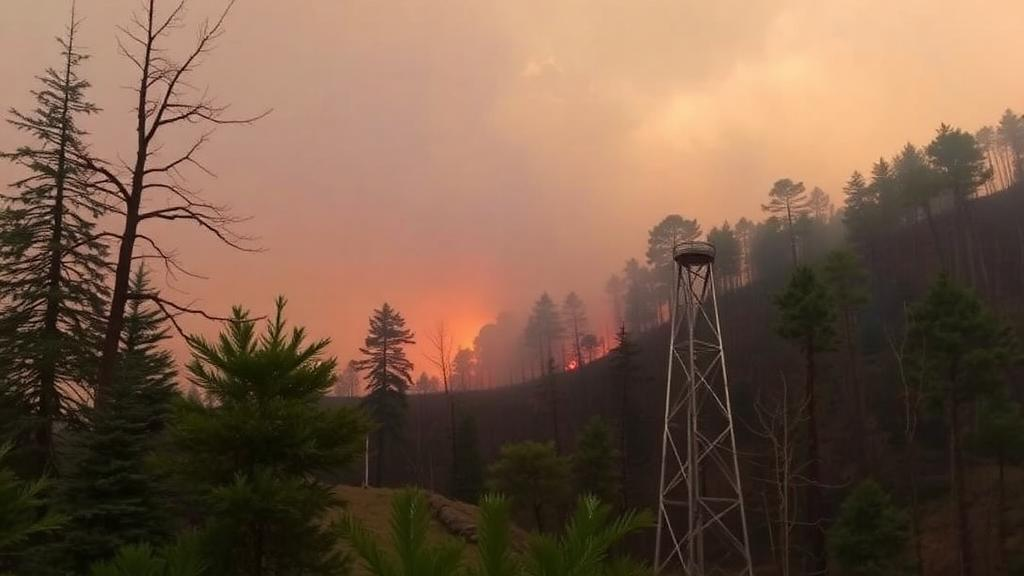
Every spring, before the monsoon rains arrive to wash the air clean, the Himalayan region chokes. Forest fires ignite across the steep slopes of India, Nepal, Bhutan, and Pakistan, sending plumes of fine particulate matter drifting across national borders and into valleys where millions of people live and breathe. A new analysis published in BMC Environmental Science by Parth Sarathi Mahapatra of GIZ India and Narayan Babu Dhital of Tribhuvan University in Nepal makes the case that these recurring pre-monsoon pollution episodes are not isolated national emergencies but a shared regional problem that demands coordinated transboundary action. Drawing on more than two decades of satellite-derived data, the authors document a steady and statistically significant rise in fine particle pollution across the Himalayas, one that tracks closely with the timing and frequency of forest fire activity.
The scale of the underlying air quality crisis in South Asia is difficult to overstate. The region, together with the Himalayan foothills, ranks among the most severe air pollution hotspots on the planet. According to figures cited in the study, air pollution is responsible for an estimated 17.7 percent of total deaths in South Asia, while exposure to particulate matter shortens average life expectancy by one to five years. The economic toll is equally sobering: the health costs attributable to fine particulate matter, known as PM2.5 because its particles measure 2.5 micrometers or less in diameter, are equivalent to roughly 10.3 percent of the region’s gross domestic product. Particles of this size are small enough to penetrate deep into the lungs and enter the bloodstream, making them the most dangerous class of airborne pollutants for human health.
To quantify the trend, the researchers analyzed long-term PM2.5 concentrations over the Himalayan region from 1998 to 2022, using global surface PM2.5 reanalysis data produced by the Atmospheric Composition Analysis Group. The dataset covers a vast area bounded by 25 to 40 degrees north latitude and 60 to 100 degrees east longitude, encompassing the full arc of the Himalayas and adjacent lowland plains. The analysis revealed a clear upward trajectory in pollution levels, with pronounced seasonal peaks during March through May and again in November and December. Applying the Mann-Kendall trend test, a non-parametric statistical method widely used in environmental science to detect monotonic trends in time-series data, the authors calculated an increase of 0.20 micrograms per cubic meter of PM2.5 per year, a result statistically significant at a p-value of 0.0047. In recent years, concentrations have reached what the authors describe as alarming levels.
The smoking gun linking this pollution to fire lies in satellite observations of active burning. Using fire count data from the Moderate Resolution Imaging Spectroradiometer, or MODIS, an instrument aboard NASA’s Terra and Aqua satellites that detects thermal anomalies at the surface, the researchers mapped fire activity across the same Himalayan domain from 2001 to 2022. The fire record shows higher counts in recent years, with activity peaking in March through May and again in October and November. That seasonal rhythm mirrors the PM2.5 cycle almost exactly, a temporal alignment the authors interpret as strong evidence that fire emissions contribute substantially to the region’s fine particle burden. The correspondence between burning seasons and pollution peaks is not coincidental; it reflects the direct injection of smoke, soot, and organic aerosols into the atmosphere during the driest and most fire-prone months of the year.
Case studies from individual fire events underscore just how dominant fire emissions can become. A study of the April 2022 forest fires in Uttarakhand, India, cited in the analysis, concluded that the blazes contributed approximately 71 percent of the PM2.5 measured during that episode. In other words, during peak fire periods, the overwhelming majority of the region’s most hazardous airborne particles originate not from vehicles or industry but from burning forests. While earlier research has linked forest fires to particulate emissions in South Asia, the authors note that a comprehensive long-term analysis covering the entire Himalayan region had been missing, a gap their new study begins to fill and one that they argue requires further investigation.
What makes the Himalayan situation particularly pernicious is the region’s topography and meteorology. Emissions from the densely populated low-lying plains of South Asia are routinely transported upward into the mountains, where they compound pollution generated by local fires. Mountain passes and valleys act as natural conduits, channeling pollutant-laden air across the Himalayan crest and spreading it far beyond its point of origin. This orographic transport, driven by the interplay of valley winds, slope heating, and synoptic-scale circulation patterns, means that no single country can protect its own air quality through domestic policy alone. The consequences cascade through the mountain environment: deposited particles darken glacier surfaces, reducing their reflectivity and accelerating melting, while the absorbed solar radiation contributes to localized atmospheric heating. For a region whose glaciers feed major river systems serving hundreds of millions of people, the stakes extend well beyond respiratory health.
The authors argue that existing responses, while well intentioned, remain fragmented. Individual governments have pursued policy formulation, resource enhancement, capacity building, and improvements to fire and air quality databases, yet these efforts stop at national borders even when the pollution does not. What is needed, they contend, is a genuinely integrated approach that treats forest fires and air pollution as the coupled regional challenge they are. A combined strategy addressing climate change and air quality simultaneously could deliver co-benefits, including improved public health, greater ecosystem resilience, and economic efficiency. Aligning fire emission reductions with broader climate mitigation goals would also unlock additional financing opportunities, since many climate funds can support activities that reduce biomass burning and its associated greenhouse gas and aerosol emissions.
The study outlines a concrete agenda for regional cooperation. Harmonizing standards and practices through regional agreements would ensure a cohesive response to fires and transboundary haze. Technology transfer, the sharing of best practices in fire management, and the deployment of economic instruments such as emission trading could align incentives across countries. Shared research programs would help close remaining scientific gaps, including the need for a fuller accounting of fire contributions to pollution across the entire mountain range. Perhaps most consequentially, the authors call for the regional implementation of state-of-the-art forecasting systems that could predict fire outbreaks and pollution episodes before they unfold, giving governments the decision support they need to act preemptively rather than reactively. Such systems, which combine satellite fire detection, meteorological modeling, and chemical transport models, are already operational in other parts of the world; adapting them to the Himalayas is a matter of investment and political will rather than technical feasibility.
The urgency of that investment is difficult to dispute. The pre-monsoon fire season arrives with metronomic regularity, and each year the underlying trend in particulate pollution ticks upward. Glaciers continue to retreat under a double burden of warming temperatures and darkening deposits of soot. Populations across South Asia continue to lose years of life to air they cannot choose not to breathe. Mahapatra and Dhital’s message is ultimately a simple one: the smoke does not carry a passport, and neither can the response. Unless the countries of the Himalayan region coordinate their fire management, air quality monitoring, and pollution control policies across borders, the region will remain trapped in an annual cycle of preventable harm, one that science has now documented with considerable precision and that policy has yet to match.
Subject of Research: Forest fire-induced transboundary air pollution in the Himalayan region
Article Title: Forest fire-induced air pollution events in the Himalayan region: urgent need for regional collaboration and action
Article References: Mahapatra, P. S., & Dhital, N. B. (2025). Forest fire-induced air pollution events in the Himalayan region: urgent need for regional collaboration and action. BMC Environmental Science, 2(1), Article 13. https://doi.org/10.1186/s44329-025-00027-5
Image Credits: AI Generated
DOI: 10.1186/s44329-025-00027-5
Keywords: Himalayas, forest fires, air pollution, PM2.5, South Asia, transboundary pollution, MODIS, glacial retreat, regional cooperation, particulate matter, pre-monsoon season, public health
Cite Scienmag News
Russell Cooper. (October 2, 2026). Himalayan Forest Fires Are Driving a Cross-Border Air Pollution Crisis, Scientists Warn. Scienmag. https://scienmag.com/himalayan-forest-fires-are-driving-a-cross-border-air-pollution-crisis-scientists-warn/
Russell Cooper. "Himalayan Forest Fires Are Driving a Cross-Border Air Pollution Crisis, Scientists Warn." Scienmag, 2 October 2026, https://scienmag.com/himalayan-forest-fires-are-driving-a-cross-border-air-pollution-crisis-scientists-warn/. Accessed 2 October 2026.
Russell Cooper. "Himalayan Forest Fires Are Driving a Cross-Border Air Pollution Crisis, Scientists Warn." Scienmag. October 2, 2026. https://scienmag.com/himalayan-forest-fires-are-driving-a-cross-border-air-pollution-crisis-scientists-warn/


