


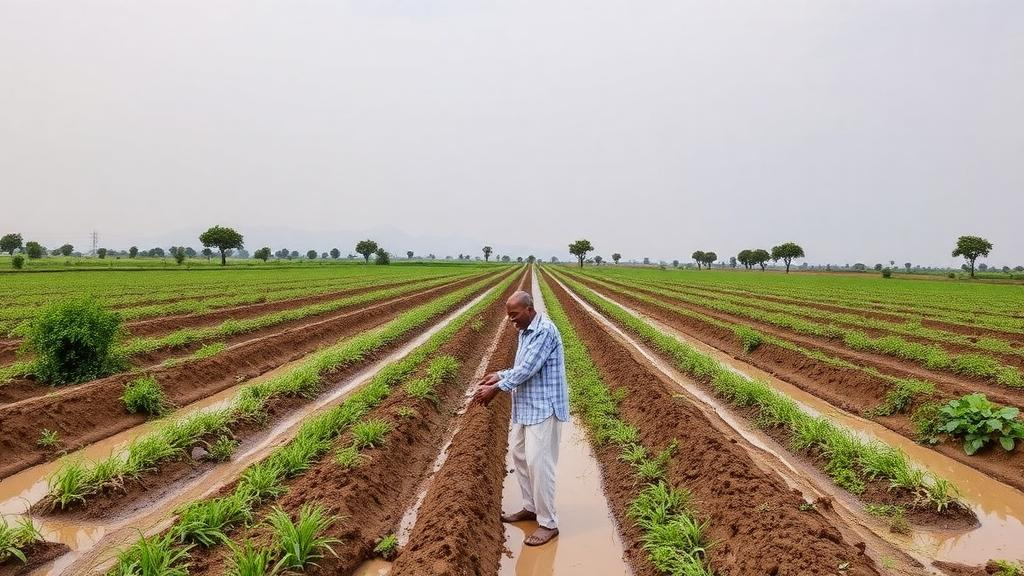
In the highlands and lowlands of southern Ethiopia, water is often close at hand, yet the fields above it stay dry. A sweeping new analysis of more than 33,000 farming households and over 41,000 cultivated plots across ten zones of the former Southern Nations, Nationalities, and Peoples’ Region has quantified just how large the gap is between irrigation’s promise and its reality on the ground. Despite a region endowed with surface water, diverse agroecologies, and a national irrigation potential running into millions of hectares, only 9.4 percent of households and a mere 5.2 percent of plots used any form of irrigation during the 2018/19 agricultural season covered by the survey. Even within households that did irrigate, only a fraction of their land received water, pointing to binding constraints on water access, infrastructure, and labor rather than a simple lack of interest among farmers.
The study, published in BMC Agriculture by Teklu Gebretsadik Wana and Tsadiku Alemu Dukamo of the Sidama Region Agricultural Research Institute, is notable for its scale and its statistical machinery. The researchers drew on secondary data from the 2018/19 Regional Agricultural Household Survey and 2020 regional reports, with sampling based on the population census and stratified by agroecological zone. Rather than treating irrigation as a single yes-or-no decision, they disaggregated it into four distinct technologies: manual methods, mechanized systems, gravity-fed schemes, and treadle pumps. This distinction matters because each technology demands different combinations of capital, labor, and institutional support, and because farmers frequently combine or substitute between them in ways that simpler models miss entirely.
To capture this complexity, the team applied two econometric frameworks. A multivariate probit model estimated the joint probability of adopting each of the four technologies simultaneously, accounting for the correlation of unobserved factors across adoption decisions. A Cragg double hurdle model then separated the decision to irrigate at all from the decision of how much land to irrigate, a two-stage structure chosen over a Tobit alternative after a likelihood ratio test confirmed its superior fit. The double hurdle approach is particularly powerful in settings like southern Ethiopia, where many farmers report zero irrigated area for very different reasons: some face insurmountable barriers to adoption, while others adopt but irrigate only small patches. Conflating these two groups, the authors argue, biases estimates and misleads policy.
The headline numbers conceal striking geographic variation. In the Central zones of Gurage and Hadiya, 15.4 and 15.0 percent of households irrigated respectively, with 6.5 and 6.1 percent of plots receiving water. Wolaita recorded the highest household adoption in the southern cluster at 16.1 percent. At the other extreme, Sidama lagged far behind, with only 3.4 percent of plots irrigated, and zones such as Gedio and Gofa also showed weak uptake. These spatial patterns, the authors suggest, reflect differences in infrastructure development, institutional support, terrain, and access to water sources such as the Sile and Bilate rivers, which have underpinned horticultural booms in banana, avocado, and mango production in the Sidama and Gamo zones.
The econometric results paint a nuanced picture of who adopts what, and why. Manual irrigation, the dominant method at roughly 75 to 88 percent of irrigating households, was strongly associated with access to irrigation schemes, secure land tenure evidenced by holding a deed, and participation in wage employment. The interpretation is intuitive: manual systems carry low capital requirements and minimal sunk costs, making them attractive to farmers with stable but modest incomes who lack the financing for equipment. Mechanized irrigation, by contrast, was significantly more likely among male-headed households, households with full-time or part-time hired labor, and those with access to irrigation infrastructure, reflecting its heavy demands on both capital and labor. Gravity-fed systems were positively linked to extension services and scheme access but negatively associated with self-employment, suggesting that off-farm obligations crowd out the time and organization needed to manage communal water flows.
Treadle pumps, the least common technology at an estimated 2.5 to 3.0 percent adoption, told perhaps the most interesting story. Uptake was higher among younger, male farmers with access to extension support, consistent with the physical demands of foot-powered pumping. The technology also proved the most labor-intensive in the analysis of household labor use, with treadle pump users logging more person-days per hectare than users of any other method. Meanwhile, education showed a subtle dual effect: it slightly increased the use of gravity systems but reduced reliance on manual labor, hinting that more educated farmers may be positioning themselves for a transition toward capital-intensive techniques as circumstances allow.
One finding stands out as genuinely counterintuitive: access to credit was negatively associated with irrigation adoption. Only 1.2 percent of surveyed households reported credit access, and rather than unlocking investment in pumps and canals, it correlated with lower uptake. The authors attribute this to non-targeted financing, loans that are not designed for irrigation-specific investments and may instead burden households with debt service that competes with on-farm spending. The result is a caution against assuming that financial access alone catalyzes technology adoption; the design and targeting of credit products may matter as much as their availability.
The double hurdle analysis of irrigated area added another layer of insight. Farm size emerged as a consistently positive predictor across all four technologies, with coefficients ranging from 0.57 for treadle pumps to 0.78 for gravity systems, evidence of economies of scale in irrigation. Household size and male leadership boosted the area under manual irrigation, while extension access drove the intensity of mechanized use. For treadle pumps, irrigated area correlated with the household head’s age, extension contact, and access to market price information, underscoring that knowledge and market connectivity, not just hardware, determine whether a technology delivers. The authors propose that a land threshold may exist above which irrigation becomes distinctly more profitable, a hypothesis they suggest testing with regression discontinuity designs in future work.
The study’s regional context sharpens its urgency. Ethiopia holds an estimated 3.7 to 5.3 million hectares of irrigation potential, yet only 10 to 15 percent had been realized by 2023, and the southern region alone accounts for roughly 16 percent of the national total. Agriculture employs more than 80 percent of the workforce and generates about 45 percent of GDP, yet remains hostage to erratic rainfall. The costs of inaction are quantifiable: child undernutrition alone was estimated to have cost the country 1.7 billion US dollars in 2015, around 11 percent of GDP. Success stories such as farmer-led motor pump irrigation in Sidama and Gamo sit alongside cautionary tales, including government canal projects in Hadiya that collapsed into disuse through poor maintenance and weak post-construction support, and gender-exclusionary water governance in Halaba and Gedeo that suppressed both equity and productivity.
The authors’ policy prescriptions follow directly from the evidence: secure land tenure to encourage long-term investment, upgrade water harvesting and distribution infrastructure, strengthen extension services that proved so influential across technologies, and redesign credit and market systems to fit the realities of gender, age, labor availability, and farm size. They also flag emerging opportunities in climate-smart approaches, including solar-powered pumps, water-saving sprinkler and drip systems, integrated watershed management, and community-based water governance that involves local users in allocation and maintenance. The study is candid about its limits, relying on cross-sectional data that cannot capture seasonal dynamics or policy shifts, but its central message is unambiguous. Southern Ethiopia’s irrigation gap is not a story of farmer reluctance; it is a story of misaligned institutions, and closing it could transform food security and climate resilience across one of Africa’s most vulnerable farming landscapes.
Subject of Research: Determinants and sustainability of small-scale irrigation adoption among smallholder farmers in Southern Ethiopia
Article Title: Trends and sustainability of small-scale irrigation in Southern Ethiopia: exploring constraints and adoption dynamics
Article References: Wana, T. G., & Dukamo, T. A. (2025). Trends and sustainability of small-scale irrigation in Southern Ethiopia: exploring constraints and adoption dynamics. BMC Agriculture, 1(1), Article 16. https://doi.org/10.1186/s44399-025-00013-x
Image Credits: AI Generated
DOI: 10.1186/s44399-025-00013-x
Keywords: small-scale irrigation, Ethiopia, smallholder farming, multivariate probit model, double hurdle model, food security, climate resilience, land tenure, extension services, agricultural economics, water management, Southern Ethiopia
Cite Scienmag News
Alan Morgan. (October 2, 2026). Only One in Ten Farms Irrigates: The Hidden Barriers Holding Back Southern Ethiopia’s Smallholders. Scienmag. https://scienmag.com/only-one-in-ten-farms-irrigates-the-hidden-barriers-holding-back-southern-ethiopias-smallholders/
Alan Morgan. "Only One in Ten Farms Irrigates: The Hidden Barriers Holding Back Southern Ethiopia’s Smallholders." Scienmag, 2 October 2026, https://scienmag.com/only-one-in-ten-farms-irrigates-the-hidden-barriers-holding-back-southern-ethiopias-smallholders/. Accessed 2 October 2026.
Alan Morgan. "Only One in Ten Farms Irrigates: The Hidden Barriers Holding Back Southern Ethiopia’s Smallholders." Scienmag. October 2, 2026. https://scienmag.com/only-one-in-ten-farms-irrigates-the-hidden-barriers-holding-back-southern-ethiopias-smallholders/


