


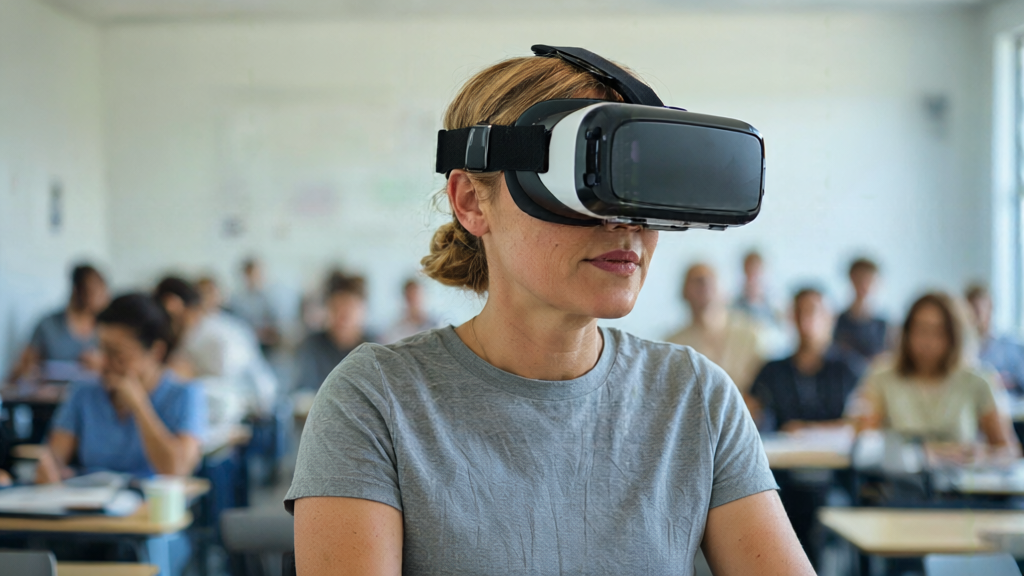
Effective communication in English extends far beyond the mastery of vocabulary and grammatical structures. It requires a nuanced understanding of how language shifts based on social dynamics, cultural norms, and specific situational contexts. A recent experimental study suggests that immersive virtual reality (VR) technology can serve as a powerful tool for helping English teachers develop this often-overlooked dimension of language use, known as pragmatic competence. The research indicates that such technology can bridge the gap between theoretical knowledge and practical application in professional settings.
The study, titled “Socio-Culturally Responsive VR Training for Enhancing English Teachers’ Pragmatic Competence,” was conducted by researchers Mohsen Mahmoudi-Dehaki and Nasim Nasr-Esfahani. Published online on August 27, 2026, in the journal ECNU Review of Education, the work focuses on the specific challenges faced by educators in English as a Foreign Language (EFL) contexts. In these environments, opportunities for authentic, real-world interaction are often limited, making it difficult for teachers to practice context-sensitive communication repeatedly.
Pragmatic competence is defined as the ability to use language appropriately in real-world situations. For instance, a request, refusal, apology, or complaint can be expressed in numerous grammatically correct ways. However, the most appropriate choice depends heavily on factors such as the social relationship between speakers, power dynamics, social distance, and cultural expectations. Traditional classroom instruction can explain these pragmatic rules, but providing repeated opportunities to practice them in realistic, high-stakes situations remains a significant challenge for teacher education programs.
To investigate whether immersive technology could address this pedagogical gap, the researchers employed a sequential explanatory mixed-methods design. The study involved 122 randomly selected EFL teachers who participated in a comprehensive 108-hour intervention. This program utilized fully immersive VR simulations featuring artificial intelligence (AI)-driven avatars. The simulations were designed to incorporate diverse sociocultural scenarios, varying speech acts, power relations, and levels of social distance, ensuring that the training was not merely linguistic but deeply contextual.
The intervention followed a human-on-the-loop (HOTL) approach, which maintains human involvement in the AI-supported learning process. This design choice was critical in ensuring that the technology served as a facilitator of learning rather than a replacement for human interaction. Participants completed verbal discourse completion tasks (DCTs) both before and after the training period. These tasks allowed the researchers to quantitatively assess changes in the teachers’ pragmatic competence, specifically looking at their ability to navigate complex social and cultural expectations.
The results of the study demonstrated that participants achieved statistically significant improvements in pragmatic competence following the 108-hour training program. These gains were evident in two key dimensions: pragmalinguistic accuracy and sociopragmatic appropriateness. Pragmalinguistic accuracy refers to the ability to select and use appropriate linguistic forms, while sociopragmatic appropriateness relates to the ability to respond in a manner that aligns with the social and cultural expectations of a given situation. The data suggests that the immersive environment effectively targeted both the structural and social aspects of language use.
Qualitative data gathered through focus group interviews provided further insight into the mechanisms behind these improvements. Participants identified several key factors that contributed to their enhanced competence. These included immersive engagement, which kept learners focused and present in the simulated scenarios; real-time adaptive feedback, which allowed for immediate correction and learning; and increased communicative confidence. Additionally, teachers reported greater metapragmatic awareness, meaning they became more conscious of the pragmatic rules governing their speech, and engaged in reflective practice, analyzing why certain choices were appropriate in specific contexts.
The researchers emphasize that the value of the VR intervention lay not simply in the fact that teachers were practicing English in a virtual environment. Rather, the simulations created specific opportunities for participants to make communicative choices within sociocultural situations. By receiving adaptive feedback and reflecting on the appropriateness of their choices, teachers were able to internalize the complex social rules of English communication. This approach distinguishes the study from previous uses of VR in language education, which have often focused on conventional exercises rather than sociocultural responsiveness.
It is important to note that the researchers do not propose VR as a replacement for human interaction or conventional teacher education. Instead, they suggest that immersive technology can serve as an additional environment for professional learning. This is particularly relevant in EFL contexts where authentic interaction opportunities are constrained. The integration of AI-driven interaction with a socio-culturally responsive approach allows for a scalable and repeatable training environment that can be tailored to various social and cultural scenarios, providing a level of practice that is difficult to achieve in traditional classroom settings.
While the findings are promising, the researchers note that further research is needed to determine the long-term sustainability of these improvements. Specifically, it remains to be seen how effectively skills developed in immersive simulations transfer to teachers’ real-world professional and classroom interactions over time. The study contributes to the growing body of research on technology-enhanced language teacher education by demonstrating the potential of immersive, AI-supported environments. It highlights the importance of combining technological innovation with sociocultural awareness, adaptive feedback, and reflective practice when designing professional learning experiences for educators.
Subject of Research: Education
Article Title: Virtual reality helps English teachers strengthen the social side of language
Article References: Virtual reality helps English teachers strengthen the social side of language. (n.d.). Original publication
Image Credits: AI Generated
DOI: Not provided
Keywords: Virtual Reality, Language Education, Pragmatic Competence, Teacher Training, AI in Education, Virtual, reality, helps, English, teachers, strengthen, social
Cite Scienmag News
Courtney Benton. (October 2, 2026). Immersive VR Training Enhances Pragmatic Competence in English Teachers. Scienmag. https://scienmag.com/immersive-vr-training-enhances-pragmatic-competence-in-english-teachers/
Courtney Benton. "Immersive VR Training Enhances Pragmatic Competence in English Teachers." Scienmag, 2 October 2026, https://scienmag.com/immersive-vr-training-enhances-pragmatic-competence-in-english-teachers/. Accessed 2 October 2026.
Courtney Benton. "Immersive VR Training Enhances Pragmatic Competence in English Teachers." Scienmag. October 2, 2026. https://scienmag.com/immersive-vr-training-enhances-pragmatic-competence-in-english-teachers/


