


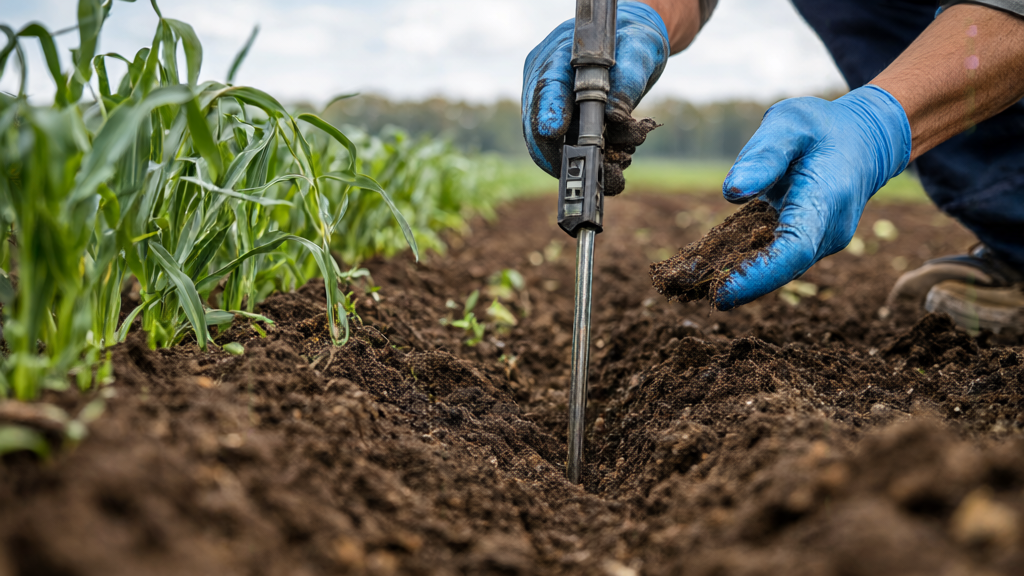
Agricultural fields appear simple from a distance, consisting primarily of soil and crops, but the subsurface environment is a complex ecosystem of microbes, nutrients, and chemical reactions that determine harvest health. Understanding these subsurface processes has long been a challenge for agriculture because key indicators such as soil pH, microbial activity, and plant physiology are dynamic and difficult to track in real time. Researchers in the Paul M. Rady Department of Mechanical Engineering at the University of Colorado Boulder have developed a low-cost electronic sensor designed to address this gap by continuously monitoring soil pH. This technology offers a new method for observing the hidden conditions beneath the soil surface, potentially allowing farmers to detect changes earlier and make more informed management decisions.
The importance of soil pH in agriculture cannot be overstated, as it is often referred to as the “master variable” because it influences nearly every aspect of farm productivity, from nutrient availability to plant growth. However, traditional methods for tracking pH have significant limitations. Professor Gregory Whiting, who leads the Boulder Experimental Electronics and Manufacturing Laboratory (BEEM Lab) at CU Boulder, noted that conventional pH sensors are often ill-suited for soil environments. These traditional devices typically feature fragile glass bulbs that require frequent recalibration. The measurements provided by these sensors drift over time and vary across different environments, necessitating cumbersome manual calibration that is impractical for continuous field monitoring.
To overcome these challenges, the research team pivoted toward a new type of electronic sensor that utilizes a pH-sensitive dye called alizarin to provide more dependable readings. While the underlying technology is not entirely new, with scientists worldwide having studied it for years and demonstrated its efficacy in simple settings, a critical question remained unresolved: whether the sensor could reliably monitor real soil outside of laboratory conditions for weeks or months. The CU Boulder team aimed to bridge the gap between laboratory proof-of-concept and practical agricultural application by testing the device in diverse, realistic soil environments.
The study, led by PhD student Juan Cisneros Barba, involved burying a series of electrochemical sensors in various types of soil to assess their performance. The researchers selected soil samples that differed in organic matter content, with some being more sandy or muddy. To mimic the changing environmental conditions encountered in actual fields, the team included both compacted and uncompacted soils. This rigorous testing protocol was designed to evaluate the sensor’s robustness against the variability inherent in agricultural landscapes, ensuring that the device could function effectively regardless of the specific soil composition or physical structure.
In addition to testing the sensor’s response to different soil types, the team improved the original design to enhance its manufacturability and practicality. They transitioned to a printed circuit board-based design, which is easier to produce at scale. This redesign was paired with an inexpensive, field-deployable readout system, making the technology more practical for distribution and outdoor use. The goal was to create a device that was not only scientifically accurate but also economically viable and user-friendly for farmers who may lack access to sophisticated laboratory equipment or technical support.
The results of the field and laboratory tests exceeded the team’s expectations. Across the multiple soil types tested, the redesigned sensor delivered reliable, continuous pH measurements over a period of several months. A multi-month outdoor monitoring test in soil demonstrated stable performance without the need for constant recalibration. This stability is a significant improvement over traditional sensors, which often require frequent manual adjustments to maintain accuracy. The findings suggest that the new sensor can maintain its integrity and precision in the harsh and variable conditions of an agricultural field, providing a consistent data stream for growers.
Professor Whiting emphasized that the primary advantage of this new technology is its usability. He stated that the devices cost very little to manufacture, function with minimal human effort, and are compatible with various soil types. These characteristics allow the technology to be genuinely useful in farm settings, where cost and ease of use are critical factors for adoption. By reducing the barrier to entry for continuous soil monitoring, the researchers hope to enable a broader range of farmers to access real-time data on their soil health, thereby improving the overall management of agricultural land.
The study was published in the journal Scientific Reports, marking a significant contribution to the field of agricultural technology. It represents the latest development in a series of recent discoveries by Whiting and his team, whose work is helping farmers listen to soils, monitor living plants, and gather important information for future farms. The research highlights a shift toward more integrated and continuous monitoring systems in agriculture, moving away from sporadic, manual sampling toward automated, real-time data collection. This approach has the potential to transform how farmers interact with their land, providing insights that were previously inaccessible or too costly to obtain.
By enabling continuous monitoring of soil pH, this technology could help growers detect changes in soil conditions sooner, allowing for more timely and effective interventions. Whiting noted that in many cases, by the time farmers discover that something is wrong with their soil or plants, the window for effective treatment may have already passed. Continuous monitoring offers a way to mitigate this risk by providing early warnings of potential issues. This proactive approach to soil management could lead to more sustainable agricultural practices, improved crop yields, and greater food security. The development of such low-cost, durable sensors represents a significant step toward making advanced soil monitoring accessible to a wider audience of farmers and agricultural professionals.
Subject of Research: New technology could help farmers keep better tabs on soil health
Article Title: New technology could help farmers keep better tabs on soil health
Article References: New technology could help farmers keep better tabs on soil health. (n.d.). Original publication
Image Credits: AI Generated
DOI: Not provided
Keywords: technology, help, farmers, keep, better, tabs, soil, health, scientific research
Cite Scienmag News
Alan Morgan. (October 2, 2026). CU Boulder Researchers Develop Low-Cost Sensor for Continuous Soil pH Monitoring. Scienmag. https://scienmag.com/cu-boulder-researchers-develop-low-cost-sensor-for-continuous-soil-ph-monitoring/
Alan Morgan. "CU Boulder Researchers Develop Low-Cost Sensor for Continuous Soil pH Monitoring." Scienmag, 2 October 2026, https://scienmag.com/cu-boulder-researchers-develop-low-cost-sensor-for-continuous-soil-ph-monitoring/. Accessed 2 October 2026.
Alan Morgan. "CU Boulder Researchers Develop Low-Cost Sensor for Continuous Soil pH Monitoring." Scienmag. October 2, 2026. https://scienmag.com/cu-boulder-researchers-develop-low-cost-sensor-for-continuous-soil-ph-monitoring/


