


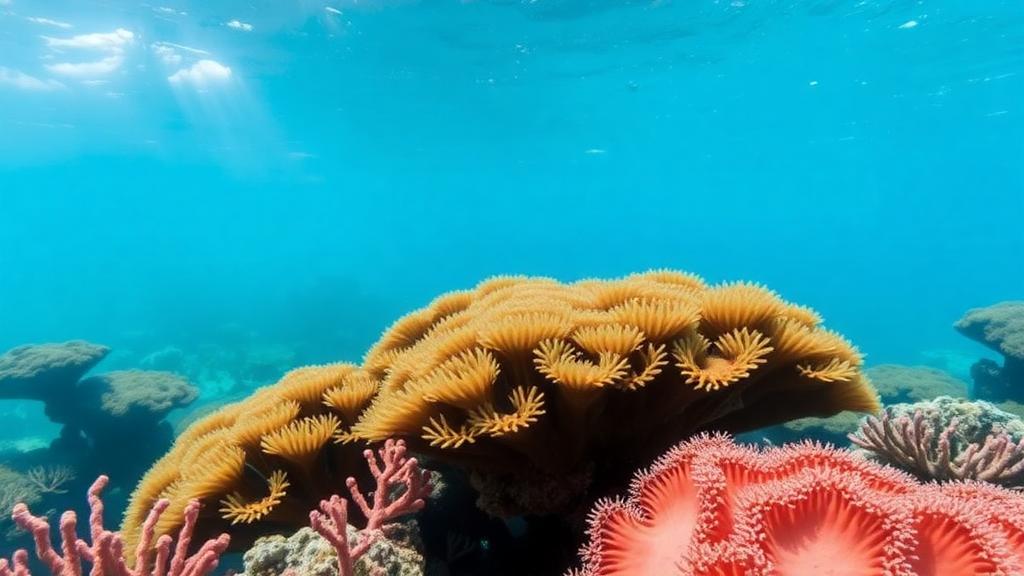
On the reefs of the Gulf of Panamá, two of the region’s most important reef-building corals keep their reproductive calendars in strikingly different ways, and a new long-term study has finally worked out what sets the timing. By combining decades of histological observations with satellite-derived climate data, researchers found that the annual migration of the Intertropical Convergence Zone, the great band of low pressure and heavy rain that sweeps across the equatorial eastern Pacific, effectively orchestrates when these corals make gametes. The work, published in Discover Oceans, is the first in a series examining how local environmental conditions shape the sexual reproduction of corals across this under-studied corner of the ocean.
The study focused on two species with very different biologies. Pavona gigantea is a hermaphroditic, massive coral that contributes substantially to reef frameworks across the eastern Pacific, while Psammocora stellata is a small, nodular, free-living species with separate male and female colonies. Both are broadcast spawners, releasing gametes into the water column, and both had previously been shown to reproduce over extended periods, an anomaly among corals that is often attributed to their equatorial position. What remained unclear was which environmental signals actually govern the initiation and cessation of gamete development in a region where the climate swings between a cool, windy upwelling season and a warm, wet season.
To answer that question, the team drew on gametogenesis records collected between 1985 and 1993 from colonies at Taboga and Saboga Islands in the Gulf of Panamá, part of a monitoring program begun after the catastrophic 1982–83 El Niño bleaching event devastated eastern Pacific reefs. Coral fragments collected by scuba were fixed, decalcified, stained and examined under a compound microscope to detect the presence of male or female gametes at any stage of development. Monthly percentages of reproductive samples were then regressed against a suite of environmental variables: reef temperature, precipitation, cloud cover, wind speed, wind direction, photosynthetically active radiation (PAR), insolation and photoperiod, using generalized linear mixed models and a principal component analysis to handle the strong correlations among these factors.
The results reveal two species marching to different drummers. Pavona produced gametes from January through August, with peak activity between May and August, and its reproduction was most strongly associated with photoperiod and the rate of temperature change. Psammocora, by contrast, bred from May to December and showed a strong association with nearly every warm-wet season variable tested, with sea temperature and insolation exerting the strongest statistical effects. Critically, all reproductive samples of Psammocora appeared only once mean monthly reef temperature had reached 27.8 degrees Celsius, suggesting a clear thermal threshold for this species, whereas Pavona tolerated a much broader temperature range and even produced gametes at low frequency during the coolest months.
Perhaps the most surprising finding concerns light. Coral gametogenesis in both species was negatively associated with PAR and positively associated with cloud cover, implying that excessive solar radiation, rather than its absence, may limit reproduction in this equatorial setting. PAR values in the Gulf of Panamá peaked at roughly 108 to 118 watts per square meter during the upwelling season, when skies are clear and reproductive activity is minimal, while the greatest reproductive activity occurred when PAR had fallen to between 88 and 97 watts per square meter under thick wet-season cloud. The authors suggest that heavy cloud cover may shield the corals’ symbiotic algae from damaging radiation near the equator, where photoinhibition is a real risk, and note that on-reef light measurements will be needed to confirm this interpretation.
Wind emerged as another key player, both through its speed and its direction. Most Pavona colonies carried gametes only when mean monthly wind speeds dropped to around 5 meters per second or below, and reproduction in both species surged as the strong northerly trade winds that drive seasonal upwelling relaxed in April and May. Wind direction proved an even better predictor than speed: when winds blew steadily from the north during the cool season, reproduction was nominal in Pavona and absent in Psammocora, but as winds swung away from north in May, gamete production began. A later shift toward westerly and southwesterly winds in August and September coincided with the end of Pavona’s breeding season, while Psammocora continued until winds returned to the north in January.
Overlaying all the environmental curves revealed something remarkable: nearly every factor the team measured, including temperature, precipitation, cloud cover, wind speed, insolation and PAR, converges at a critical transition in mid-April, just after the March equinox, when the Intertropical Convergence Zone moves in and the dry season gives way to the wet. A second, looser convergence occurs in November and December as conditions swing back. The researchers describe these intersections as reproductive ‘sweet spots’ that predict when gamete development starts, accelerates or stops. Psammocora’s entire breeding season fits neatly between the two transitions, while Pavona initiates gametogenesis at the second transition into the dry season, when rising insolation appears to matter more than falling temperature.
The study also highlights how these corals manage to reproduce at all in such a marginal habitat. Unusually cold water during upwelling, sometimes dipping below 20 degrees Celsius, suppresses reproduction and can even threaten survival, yet Pavona appears better equipped to cope, possibly by feeding on the plankton blooms that upwelling generates with its large polyps and extensible tentacles. Psammocora, with its small polyps, may compensate through a fast, opportunistic strategy, producing gametes rapidly throughout the warm season and maintaining abundant populations across varied habitats. Neither species produces buoyant egg-sperm bundles like corals elsewhere, an adaptation the authors suggest may protect fertilization success from the sudden salinity drops caused by intense seasonal rainfall.
Why does this matter now? Understanding the timing and environmental triggers of coral sexual reproduction is essential for predicting how reefs can recover from bleaching and mortality events, and for designing rehabilitation and conservation programs that work with, rather than against, natural reproductive rhythms. Eastern Pacific corals have already endured repeated El Niño-driven catastrophes, and their populations remain small and vulnerable. As ocean warming accelerates a global reef decline, knowing which species can breed under which conditions, and when, offers a practical tool for restoration planning. The authors argue that seasonal transitions, those ‘sweet spots’ where the region’s climate pivots, provide a usable predictor of reproductive activity that managers can apply directly. Future papers in the series will extend this approach to other equatorial eastern Pacific sites, helping to identify which coral species are most resilient to the thermal extremes and ENSO-driven variability that define life on these remarkable, and imperiled, reefs.
Subject of Research: Environmental drivers of coral reproductive phenology in the equatorial eastern Pacific
Article Title: Environmental conditions and Equatorial Eastern Pacific coral reproductive phenology in the Gulf of Panamá (Pavona gigantea and Psammocora stellata)
Article References: Colley, S. B., Maté, J. L., Danos, D., & Glynn, P. W. (2026). Environmental conditions and Equatorial Eastern Pacific coral reproductive phenology in the Gulf of Panamá (Pavona gigantea and Psammocora stellata). Discover Oceans, 3(1), Article 26. https://doi.org/10.1007/s44289-026-00122-8
Image Credits: AI Generated
DOI: 10.1007/s44289-026-00122-8
Keywords: coral reproduction, gametogenesis, Gulf of Panamá, Intertropical Convergence Zone, Pavona gigantea, Psammocora stellata, upwelling, photoperiod, PAR, sea temperature, coral reefs, eastern Pacific
Cite Scienmag News
Violet Maxwell. (October 2, 2026). Clouds, Winds and Warm Water Set the Clock for Coral Breeding in Panama. Scienmag. https://scienmag.com/clouds-winds-and-warm-water-set-the-clock-for-coral-breeding-in-panama/
Violet Maxwell. "Clouds, Winds and Warm Water Set the Clock for Coral Breeding in Panama." Scienmag, 2 October 2026, https://scienmag.com/clouds-winds-and-warm-water-set-the-clock-for-coral-breeding-in-panama/. Accessed 2 October 2026.
Violet Maxwell. "Clouds, Winds and Warm Water Set the Clock for Coral Breeding in Panama." Scienmag. October 2, 2026. https://scienmag.com/clouds-winds-and-warm-water-set-the-clock-for-coral-breeding-in-panama/


