


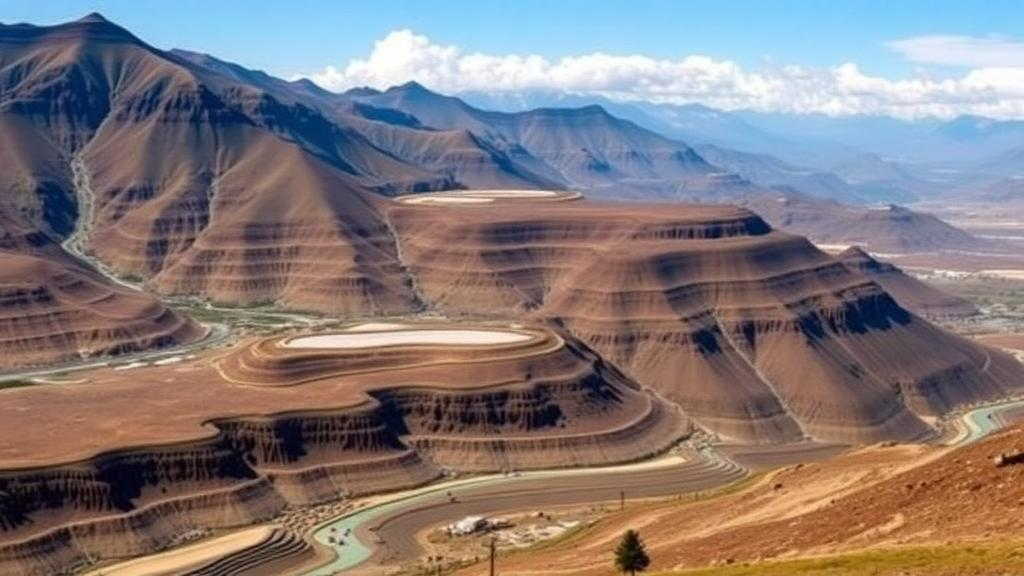
High on the Tibetan Plateau, the fate of billions of people downstream is being decided by a quiet competition between two forces: how much water the sky delivers, and how hard the atmosphere pulls moisture back out of the land. A new study published in Climate Dynamics by Libin Huang of the China University of Geosciences and colleagues maps that competition in unprecedented detail, and its results carry a stark warning. Under a moderate emissions pathway, the plateau’s climate may stay roughly in balance through the end of the century. Under a high-emissions pathway, the atmosphere’s growing thirst overwhelms the extra rain, and the region dries out dramatically. Which future materializes depends, quite literally, on the choices made now about greenhouse gas emissions.
The team approached the problem through the aridity index, a standard metric defined as the ratio of precipitation to potential evapotranspiration, the amount of water the atmosphere would evaporate from soil and vegetation if water were freely available. When precipitation rises faster than evaporative demand, the index climbs and the climate grows wetter; when demand outpaces supply, the index falls and aridity deepens. Because the index blends both sides of the water balance, it is a sensitive barometer of how warming reshapes regional climates. The researchers computed it across the plateau using the ERA5 reanalysis from the European Centre for Medium-Range Weather Forecasts for the historical period 1979 to 2023, and then turned to the future with bias-corrected simulations from the REMO regional climate model, driven by three different global climate models under the Representative Concentration Pathways RCP2.6 and RCP8.5.
The historical record reveals a plateau in transition, but not uniformly so. Between 1979 and 2023, roughly 60 percent of the Tibetan Plateau became wetter, with the most pronounced wetting concentrated in the relatively dry western regions. That finding aligns with a broader picture of the so-called Asian water tower growing warmer and wetter in recent decades, a trend documented in lake expansion, glacier mass changes, and vegetation greening. Yet the study also shows that the wetting story is incomplete. Parts of the humid southeastern plateau have actually been drying, a reminder that regional trends within a single mountain system can run in opposite directions depending on local moisture supply and energy balance.
One of the most striking results is the elevation dependence of these trends. Below about 4.5 kilometers, drying signals weakened over the historical period, while above that threshold, wetting strengthened. Elevation-dependent climate change is a well-documented phenomenon in mountain regions, with warming rates often amplified at high altitudes, and previous work has suggested elevation-dependent aridification in many of the world’s high mountains after the 1970s. The new analysis adds nuance: on the Tibetan Plateau, the elevation at which the aridity balance tips sits near 4.5 kilometers, and the direction of change on either side of that line has been diverging for decades. For ecosystems and water managers, that means a single plateau-wide forecast conceals fundamentally different trajectories for valley communities and high-altitude permafrost zones.
To understand why aridity changed where it did, the researchers decomposed the trends into their climatic drivers. The verdict was lopsided: precipitation dominated the aridity index changes across 71 percent of the plateau, and it was the engine of the wetting in the west. But in the east-central plateau, a different mechanism took over. There, increases in surface net radiation and surface air temperature, the two main ingredients of potential evapotranspiration, contributed substantially to drying. In other words, the east-central plateau is not drying because less rain falls, but because a warmer, more energy-rich atmosphere extracts more of the water that does arrive. This distinction matters enormously for drought prediction, because temperature-driven drying can proceed even while precipitation holds steady or increases.
When the team projected the future, the two emissions scenarios told sharply different stories. Under RCP2.6, the moderate pathway roughly consistent with the Paris Agreement’s ambitions, the plateau’s aridity index shows little net change overall, even though precipitation increases. Under RCP8.5, the high-emissions pathway, the plateau dries out pronouncedly despite also receiving more precipitation. That paradox, more rain but a drier climate, is the signature of runaway evaporative demand. Warming raises potential evapotranspiration through higher temperatures, longer growing seasons of atmospheric thirst, and increased radiative forcing, and under strong warming those effects grow faster than the moisture supply can keep pace. The study’s central conclusion is that future plateau aridity is governed by a scenario-dependent competition between moisture supply and evaporative demand, and stronger warming shifts the balance decisively toward demand-side control.
The scenario divergence deepens over time. Under RCP2.6, the contributions of precipitation and potential evapotranspiration are nearly balanced by the mid-twenty-first century, but by the late century precipitation becomes the dominant control over 58.1 percent of the plateau, meaning the wetting signal reasserts itself once warming stabilizes. Under RCP8.5, the opposite happens: the dominance of potential evapotranspiration strengthens with every passing decade and expands to cover 67.8 percent of the plateau by the late twenty-first century. The high-emissions future is one in which the atmosphere’s evaporative pull, not the rain gauge, dictates the plateau’s water balance across most of its area. For a region that feeds the headwaters of the Indus, the Ganges, the Brahmaputra, the Yangtze, and the Yellow River, that shift would ripple through the hydrology of an entire continent.
Elevation, too, becomes scenario-dependent by century’s end. The historical pattern, in which high-altitude zones were wetting while lower elevations trended toward drying, does not simply continue. Under RCP2.6, drying at high elevations is alleviated in the late twenty-first century, consistent with the restored dominance of precipitation. Under RCP8.5, high-elevation drying intensifies, as the amplified warming that characterizes mountain summits supercharges evaporative demand where the water balance is most fragile. This is particularly consequential because the highest elevations host permafrost, glaciers, and alpine ecosystems that store and release water on timescales critical to downstream users. Intensified aridification there would compound the well-documented imbalance of the Asian water tower, accelerating permafrost degradation and altering the seasonal timing of runoff.
The methodological choices behind these findings deserve attention. The researchers used the REMO regional climate model from the CORDEX-East Asia Phase II framework, dynamically downscaling three global models, and applied bias correction to the driving data, a step essential for aridity work because the aridity index is a ratio of two quantities that models simulate with different levels of skill. They validated the historical simulations against station observations from the China Meteorological Administration and against independent gridded datasets, including the High Asia Refined Analysis version 2 and the China Meteorological Forcing Dataset. The decomposition of aridity trends into contributions from individual climatic variables follows a framework widely used in global dryland research, which has shown that rising potential evapotranspiration increasingly weakens the effect of precipitation on aridity in drylands worldwide.
What emerges is a picture of the Tibetan Plateau at a hydrological crossroads. The historical era of widespread wetting, driven largely by increasing precipitation, is not a guarantee of the future. If emissions follow the moderate pathway, the plateau’s extra rain can keep pace with warming, and precipitation will remain the dominant arbiter of wet and dry across most of the region. If emissions continue along the high pathway, the same warming that once accompanied abundant rain becomes the dominant force, and the plateau dries even as it rains more. The study’s authors frame this as a scenario-dependent competition between moisture supply and evaporative demand, but the practical translation is simpler: the difference between two emissions futures is the difference between a water tower that holds and one that leaks, for the glaciers, grasslands, and rivers on which nearly two billion people depend.
Subject of Research: Historical and projected changes in aridity and their climatic drivers on the Tibetan Plateau
Article Title: Historical and future changes in Tibetan Plateau aridity and their scenario-dependent climatic controls
Article References: Huang, L., Li, P., Zhang, J., Mao, Y., Chen, X., Hu, X., & Niu, X. (2026). Historical and future changes in Tibetan Plateau aridity and their scenario-dependent climatic controls. Climate Dynamics, 64(10), Article 413. https://doi.org/10.1007/s00382-026-08368-w
Image Credits: AI Generated
DOI: 10.1007/s00382-026-08368-w
Keywords: Tibetan Plateau, aridity index, potential evapotranspiration, precipitation, climate change, RCP2.6, RCP8.5, CORDEX-East Asia, REMO regional climate model, elevation-dependent warming, drought, Asian water tower
Cite Scienmag News
Sloane Callahan. (October 2, 2026). The Tibetan Plateau’s Water Future Hinges on a Warming Tug-of-War Between Rain and Thirst. Scienmag. https://scienmag.com/the-tibetan-plateaus-water-future-hinges-on-a-warming-tug-of-war-between-rain-and-thirst/
Sloane Callahan. "The Tibetan Plateau’s Water Future Hinges on a Warming Tug-of-War Between Rain and Thirst." Scienmag, 2 October 2026, https://scienmag.com/the-tibetan-plateaus-water-future-hinges-on-a-warming-tug-of-war-between-rain-and-thirst/. Accessed 2 October 2026.
Sloane Callahan. "The Tibetan Plateau’s Water Future Hinges on a Warming Tug-of-War Between Rain and Thirst." Scienmag. October 2, 2026. https://scienmag.com/the-tibetan-plateaus-water-future-hinges-on-a-warming-tug-of-war-between-rain-and-thirst/


