


Marine heatwaves have become one of the most destructive forces acting on the world’s coral reefs, bleaching entire reef systems ghostly white and, in the worst cases, killing corals outright. Restoration of dead reefs is possible, but it is difficult, expensive, and the corals that are replanted remain vulnerable to the very heatwaves that killed their predecessors. Now, a study published in Frontiers in Marine Science offers a strikingly simple proof of concept: umbrella-like shades, anchored to the seabed above individual coral colonies, can mitigate and even partly reverse bleaching driven by extreme water temperatures. The research, led by Dr Karen Neely of Nova Southeastern University, focused on especially vulnerable Caribbean corals in the Florida Keys and suggests that targeted, small-scale interventions could buy precious time for corals that would otherwise be lost.
The science behind the approach rests on the way light and heat interact to damage corals. Shading cannot cool the water itself, but it prevents damage from ultraviolet radiation and excessive irradiance, both of which make heat stress substantially worse for the corals’ biology. Corals live in a symbiotic relationship with microscopic algae housed inside their tissues. The coral provides the algae with shelter, and the algae, in turn, supply the coral with most of its nutritional needs through photosynthesis. These algae also lend corals their color. When water temperatures climb too high, that symbiosis breaks down, the algae are expelled, and the coral turns white, a condition known as bleaching. A bleached coral is effectively starving, and prolonged bleaching leads to mortality. By cutting the light reaching the coral, the shades reduce the photosynthetic burden on the algae and lessen the oxidative stress that drives the breakdown of the partnership.
The motivation for the study came directly from disaster. The 2023 coral bleaching event in Florida essentially wiped out branching corals, and at some inshore sites it had a devastating impact on brain corals as well. Neely and her team wanted to provide proof of concept for tools that could save targeted corals in similar future events. As she explained, heat-related coral bleaching is probably the biggest threat to reefs worldwide, and addressing climate change remains essential for reefs to survive in any recognizable form. Solutions like shading, however, can offer temporary protection on small scales, acting as an emergency measure for individual colonies of high value while the larger problem of global warming is confronted.
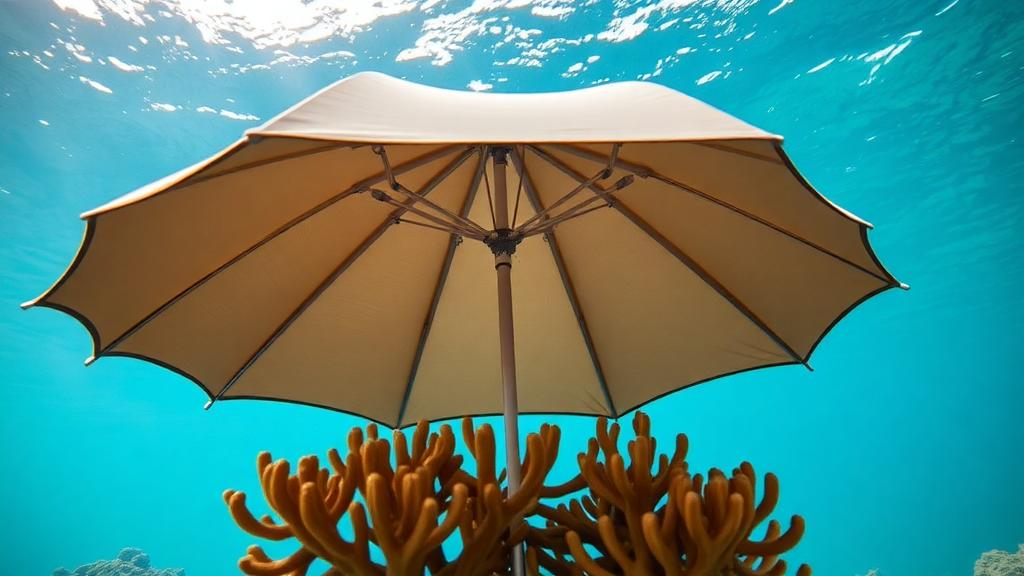
In the summer of 2024, the researchers put the concept to the test at Newfound Harbor in the Florida Keys. They set up 20 custom-made shades over 10 different colonies of two species of brain coral, Pseudodiploria clivosa and Colpophyllia natans. They also selected 20 matching corals to act as controls, allowing direct comparison between shaded and unshaded colonies under identical environmental conditions. The umbrella-like structures were built from pipes with nylon cloths attached, temporarily fixed to the seabed with cord, and floated 30 centimeters above each shaded coral. The design reduced incoming light by 60 percent, a substantial reduction that still left enough illumination for the corals’ symbiotic algae to function.
Monitoring was carried out by divers who visited the site every two weeks throughout the heatwave. At each visit, they tracked color changes in the coral colonies and took tissue biopsies to monitor the algae living inside the corals’ tissues. This combination of visual assessment and biological sampling allowed the team to measure not just whether the corals looked bleached, but what was happening at the level of the symbiont populations that sustain them. The repeated sampling design meant the researchers could follow the trajectory of bleaching and recovery through the entire period of thermal stress, rather than relying on a single before-and-after comparison.
The results were encouraging, though nuanced. Although the heat stress measured at Newfound Harbor that summer was the second-highest on record, the shaded corals lost less color than expected, and the differences between shaded and control colonies were greatest during the most intense periods of thermal stress. Remarkably, shaded corals even recovered some of their color after the shades were installed, indicating that the intervention did not merely slow the onset of bleaching but actively helped corals regain their algal partners and their pigmentation. In other words, the shades reversed observed bleaching rather than simply delaying it.
There was, however, an unexpected complication in interpreting the full magnitude of the effect. Neely and her team saw less bleaching than they anticipated overall, and no coral died during the study period, in either the shaded or the control group. One plausible explanation lies in the legacy of the previous year’s record heatwave. Because of the 2023 event, most of the corals at the site were occupied by an algae called Durusdinium, a symbiont type that is very heat-tolerant but is associated with lower coral growth and possibly greater susceptibility to disease. Corals hosting these heat-resistant algae are inherently more resilient to subsequent thermal stress, which may have cushioned both the shaded and control colonies against the worst effects of the 2024 heatwave.
The study also encountered practical constraints that likely dampened the measured difference between treatments. There were no differences in the density of algae occupation or in algae species between the control and shaded groups, but this may have been influenced by where the samples were taken. The team’s permits stipulated sampling from the corals’ edges, which are less exposed to light and experience less bleaching than the more sun-exposed surfaces. That means even the samples from the control corals received some degree of natural shade, blurring the contrast between the two groups. In addition, the same permit constraints meant the scientists could not install the shades until well after the water temperature had risen high enough to bleach coral. Had the shades been deployed earlier, before the thermal stress peaked, they might have been considerably more effective. Even so, a significant positive impact was still detectable.
Neely is candid about the limits of the technique. Scaling is the big limitation of the study, she notes, and shading is not a cure-all for coral reefs. Deploying shades across meaningful areas would require hard decisions about which corals are worth saving, a triage question that conservation managers will increasingly face as heatwaves intensify. The researchers found the method effective on two highly susceptible coral species, which suggests it is likely to be useful for most others, but additional studies would be needed to confirm that broader applicability. It is also likely that thermal stress would eventually reach a point at which no amount of shading could help a coral, and only future experimentation will be able to define the bounds of that threshold. The approach, in other words, is an emergency tool with defined limits, not a substitute for emissions reductions.
Even bleaching that does not cause mortality can have lasting consequences, affecting corals’ future disease susceptibility and reproductive capacity. Neely suggests it would be interesting to quantify whether, and to what extent, the shade structures benefited the corals after their removal, by tracking disease incidence and reproductive output in the seasons that followed. Such follow-up work could reveal whether the temporary protection conferred by shading translates into long-term fitness advantages for the treated colonies. For now, the study stands as a proof of concept born from crisis: when the 2023 bleaching event devastated Florida’s reefs, researchers responded by engineering a low-tech, reversible intervention that demonstrably reduced paling under the second-highest heat stress on record. As marine heatwaves grow more frequent and more severe, underwater umbrellas may become part of a growing toolkit of targeted interventions, offering vulnerable corals a fighting chance while the world works on the far larger challenge of stabilizing the climate they depend on.
Subject of Research: In situ shading to reduce heatwave-induced bleaching in Caribbean corals
Article Title: Underwater umbrellas for coral reefs could help protect against heat damage, study finds
Article References: Underwater umbrellas for coral reefs could help protect against heat damage, study finds. (n.d.). Original publication
Image Credits: AI Generated
DOI: Not provided
Keywords: coral reefs, coral bleaching, marine heatwaves, Florida Keys, symbiotic algae, Durusdinium, Pseudodiploria clivosa, Colpophyllia natans, shading intervention, climate change, Frontiers in Marine Science, reef conservation
Cite Scienmag News
Ophelia Keating. (October 2, 2026). Underwater Umbrella Shades Shield Vulnerable Corals From Deadly Heat Stress. Scienmag. https://scienmag.com/underwater-umbrella-shades-shield-vulnerable-corals-from-deadly-heat-stress/
Ophelia Keating. "Underwater Umbrella Shades Shield Vulnerable Corals From Deadly Heat Stress." Scienmag, 2 October 2026, https://scienmag.com/underwater-umbrella-shades-shield-vulnerable-corals-from-deadly-heat-stress/. Accessed 2 October 2026.
Ophelia Keating. "Underwater Umbrella Shades Shield Vulnerable Corals From Deadly Heat Stress." Scienmag. October 2, 2026. https://scienmag.com/underwater-umbrella-shades-shield-vulnerable-corals-from-deadly-heat-stress/


