


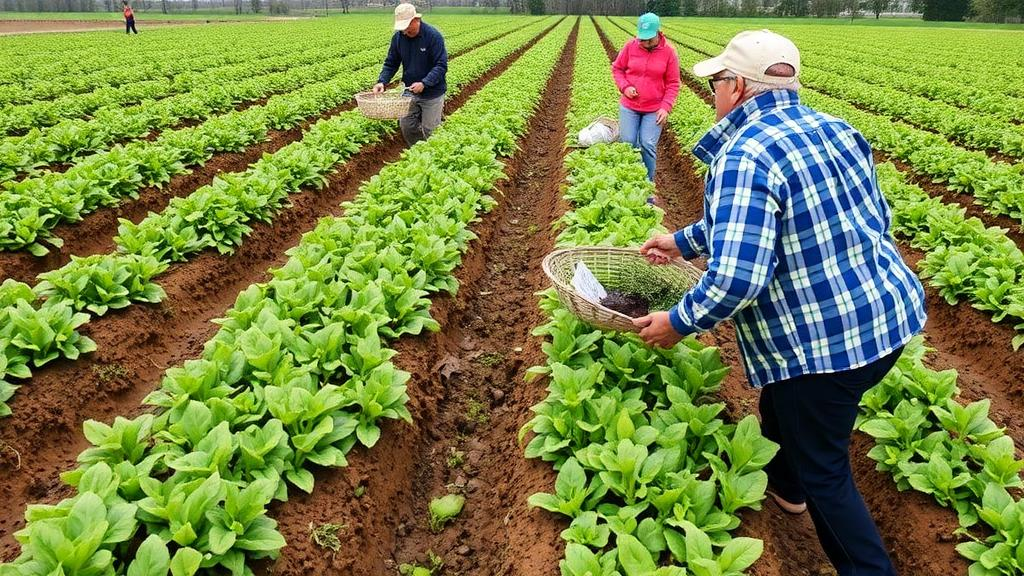
When climate change arrives at the farm gate, it arrives as weather: hotter growing seasons, longer dry spells, heavier storms. But the decision to respond to those shocks is made inside the human mind, and that is where a new study from the University of Florida turns its attention. In research published in Discover Sustainability, Yong Liu and Jorge Ruiz-Menjivar set out to answer a deceptively simple question: which psychological theory best explains why farmers in the southern United States choose to adapt to climate change? Their findings carry practical weight for anyone designing the agricultural adaptation programs that governments and extension services increasingly depend on.
The study is built around a direct empirical contest between two of the most widely used frameworks in environmental behavior research. The first is the theory of planned behavior, or TPB, which holds that a person’s intention to act is driven by three forces: attitudes toward the behavior, perceived social pressure from norms, and perceived behavioral control, often operationalized as self-efficacy. The second contender is protection motivation theory, or PMT, which frames behavior as a response to threat: people act when they perceive a hazard as severe and likely, believe the recommended action will work, and feel capable of carrying it out. Both theories have long pedigrees and large literatures, but they are rarely tested against each other on the same dataset, in the same population, with the same statistical machinery.
To run that comparison, the researchers surveyed field crop farmers across the southern United States between May and December 2022, collecting data from 69 respondents. The sample size is modest, and the authors are transparent about the statistical implications, reporting minimum sample size requirements for each modeled path under different significance levels and statistical power assumptions. What the study lacks in breadth it attempts to make up for in methodological rigor. The team employed weighted partial least squares structural equation modeling, abbreviated WPLS-SEM, a technique that allows researchers to assess not only how well a model explains the variation in observed outcomes but also how well it predicts them, a distinction that is increasingly emphasized in behavioral science.
A second design choice gives the study much of its novelty. Rather than treating climate adaptation as a single undifferentiated behavior, Liu and Ruiz-Menjivar split it into two categories: incremental adaptation and transformative adaptation. Incremental strategies are the adjustments most farmers already recognize, such as altering planting dates, switching crop varieties, or tweaking irrigation schedules within an existing production system. Transformative strategies go further, fundamentally restructuring the farm itself, potentially changing what is produced, how land is used, or whether farming continues in its current form at all. The distinction matters because the psychological levers that nudge a farmer toward a small adjustment may be entirely different from those required for a wholesale reinvention of the enterprise.
The results of the head-to-head comparison were clear on one front. Both frameworks demonstrated strong explanatory power for farmers’ intentions to adopt incremental adaptations, with the TPB model accounting for roughly 70.6 percent of the variance in intention and the PMT model accounting for 67.1 percent. In the TPB framework, attitudes, norms, and self-efficacy emerged as strong predictors of incremental adaptation intentions and behaviors. In practical terms, this means that farmers who view adaptation positively, who perceive that people around them expect or endorse it, and who believe in their own capacity to carry it out are substantially more likely to intend to act and to follow through. The TPB edged out PMT in explanatory power, suggesting that for incremental changes, the social and attitudinal architecture of decision-making may matter as much as, or more than, the perception of climate threat itself.
That last point deserves emphasis, because it cuts against a common intuition in climate communication. Protection motivation theory assumes that threat appraisal, the perceived severity and likelihood of harm, is a central engine of protective behavior. Yet in this study the threat-centered framework performed slightly worse than the attitude-and-norms framework for incremental adaptation. If the finding generalizes, it implies that simply amplifying messages about climate danger may be a less effective route to changing farmer behavior than building confidence, cultivating supportive social norms, and framing adaptation as a positive and feasible step. For extension agents and program designers, the leverage may lie in demonstration, peer networks, and skills training rather than in alarm.
The picture changes, however, when the analysis turns to transformative adaptation. Here, both the TPB and PMT models showed limited predictive power, meaning the psychological variables measured in the survey did not reliably explain which farmers intended to pursue or undertake fundamental changes to their operations. The authors interpret this as a signal that transformative adaptation may not be governed primarily by individual-level cognition. Decisions of that magnitude are likely entangled with financial constraints, land tenure, market structures, policy environments, and household circumstances, factors that sit outside the scope of both classic behavioral models. A farmer’s belief in their own efficacy may matter little if the economic system around them makes transformation prohibitively risky.
This is where the study connects to a broader intellectual agenda. Liu and Ruiz-Menjivar frame their work as a contribution to the psychology of sustainability and sustainable development, a field that seeks to understand the mental and social drivers of pro-environmental behavior. Their central argument is that individual-level behavioral models, however well validated, need to be integrated with systemic perspectives to fully understand and support transformative adaptation in agriculture. The finding that two decades-old theories excel at explaining small adjustments but falter at explaining structural change is itself an important result. It maps the boundary conditions of the psychological toolkit and points researchers toward hybrid models that combine cognition with economics, institutions, and social structure.
The research also has concrete implications for the formulation and design of future climate adaptation programs in agriculture, which the authors discuss explicitly. If attitudes, norms, and self-efficacy are the strongest levers for incremental adaptation, programs targeting those everyday adjustments should invest in building farmers’ confidence through hands-on training, showcasing successful peers to shift perceived norms, and framing adaptive practices in terms that resonate with farmers’ existing values. Conversely, programs aiming at transformative change should not assume that persuasion alone will suffice; they will likely need to address the structural barriers, from credit access to insurance design, that individual psychology cannot overcome. The study’s regional focus on the southern United States, a region exposed to hurricanes, heat, and variable rainfall, makes these lessons immediately relevant to a significant share of American row-crop production.
Caveats remain, and the authors do not hide them. With 69 respondents, the study is a focused empirical test rather than a definitive national verdict, and the survey was conducted with field crop farmers in a single region during a specific window in 2022. The use of WPLS-SEM partially mitigates concerns about sample size by emphasizing predictive validity, and the authors report the statistical power requirements for their modeled paths, but replication with larger and more diverse samples will be needed before the TPB’s narrow victory can be treated as settled. Still, the study’s core contribution stands: it subjects two dominant theories to a fair fight on the same data, splits adaptation into increments and transformations, and shows exactly where psychological models shine and where they run out of explanatory road. As climate pressures intensify across agricultural landscapes, knowing which levers actually move farmer decisions, and which require deeper structural change, may prove as valuable as any new drought-tolerant seed.
Subject of Research: Psychological determinants of farmers' climate change adaptation decisions in the southern United States
Article Title: Exploring farmers’ climate change adaptation decisions in the Southern United States through an empirical comparison of the theory of planned behavior and protection motivation theory
Article References: Liu, Y., & Ruiz-Menjivar, J. (2026). Exploring farmers’ climate change adaptation decisions in the Southern United States through an empirical comparison of the theory of planned behavior and protection motivation theory. Discover Sustainability. https://doi.org/10.1007/s43621-026-04363-7
Image Credits: AI Generated
DOI: 10.1007/s43621-026-04363-7
Keywords: climate change adaptation, theory of planned behavior, protection motivation theory, farmers, agriculture, decision-making, environmental psychology, structural equation modeling, incremental adaptation, transformative adaptation, southern United States, sustainability
Cite Scienmag News
Sloane Callahan. (October 2, 2026). What Really Makes Farmers Adapt to Climate Change? Two Classic Theories Go Head to Head. Scienmag. https://scienmag.com/what-really-makes-farmers-adapt-to-climate-change-two-classic-theories-go-head-to-head/
Sloane Callahan. "What Really Makes Farmers Adapt to Climate Change? Two Classic Theories Go Head to Head." Scienmag, 2 October 2026, https://scienmag.com/what-really-makes-farmers-adapt-to-climate-change-two-classic-theories-go-head-to-head/. Accessed 2 October 2026.
Sloane Callahan. "What Really Makes Farmers Adapt to Climate Change? Two Classic Theories Go Head to Head." Scienmag. October 2, 2026. https://scienmag.com/what-really-makes-farmers-adapt-to-climate-change-two-classic-theories-go-head-to-head/


