


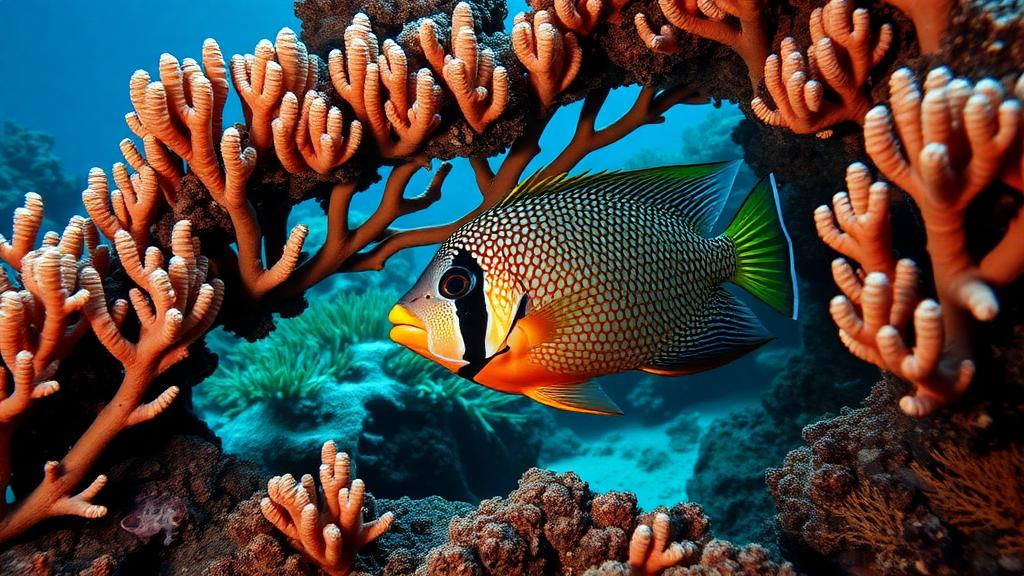
Along a stretch of Mexico’s Pacific coast where coral reefs survive at the very edge of what tropical seas can offer them, scientists have uncovered a surprisingly nuanced relationship between the architecture of the seafloor and the ecological roles that fish play. A new study of reef systems in the Mexican Tropical Pacific, published in Discover Ecology, shows that the type of coral development beneath the waves—whether scattered coral colonies on rocky reefs or dense, monospecific coral patches—leaves a measurable imprint on how many fish live there, how much they weigh, and, most importantly, what functions they perform in the ecosystem. The findings arrive at a critical moment, as repeated bleaching events and mass coral mortality continue to erode these already marginal reef habitats.
The research team, led by Ubaldo Jarquín-Martínez and Fabián A. Rodríguez-Zaragoza of the University of Guadalajara, focused on the southern coast of Jalisco, a region where reefs exist under conditions that would defeat most coral ecosystems elsewhere in the world. Upwelling and cold currents keep water temperatures below the optimum for coral growth, river mouths deliver heavy sediment loads, and the El Niño Southern Oscillation periodically triggers bleaching and widespread coral death. As a result, the reefs of the Mexican Tropical Pacific are smaller and less diverse than their Caribbean and Indo-Pacific counterparts, dominated overwhelmingly by branching corals of the genus Pocillopora, with lesser contributions from Porites and Pavona. Yet these hardy ecosystems harbor a remarkable diversity of fish, and the researchers suspected that the structural complexity of the habitat might be the key to understanding why.
To test this idea, the team compared two fundamentally different coral ecosystems. Coral communities are rocky reefs dotted with isolated coral colonies, each no larger than five square meters, interspersed with algae, sand, sponges, and rock. Coral patches, by contrast, are pavement-like, low-relief structures built almost entirely by a single clade of Pocillopora, with calcareous aggregates that can exceed 500 square meters. The researchers surveyed six sites in September 2019—four coral communities and two coral patches—using underwater visual censuses along 100-square-meter belt transects at depths of three to twelve meters. In total, they recorded 57 fish species and 4,724 individuals, estimating species richness, abundance, and biomass for every transect, while also measuring coral cover, the coverage of other benthic groups, and topographic complexity using the classic chain-link method.
What sets this study apart is its focus on functional diversity rather than species counts alone. Functional diversity measures the variety of ecological roles that organisms perform—what they eat, where they live in the water column, how big they grow, whether they school or roam solo, and when they are active. The team characterized each species using six traits spanning life history, trophic ecology, and habitat use, then built a four-dimensional functional space through a principal coordinate analysis. Within this space, they calculated three alpha diversity indices: functional richness, which captures how much of the functional space an assemblage occupies; functional divergence, which reflects how abundances are distributed toward specialized trait values; and functional evenness, which describes how evenly biomass is spread across functional roles. They also partitioned beta functional diversity—the differences between assemblages—into turnover and nestedness components.
The results revealed a clear pattern. Sites with coral communities consistently showed higher species richness, abundance, biomass, and functional diversity, particularly functional richness and functional divergence. El Estrechito, a coral community site, topped the charts with 41 species and the highest functional richness value of 0.23, while Tenacatita, a coral patch, recorded the lowest functional richness at just 0.033. Permutational analysis of variance confirmed that these differences were statistically significant both among sites within each condition and between the two conditions themselves. In other words, the heterogeneous, three-dimensional mosaic of a rocky reef studded with coral colonies supports a broader spectrum of ecological roles than the structurally flattened, monospecific coral patches.
Yet the story took an unexpected turn when the researchers examined beta functional diversity. Here, the coral patches came out ahead, displaying the highest values of total beta diversity and functional turnover. Tenacatita registered the highest beta functional diversity of any site at 0.9, and functional turnover—the replacement of functional roles between sites—was the dominant component of this differentiation. This suggests that although coral patches host fewer species and fewer functions locally, each patch contributes something functionally unique to the regional picture. Far from being biodiversity dead zones, these fragmented habitats appear to act as nodes of functional connectivity, exchanging distinct ecological roles across the seascape and thereby sustaining the overall resilience of the reef system.
The environmental analysis reinforced the structural interpretation. Using a BIOENV procedure to correlate diversity patterns with habitat variables, the team found that six benthic factors best explained the observed variation: the coverages of Pocillopora and Pavona corals, sponges, articulated calcareous algae, macroalgae, and topographic complexity. Sites rich in topographic complexity and Pavona cover, such as El Estrechito, aligned with high species richness and functional richness, while sites dominated by Pocillopora, like Tenacatita and El Paraíso, were associated with high beta diversity and functional nestedness. The physical explanation is rooted in coral growth form: the branching and submassive growth typical of Eastern Tropical Pacific corals tends to flatten the reef, reducing the three-dimensional nooks and crannies that medium and large fish need for shelter, while isolated colonies on rocky reefs create a patchwork of microhabitats that accommodates everything from tiny cryptic species to large schooling predators.
The study also highlights the role of environmental filtering in shaping these assemblages. The low functional richness observed at coral patch sites suggests that only species with traits tolerant of harsh conditions—upwelling, sedimentation, thermal stress, and wave exposure—persist there, creating functionally redundant communities where many species exploit the same narrow set of niches. High functional divergence values across both habitat types, meanwhile, indicate that abundant species with unique traits are present throughout the region, a sign that fish assemblages have evolved strategies to maximize the use of whatever resources each habitat offers. The contrast between Tenacatita, where high waves and shallow reef structures may force constant species displacement, and the sheltered El Paraíso, where stable conditions favor redundant traits, illustrates how fine-scale environmental variability sculpts functional composition.
The conservation implications are immediate and practical. Marine protected areas in Mexico have traditionally prioritized locations with high coral cover, but this study demonstrates that such a strategy would miss half the story. Coral communities are indispensable as reservoirs of local taxonomic and functional diversity, yet coral patches are equally essential as engines of regional functional connectivity through their high turnover. The authors point to Parque Nacional Huatulco as a model of how protecting areas that include both coral communities and small reefs can sustain diversity despite anthropogenic pressures. They recommend extending this dual-habitat approach across the Mexican Tropical Pacific and call for long-term monitoring programs that track changes in ecosystem structure and functionality using functional diversity as a management metric.
Looking ahead, the researchers argue that future work should explore functional connectivity between coral patches, rocky reefs, and coastal lagoons, evaluate the impacts of ongoing disturbances, and design marine protected areas that integrate taxonomic, functional, and phylogenetic diversity. In a region where El Niño events have already caused widespread bleaching and coral mortality, understanding which habitats safeguard which ecological functions is no longer an academic exercise—it is a blueprint for keeping these marginal but vital reefs alive. The message from Jalisco’s coast is clear: to conserve the full spectrum of life on a reef, one must conserve not just the corals that build it, but the varied architecture they create and the fragmented outposts that keep ecological roles circulating through the sea.
Subject of Research: The relationship between coral reef structural development and fish functional diversity in the Mexican Tropical Pacific
Article Title: Fish functional diversity and its relationship to coral reef development in the Mexican tropical Pacific
Article References: Fish functional diversity and its relationship to coral reef development in the Mexican tropical Pacific. (n.d.). https://doi.org/10.1007/s44396-025-00009-6
Image Credits: AI Generated
DOI: 10.1007/s44396-025-00009-6
Keywords: coral reefs, functional diversity, reef fish, Mexican Tropical Pacific, Pocillopora, structural complexity, beta diversity, coral communities, coral patches, marine conservation, ecosystem resilience, Jalisco
Cite Scienmag News
Gavin Prescott. (October 2, 2026). Hidden Coral Architecture Shapes the Functional Fate of Pacific Reef Fish. Scienmag. https://scienmag.com/hidden-coral-architecture-shapes-the-functional-fate-of-pacific-reef-fish/
Gavin Prescott. "Hidden Coral Architecture Shapes the Functional Fate of Pacific Reef Fish." Scienmag, 2 October 2026, https://scienmag.com/hidden-coral-architecture-shapes-the-functional-fate-of-pacific-reef-fish/. Accessed 2 October 2026.
Gavin Prescott. "Hidden Coral Architecture Shapes the Functional Fate of Pacific Reef Fish." Scienmag. October 2, 2026. https://scienmag.com/hidden-coral-architecture-shapes-the-functional-fate-of-pacific-reef-fish/


