


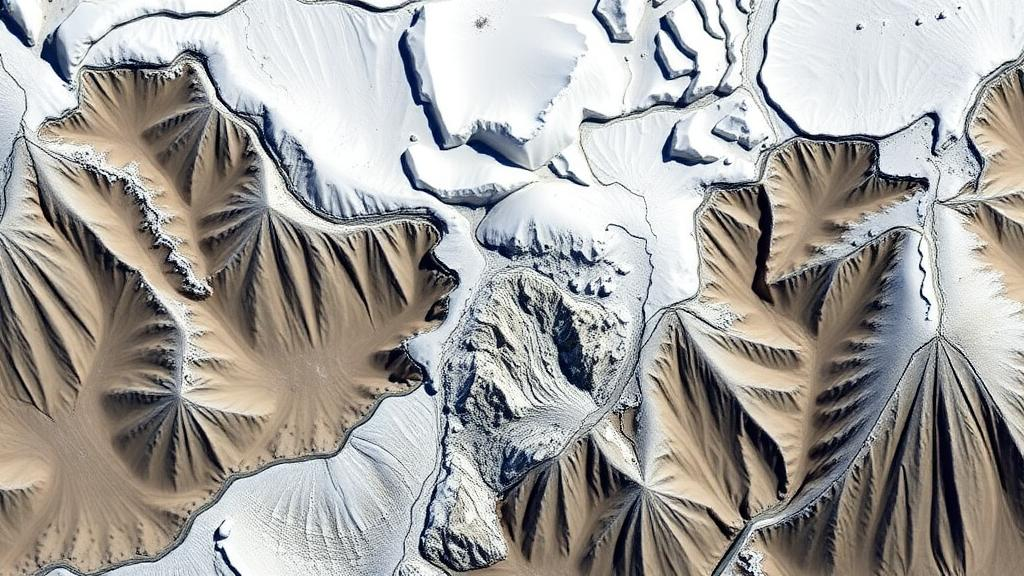
High in the Garhwal Himalaya, the glaciers that feed the Bhilangana River are melting faster than at any time in the past five decades, and a new study has now put hard numbers on that decline. By combining declassified Cold War-era spy satellite imagery with modern satellite stereo data, researchers have reconstructed the mass balance of six glaciers in the Bhilangana Valley from 1973 to 2025, producing the first comprehensive long-term geodetic assessment for this critically important sub-basin of the Bhagirathi River. The results show that glacier mass loss has not merely continued but accelerated dramatically, with some glaciers losing ice four to five times faster in the most recent decade than they did in the late twentieth century.
The research team, led by scientists at the Wadia Institute of Himalayan Geology with collaborators in the United Kingdom and the United States, focused on the six largest glaciers in the valley: Khatling, Phating, Dudhganga, Ratangariyan, Jogin and an unnamed lake-terminating glacier. Together these ice bodies cover roughly seventy-five percent of the valley’s total glacierised area and supply meltwater to the Bhilangana River, a major tributary of the Bhagirathi that ultimately sustains the Tehri Reservoir, India’s tallest hydropower dam at 2400 megawatts, along with downstream agriculture and communities. Understanding how these frozen reservoirs are changing is therefore not an abstract scientific exercise but a question of water security and hazard management for millions of people.
The technical achievement at the heart of the study lies in its use of declassified reconnaissance imagery. A Hexagon KH-9 satellite stereo image acquired on 24 November 1973, scanned at high resolution to yield a digital elevation model with roughly seven-metre ground resolution, provided the baseline against which all later measurements were compared. The researchers then differenced this historical surface model against the Shuttle Radar Topography Mission DEM from February 2000, eight-metre High Mountain Asia DEMs from 2014, and a newly generated ASTER DEM from November 2025 produced with the NASA Ames Stereo Pipeline. Careful co-registration over stable, non-glacierised terrain, polynomial correction of sensor-induced tilt, and an elevation-band-wise correction for radar penetration into snow and ice were applied to eliminate biases that could otherwise distort the thinning estimates.
Converting surface elevation change into mass balance required a further step: the team applied a constant ice density of 850 plus or minus 60 kilograms per cubic metre, the standard conversion for multi-annual periods, and quantified uncertainty using the normalised median absolute deviation over stable ground, a robust statistic that resists distortion by outliers. The result is a three-epoch picture of glacier health spanning 1973 to 2000, 2000 to 2014 and 2014 to 2025. Because ground-based mass balance measurements exist for only a few dozen Himalayan glaciers, such remotely sensed reconstructions are among the only ways to capture how these remote, high-altitude ice masses are responding to a warming climate.
The headline finding is stark acceleration. Khatling Glacier, at roughly ten kilometres the longest in the valley, saw its mass balance deteriorate to minus 0.53 metres of water equivalent per year during 2014 to 2025, about five times the loss rate recorded between 1973 and 2000. The unnamed lake-terminating glacier fared even worse, losing mass at minus 0.92 metres of water equivalent per year in the recent decade, roughly a fourfold increase over the earlier period. Dudhganga, Phating, Ratangariyan and Jogin also showed increased losses in the latest decade, even though several of them had experienced slight thickening between 2000 and 2014. Crucially, the thinning signal has migrated up-glacier, extending from the termini into the accumulation zones that normally nourish the ice.
Frontal retreat tells an equally dramatic story. Khatling Glacier retreated approximately 5.33 plus or minus 0.04 kilometres between 1973 and 2024, the largest terminus withdrawal in the valley, at rates reaching 150 metres per year in the earliest period. That retreat was sufficient to sever Khatling from its neighbour Phating around the year 2000, splitting what was once a connected ice system into two separate glaciers. Phating itself retreated about 1.8 kilometres over the same half-century. Perhaps most striking is the vertical dimension: Khatling’s terminus, which sat at about 3581 metres above sea level in the 1970s, has climbed to roughly 4144 metres, an upward shift of some 563 metres in fifty-one years, far exceeding the comparable rise documented at the better-known Gangotri Glacier in the adjacent valley.
Not all glaciers responded identically, and that heterogeneity is itself scientifically revealing. Ratangariyan and the hanging Jogin Glacier, whose termini lie at higher elevations between about 4400 and 5000 metres, actually recorded slightly positive mass balances between 2000 and 2014 before joining the accelerating decline after 2014. Using an estimated regional equilibrium line altitude of about 5100 metres, the accumulation zones of these two glaciers still cover roughly 78 and 73 percent of their total areas, buffering them against warming. By contrast, the unnamed glacier now has essentially no area above the equilibrium line at all. Although it still technically qualifies as a glacier, its complete lack of an accumulation zone places it in profound disequilibrium with the current climate, and the study’s authors conclude it is likely to disappear over the coming decades absent a major climatic reversal.
Local morphology amplifies or dampens the climatic signal. The accelerated terminus thinning of Khatling, reaching about 8 metres per year between 2014 and 2025, coincides with increased exposure of ice cliffs, features known from other Himalayan studies to enhance local melt by several metres annually. Meanwhile, thinning and flattening ice surfaces reduce driving stresses and slow ice flow, promoting stagnant ice in the lower ablation zones, a pattern consistent with documented velocity slowdowns of 25 to 40 percent for neighbouring Bhagirathi Valley glaciers. Regional climate drivers compound these effects: rising air temperatures, weakening westerly winter snowfall, declining solid monsoon precipitation and a rising rain-snow transition zone have all reduced accumulation while intensifying ablation at lower altitudes.
The most immediate concern is hazard. The unnamed glacier’s retreat has created and enlarged a proglacial lake that grew from 0.23 square kilometres in 2011 to 0.36 square kilometres by 2024. Field surveys by other researchers have measured the lake at an average depth of about 7.6 metres and a maximum near 18.6 metres, with volume swelling from roughly 1.04 million cubic metres in 1994 to about 10.74 million cubic metres by 2025. Two-dimensional flood modelling has indicated potentially destructive downstream inundation under glacial lake outburst flood scenarios, placing the villages of Devling, Deokhri and Ghuttu, the town of Ghansali, roads, bridges and hydropower infrastructure directly in harm’s way.
Beyond the hazard, the long-term trajectory threatens seasonal water supply. Continued mass loss will likely reduce dry-season meltwater contributions to the Bhagirathi River, affecting agriculture and hydropower generation across Uttarakhand, while ongoing fragmentation, already visible in tributary glaciers feeding Khatling, may further erode glacier resilience. The study’s authors argue that sustained monitoring through high-resolution remote sensing, repeated UAV surveys and targeted field measurements, integrated with state-level early-warning systems, is essential for climate-resilient planning in the Bhilangana basin and similar Himalayan catchments. As the first half-century-long mass balance record for this valley, the work demonstrates how declassified archives and modern satellites together can transform our understanding of the region’s vanishing ice, and it delivers a clear warning that the Himalaya’s water towers are being drained faster than ever measured before.
Subject of Research: Long-term geodetic mass balance and retreat of six glaciers in the Bhilangana Valley, Garhwal Himalaya, from 1973 to 2025
Article Title: Accelerating glacier mass loss in Bhilangana Valley since the 1970s
Article References: Halder, S., Watson, C. S., Haritashya, U. K., & Bhambri, R. (2026). Accelerating glacier mass loss in Bhilangana Valley since the 1970s. Regional Environmental Change, 26(3), Article 179. https://doi.org/10.1007/s10113-026-02668-x
Image Credits: AI Generated
DOI: 10.1007/s10113-026-02668-x
Keywords: Himalayan glaciers, glacier mass balance, Bhilangana Valley, geodetic method, digital elevation models, KH-9 Hexagon, glacial lake outburst flood, Khatling Glacier, climate change, Garhwal Himalaya, terminus retreat, water security
Cite Scienmag News
Sloane Callahan. (October 2, 2026). Declassified Spy Satellite Images Reveal Fivefold Surge in Himalayan Glacier Loss. Scienmag. https://scienmag.com/declassified-spy-satellite-images-reveal-fivefold-surge-in-himalayan-glacier-loss/
Sloane Callahan. "Declassified Spy Satellite Images Reveal Fivefold Surge in Himalayan Glacier Loss." Scienmag, 2 October 2026, https://scienmag.com/declassified-spy-satellite-images-reveal-fivefold-surge-in-himalayan-glacier-loss/. Accessed 4 October 2026.
Sloane Callahan. "Declassified Spy Satellite Images Reveal Fivefold Surge in Himalayan Glacier Loss." Scienmag. October 2, 2026. https://scienmag.com/declassified-spy-satellite-images-reveal-fivefold-surge-in-himalayan-glacier-loss/


