


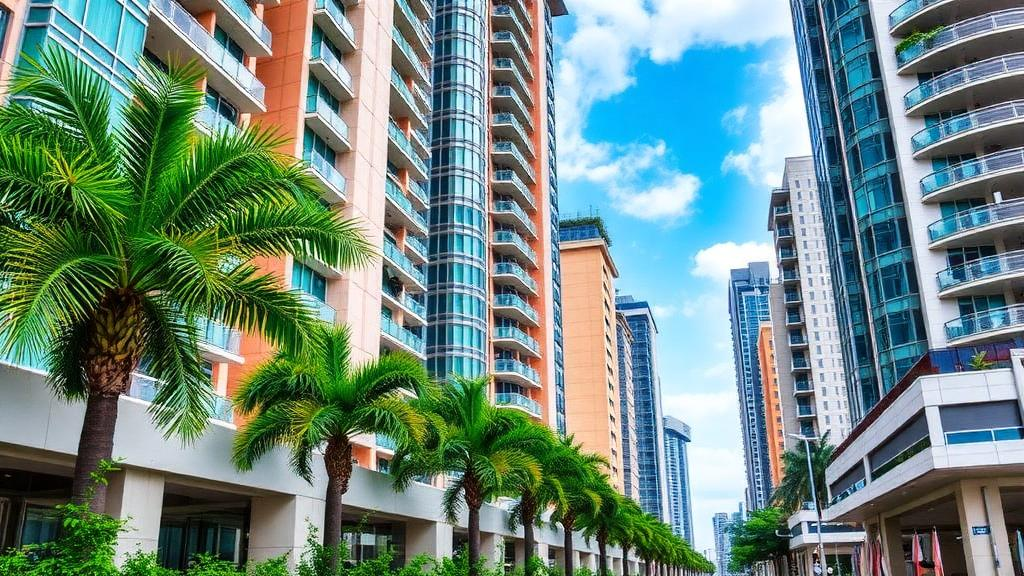
In the sweltering streets of tropical Singapore, where towering residential blocks channel breezes, trap heat and cast deep shadows across the urban canyon, the difference between a comfortable evening stroll and a punishing one can come down to a few degrees of air temperature or a shift in radiant heat. City planners hoping to design cooler neighborhoods increasingly rely on computer models that simulate these microclimates in fine detail. But a model is only as useful as its accuracy, and until now, two of the most advanced outdoor microclimate simulators had never been rigorously validated side by side in a dense tropical high-rise setting. A new study published in Theoretical and Applied Climatology closes that gap, offering the first head-to-head evaluation of the PALM-4U and urbanMicroclimateFOAM models against real-world measurements in Singapore’s compact urban terrain.
The research, led by Gabriel M. Magalhaes of the University of Minho together with colleagues from the Singapore-ETH Centre, CNRS@CREATE, the Singapore-MIT Alliance for Research and Technology and the Arts et Metiers Institute of Technology, forms part of the broader Cooling Singapore project and the DesCartes programme, both supported by Singapore’s National Research Foundation. The team’s central question was deceptively simple: when two state-of-the-art computational fluid dynamics models, built on fundamentally different simulation philosophies, are fed the same weather data and asked to reproduce the same three hot, sunny days, how closely do their outputs match what thermometers and radiation sensors actually recorded on the ground?
The two models represent contrasting approaches to a notoriously difficult problem. urbanMicroclimateFOAM, developed at ETH Zurich’s Chair of Building Physics as an extension of the open-source OpenFOAM toolkit, uses Reynolds-averaged Navier-Stokes equations, known as RANS. This technique solves for time-averaged flow fields, trading the fine texture of turbulent fluctuations for computational speed. PALM-4U, the urban extension of the Parallelized Large-Eddy Simulation model developed in Germany, takes the opposite route: it resolves the largest, energy-carrying eddies explicitly and models only the smallest scales, capturing the churning, transient character of urban airflow at a much higher computational cost. Comparing a RANS model and a large-eddy simulation against the same field data is therefore a test not just of accuracy but of whether the extra realism of LES justifies its expense in practical planning workflows.
Neither model can operate in isolation. Both require realistic initial and boundary conditions that describe what the atmosphere is doing at the edges of the simulated domain, and the researchers supplied these by nesting the microscale simulations within the Weather Research and Forecasting model, or WRF, configured with its multi-layer urban canopy parameterization. WRF, running at the mesoscale, captures the regional weather over Singapore and passes down profiles of wind, temperature and humidity that drive the street-level simulations. This mesoscale-to-microscale coupling is one of the most active frontiers in urban climate science, because errors introduced at the larger scale propagate directly into the neighborhood-scale predictions that planners ultimately use.
To ground-truth the simulations, the team identified three consecutive hot, sunny days from 2 to 4 June 2020 within an extended field observation campaign, a period chosen because clear skies and weak synoptic forcing make the urban radiation and heat balance as clean as possible to model. Three weather stations deployed within the study area recorded air temperature, relative humidity, wind and radiation throughout the days, providing the observational benchmark against which both models were scored using standard statistics including root-mean-square error.
The results were strikingly encouraging for both simulators. Outputs from PALM-4U and urbanMicroclimateFOAM agreed very well with the measurements at all three stations, and both reproduced the characteristic diurnal rhythm of the key climatic variables: the morning warm-up, the midday peak of radiant load, and the slow nocturnal release of stored heat from concrete and asphalt. For air temperature, the root-mean-square error stayed below 0.79 degrees Celsius. Relative humidity errors remained under 7.61 percent, a notable achievement in a climate where moisture fluxes from vegetation, soil and evaporating surfaces strongly shape thermal comfort. Most impressively, mean radiant temperature, the variable that often dominates human heat stress outdoors and that models routinely struggle with, was simulated with errors below 9.05 degrees Celsius.
That success with radiant temperature matters because it is the hardest variable to get right. Mean radiant temperature integrates shortwave solar radiation reflected and re-emitted from facades, pavements and the sky with longwave radiation from every surrounding surface, and it can swing by tens of degrees between a shaded courtyard and a sun-blasted plaza just meters away. Capturing that spatial heterogeneity requires the models to handle shading, surface albedo, emissivity and view factors with precision. The sub-degree accuracy in air temperature and the sub-ten-degree accuracy in radiant temperature across both a RANS and an LES framework suggest that, with careful boundary forcing, either tool can be trusted for evaluating shading strategies, vegetation placement and surface materials in tropical contexts.
Wind proved to be the weak point. Both models performed worst when estimating wind conditions, a familiar challenge in urban microclimate work. In a compact high-rise environment, airflow is governed by complex interactions between building-induced wakes, channeling effects between towers, thermal circulation and the turbulent boundary layer aloft, and small errors in the inflow profiles handed down from WRF can translate into substantial discrepancies at street level. The authors note that the performance of both models was influenced by the forcing boundary conditions, underscoring that the quality of the mesoscale driver remains a limiting factor even for the most sophisticated microscale physics. For applications such as pedestrian wind comfort or pollutant dispersion, this finding signals that coupling schemes and inflow generation deserve continued attention.
The broader significance of the study lies in its geography. Most validation studies of urban climate models have been conducted in mid-latitude cities with distinct seasons, moderate humidity and comparatively low-rise morphologies. Tropical compact high-rise districts, with their intense solar radiation, year-round heat load, high latent fluxes and canyon-like street geometry, stress the models in different ways, and a tool validated in a European or North American context cannot simply be assumed to transfer. By demonstrating that both PALM-4U and urbanMicroclimateFOAM can reproduce observed conditions in exactly such an environment, the study grants what the authors describe as the suitability of these specific models in tropical urban areas, and it gives planners in Singapore and comparable cities a validated basis for testing heat mitigation strategies digitally before pouring concrete.
For the growing community of researchers and practitioners working on urban heat, the message is pragmatic rather than partisan. The choice between a faster RANS solver and a more physically complete but costlier large-eddy simulation need not be ideological; in this tropical test, both delivered trustworthy temperature, humidity and radiation fields when driven by the same mesoscale forcing, and both stumbled on wind in similar ways. As cities across the tropics grapple with rising temperatures and densifying skylines, the ability to simulate street-level climate with this level of fidelity, and to know precisely where that fidelity ends, is a quiet but consequential step toward designing cities that people can live in comfortably under a warming sky.
Subject of Research: Validation and comparison of two urban microclimate CFD models in a tropical high-rise city
Article Title: Evaluation and comparison of PALM-4U/WRF and urbanMicroclimateFOAM in tropical high-rise urban areas
Article References: Magalhaes, G. M., Adelia, A. S., Acero, J. A., Singh, V. K., Huljak, B., Nobrega, J. M., & Chinesta, F. (2026). Evaluation and comparison of PALM-4U/WRF and urbanMicroclimateFOAM in tropical high-rise urban areas. Theoretical and Applied Climatology, 157(10), Article 666. https://doi.org/10.1007/s00704-026-06573-5
Image Credits: AI Generated
DOI: 10.1007/s00704-026-06573-5
Keywords: urban microclimate, PALM-4U, urbanMicroclimateFOAM, WRF, computational fluid dynamics, large-eddy simulation, RANS, Singapore, tropical climate, mean radiant temperature, urban heat island, model validation
Cite Scienmag News
Audrey Campbell. (October 2, 2026). Two Urban Climate Models Put to the Test in Singapore’s Tropical High-Rise Streets. Scienmag. https://scienmag.com/two-urban-climate-models-put-to-the-test-in-singapores-tropical-high-rise-streets/
Audrey Campbell. "Two Urban Climate Models Put to the Test in Singapore’s Tropical High-Rise Streets." Scienmag, 2 October 2026, https://scienmag.com/two-urban-climate-models-put-to-the-test-in-singapores-tropical-high-rise-streets/. Accessed 2 October 2026.
Audrey Campbell. "Two Urban Climate Models Put to the Test in Singapore’s Tropical High-Rise Streets." Scienmag. October 2, 2026. https://scienmag.com/two-urban-climate-models-put-to-the-test-in-singapores-tropical-high-rise-streets/


