


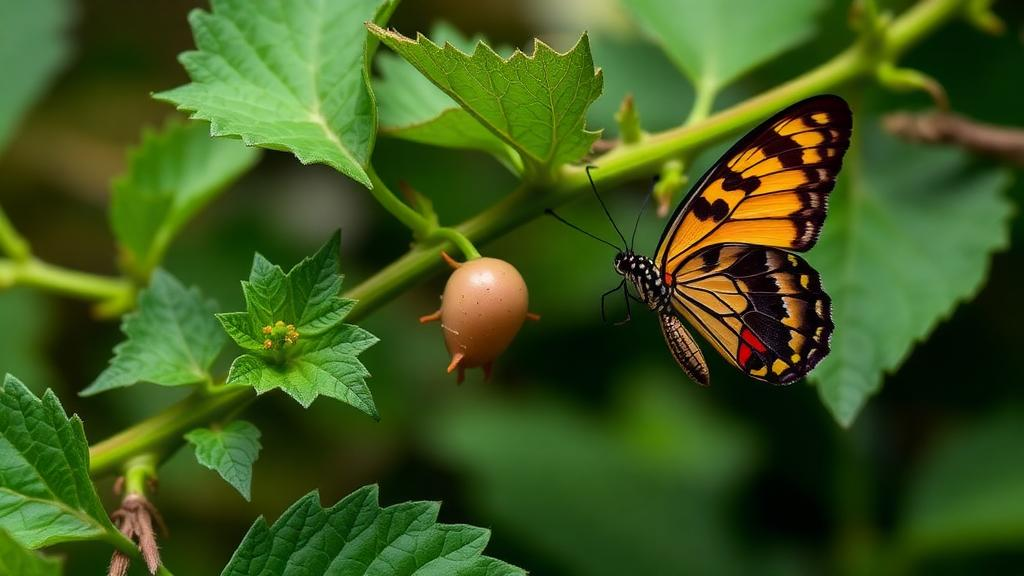
Deep in the rainforests of Malaysian Borneo, a quiet chemical war has been raging for millions of years between swallowtail butterflies and the toxic vines their caterpillars depend on. Now, a field study conducted at the Poring Butterfly Garden in Kinabalu National Park, Sabah, has revealed a weapon in this conflict that scientists have never before seen in this branch of the plant kingdom. Researchers report that the birthwort vine Aristolochia acuminata responds to butterfly eggs with two distinct killing mechanisms: a hypersensitive-like cell death that scorches the leaf tissue beneath the egg, and a neoplasm formation in which cells proliferate rapidly to push the egg off the plant. The findings, published in the journal Ecology and Evolution, mark the first documented case of leaf-based egg-killing defenses anywhere in the Magnoliids, an ancient clade of flowering plants comprising more than 10,000 species.
The relationship between Troidini butterflies and their Aristolochiaceae host plants is one of the classic stories of coevolution. These caterpillars have evolved the remarkable ability to detoxify aristolochic acids, the potent toxins that their host plants produce, and several species even sequester these chemicals in their own bodies and eggs, turning themselves into poisonous prey that most predators avoid. But plants, in turn, have not remained passive. Across the plant kingdom, botanists have documented more than thirty-five species, spread across sixteen families, that fight back against the egg stage of insect herbivores. Some plants grow wound tissue that physically crushes eggs. Others mount a hypersensitive response, a form of programmed cell death more familiar from plant-pathogen interactions, which desiccates the eggs or causes them to drop from the leaf. Still others form neoplasms, growths that lift the egg away until it falls off entirely.
Until now, however, no leaf-related egg-killing trait had ever been recorded in the Magnoliids, the group that includes magnolias, laurels, peppers and birthworts. The only known Magnoliid defense against insect eggs was wound tissue growth on avocado fruit in response to fruit flies in Mexico, a mechanically different phenomenon triggered by physical damage from an ovipositing insect rather than by the egg itself. The new observations from Borneo therefore fill a significant gap in the evolutionary geography of plant defenses, and they do so in a lineage whose relationship with herbivorous butterflies has long been recognized as a textbook example of reciprocal adaptation.
The research team, led by Veerle van Beeck, surveyed oviposition by Troidini butterflies in the Poring Butterfly Garden between early March and late April 2024. The garden, situated on the edge of primary rainforest, is planted densely with two local host plants, Aristolochia acuminata and a closely related vine referred to as A. cf. foveolata, whose taxonomic status in Borneo remains under debate. Four Troidini species frequent the site: the common birdwing Troides helena, the Malay birdwing Troides amphrysus, Rajah Brooke’s birdwing Trogonoptera brookiana, and the common rose swallowtail Pachliopta antiphus. Over the course of the study, the researchers monitored 86 eggs, recording precisely where each was laid and what happened to the plant tissue beneath it.
The results were striking. The team recorded 23 instances of hypersensitive-like cell death and 8 instances of neoplasm formation in a single month of observation. In the cell death response, the tissue surrounding the egg first turns yellow, then brown, and finally black as it dies. Remarkably, 22 of the 23 cell death responses reached the maximum severity on the study’s scoring scale, meaning the necrosis was clearly visible on both sides of the leaf and had spread well beyond the area directly beneath the egg. Daily surveys suggest the reaction can reach full severity within 24 hours of egg deposition. Both defenses were observed exclusively on A. acuminata and exclusively on the underside of leaves, and neoplasm formation was recorded only beneath eggs of Pachliopta antiphus.
The statistical analysis confirmed that these responses carry real consequences for the butterflies. Using a binomial generalized linear model, the researchers found that the presence of cell death significantly reduced the odds of a caterpillar emerging from its egg. For Troides helena, the effect was total: not a single egg hatched when cell death was present, compared with a survival rate of 22 percent on non-responding leaves. Pachliopta antiphus fared somewhat better, with survival falling from 56 percent on healthy leaves to 29 percent where the leaf tissue had died beneath the egg. Of the seven eggs associated with neoplasm formation, only two caterpillars ultimately emerged, though the small sample size prevented formal statistical testing of that trait. Overall survival rates across the study ranged from 22 to 56 percent, figures broadly consistent with the scarce data available for other Troidini, such as Troides aeacus in Taiwan, whose clutches have been reported to survive at rates between roughly 6 and 40 percent.
Perhaps the most intriguing finding concerns where the butterflies chose to lay their eggs. A substantial proportion of eggs were deposited nowhere near the vulnerable leaf surfaces. Troides helena placed nearly half of its observed eggs, 46.7 percent, on stems rather than leaves, while Pachliopta antiphus occasionally used petioles. Even more remarkably, up to 37.6 percent of eggs across the species surveyed were laid on structures entirely outside the host plants, including plastic support sticks, dead material and non-Aristolochia plants. Troides helena deposited almost a third of its observed eggs on plants belonging to other genera altogether. Earlier literature on Troidini oviposition has generally mentioned only leaves and stems of host plants, though scattered observations, including eggs of Trogonoptera brookiana found up to 20 centimeters from the host vine, hint that this behavior may be more widespread than previously appreciated.
The researchers cautiously interpret this off-plant egg placement as a possible behavioral counteradaptation, an avoidance strategy that allows female butterflies to sidestep the egg-killing responses of their own host plants. A parallel pattern is well documented in the Pieridae-Brassicaceae system, where pierid butterflies exposed to hypersensitive-response-expressing crucifers similarly shift their oviposition away from the lethal leaf surfaces. The authors acknowledge alternative explanations, however. Females may select concealed sites to evade egg predators, microclimatic conditions around the vine may influence site choice, or butterflies may simply mistake similarly shaped nonhost leaves for their target. Notably, related Troidini such as Battus polydamas locate their hosts primarily through olfactory and tactile cues rather than vision, which could plausibly lead to occasional misplacement of eggs on look-alike plants. The observational, single-site, seminatural design of the study means these hypotheses cannot yet be fully disentangled, and the authors call for experiments with plants of known genetic background in natural settings.
The study also revealed substantial variation in the defense response itself. Not every egg triggered a reaction: on five plants that had previously mounted cell death responses, the researchers found eggs that provoked no response at all. Some plants consistently failed to react, while others responded to some eggs but not others. The authors suggest several possible explanations, including genetic variation among plants grown from a small number of wild donor stock, differences in the chemistry of individual egg casings, and variation in the plant-derived chemicals that female butterflies carry from their own diets. Leaf age may also matter, as the single low-severity response was recorded on a very young, developing leaf. Disentangling these sources of variation will require common garden experiments and genomic comparisons across populations.
Beyond its evolutionary significance, the discovery carries immediate practical weight for conservation. Several Troidini species are classified as vulnerable by the IUCN, threatened by international trade and the drastic loss and degradation of Borneo’s forests. In Sabah, conservation efforts center on the endemic Kinabalu birdwing, Troides andromache, recently proclaimed the state butterfly, with programs propagating host plants and developing ecotourism around the species. Captive and seminatural breeding projects for other threatened birdwings, including Wallace’s birdwing in North Maluku and even Queen Alexandra’s birdwing, rely on easily cultivated A. acuminata as a substitute host. If the plants used in those breeding enclosures express egg-killing traits, they could silently undermine the very programs designed to save the butterflies. The authors recommend that breeding projects screen their host plants for these responses, and they argue that understanding the full arc of this coevolutionary arms race, from toxic chemistry to egg-killing necrosis to the butterflies’ evasive egg-laying behavior, is essential both for conserving some of the world’s most spectacular insects and for appreciating how deeply intertwined the fates of plants and their enemies truly are.
Subject of Research: Egg-killing plant defenses in Aristolochia vines against Troidini butterfly eggs in Borneo
Article Title: Vengeful Vines: Cell Death and Neoplasm Formation in Aristolochia (Aristolochiaceae, Piperales) in Response to Oviposition of Troidini (Papilionidae, Lepidoptera) Butterflies
Article References: van Beeck, V., Parantis, J., Zandstra, B. E., Fernhout, T., Chung, A., Mustaffa, N., Fatouros, N. E., & van der Linden, C. F. H. (2026). Vengeful Vines: Cell Death and Neoplasm Formation in Aristolochia (Aristolochiaceae, Piperales) in Response to Oviposition of Troidini (Papilionidae, Lepidoptera) Butterflies. Ecology and Evolution, 16(10), Article e74426. https://doi.org/10.1002/ece3.74426
Image Credits: AI Generated
DOI: 10.1002/ece3.74426
Keywords: Aristolochia, Troidini, birdwing butterflies, coevolution, hypersensitive response, neoplasm formation, plant defense, oviposition, Borneo, conservation, Magnoliids, aristolochic acids
Cite Scienmag News
Drew Townsend. (October 1, 2026). Killer Vines: Bornean Birthwort Plants Strike Back at Butterfly Eggs. Scienmag. https://scienmag.com/killer-vines-bornean-birthwort-plants-strike-back-at-butterfly-eggs/
Drew Townsend. "Killer Vines: Bornean Birthwort Plants Strike Back at Butterfly Eggs." Scienmag, 1 October 2026, https://scienmag.com/killer-vines-bornean-birthwort-plants-strike-back-at-butterfly-eggs/. Accessed 1 October 2026.
Drew Townsend. "Killer Vines: Bornean Birthwort Plants Strike Back at Butterfly Eggs." Scienmag. October 1, 2026. https://scienmag.com/killer-vines-bornean-birthwort-plants-strike-back-at-butterfly-eggs/


