


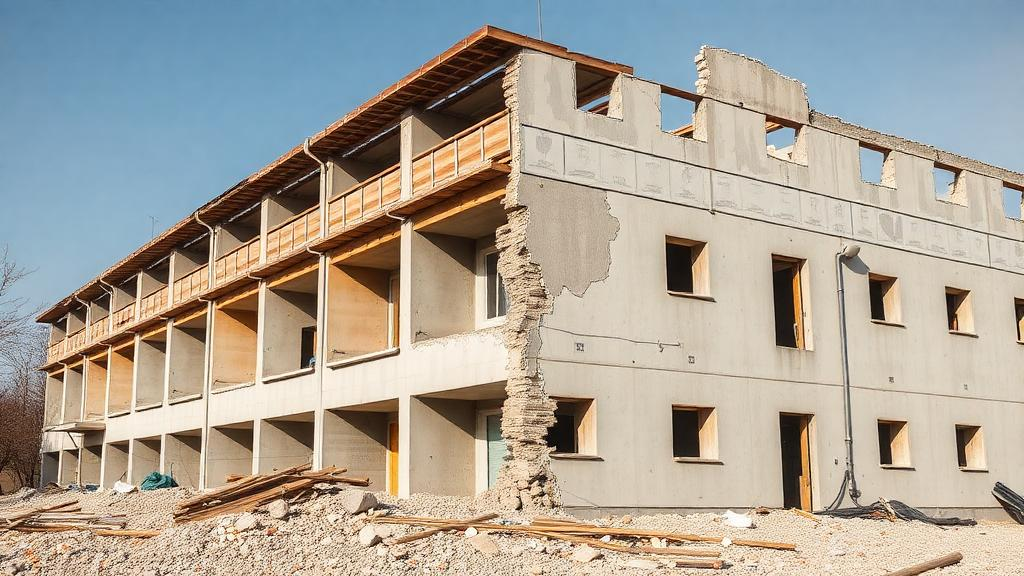
When two earthquakes of magnitude 7.8 and 7.6 struck southeastern Türkiye on 6 February 2023, they did more than devastate cities along the East Anatolian Fault. They also subjected thousands of industrial and commercial buildings to one of the most intense near-fault shaking episodes ever recorded in the region. Among the structures most closely watched by engineers were reinforced concrete prefabricated buildings, the precast frames that house factories, warehouses, and logistics centers across the country. A new study published in the Bulletin of Earthquake Engineering by Mehmet Ömer Timurağaoğlu, Özkan Hakan, Ali Haydar Bayram, and Ramazan Livaoğlu of Bursa Uludağ University and RL ProjeDestek Consulting now offers one of the most detailed assessments to date of how these structures actually performed, combining field reconnaissance with rigorous numerical fragility analysis.
Prefabricated reinforced concrete construction occupies a distinctive place in structural engineering. Unlike cast-in-place buildings, whose columns and beams are monolithically poured, precast structures are assembled from factory-produced elements joined on site. This makes them fast and economical to build, but it concentrates seismic vulnerability in the connections. In the classic Turkish precast industrial building, roof girders rest on column corbels, typically through dowel bars and elastomeric bearing pads, and the entire lateral load path depends on how well these joints hold together when the ground lurches. The 2023 Kahramanmaraş earthquake sequence, with its pulse-like near-fault motions and unusually high vertical accelerations, tested those joints as severely as any event in Turkish history.
The research team began with field investigations in the affected region, documenting damage patterns across prefabricated buildings exposed to the twin shocks. Their reconnaissance identified a recurring catalogue of construction deficiencies: inadequate dowel detailing at girder-corbel connections, missing elastomeric bearing pads, substandard grout applications, and insufficient confinement reinforcement in columns and joints. Each of these defects, individually modest in appearance, proved capable of triggering or accelerating structural failure. Where bearing pads were absent, girders pounded directly against concrete corbels, crushing the bearing surfaces and losing their ability to accommodate the relative displacements that near-fault shaking imposes. Where dowels were poorly anchored or under-reinforced, the connections that should have tied roof girders to columns simply gave way.
These observations align with a long history of lessons from Turkish earthquakes. Precast structures were damaged in the 1998 Ceyhan earthquake, the 1999 Kocaeli earthquake, the 2011 Van earthquake, and the 2020 Sivrice earthquake, and in each event the same weak points surfaced: connections, corbels, and the detailing that modern codes require but field practice does not always deliver. What distinguishes the new study is that it does not stop at cataloguing damage. It converts the field evidence into quantitative fragility models, the statistical machinery that engineers use to estimate the probability that a structure will exceed a given damage state at a given level of ground shaking intensity.
Fragility analysis works by subjecting numerical models of a structure to suites of ground motion records and tracking how often a governing limit state, such as the onset of significant connection damage or loss of lateral load capacity, is exceeded as shaking intensity increases. The team built detailed nonlinear models of representative reinforced concrete prefabricated buildings and ran them through ground motions representative of the Kahramanmaraş sequence, including records with the velocity pulses and strong vertical components characteristic of near-fault sites. The resulting fragility curves provide a probabilistic portrait of vulnerability, allowing engineers to compare design variants on a common, defensible footing rather than relying on anecdote alone.
The single most striking quantitative finding concerns the roof girder-to-corbel connection. When the dowels connecting girders to columns were bolted, the seismic resilience of the structure improved dramatically: the median ground motion intensity at which the governing limit state was exceeded nearly doubled compared with structures relying on unbolted dowel connections. In practical terms, a building with bolted dowel connections could withstand roughly twice the shaking intensity before reaching its critical damage threshold. That is not an incremental improvement; it is the difference between a structure that survives a near-fault event and one that does not, achieved through a connection detail that costs comparatively little to implement.
The study also examined the role of infill walls, the masonry or precast panels that fill the bays between columns. In general, infill walls improved seismic resistance, stiffening the frames and sharing lateral load that would otherwise concentrate entirely on the columns. But the analysis revealed a crucial caveat: the benefit depended heavily on the integrity of the connections between the walls and the surrounding frame. Where those connections were robust, the walls acted as effective seismic fuses and load-sharing elements. Where the connections were poor, the walls detached early, their contribution vanished, and in some scenarios the falling panels introduced additional hazards. The lesson is that infill walls are not a passive benefit that can be assumed; they are only as good as the detailing that ties them into the structural system.
Near-fault effects emerged as a decisive amplifier of all these vulnerabilities. Earthquakes that rupture directly beneath or very close to a site produce ground motions with forward directivity, meaning a long-period velocity pulse arrives with much of the fault’s slip concentrated in a single large cycle of motion. The Kahramanmaraş events, including documented episodes of supershear rupture, delivered exactly this kind of pulse-like loading, along with vertical accelerations strong enough to degrade the friction and bearing capacity of simply supported precast elements. For connections already weakened by missing pads or deficient dowels, the combination of horizontal pulses and vertical acceleration was punishing. The study’s numerical results make clear that fragility assessments for precast buildings in near-fault zones must explicitly account for these motion characteristics rather than relying on generic record sets.
From these findings the authors draw a clear retrofitting agenda for the existing stock of reinforced concrete prefabricated structures. Priority measures include upgrading connection details, particularly bolting dowel connections at girder-corbel joints; adding elastomeric bearing pads where they are missing; and installing properly designed precast infill walls with reliable connections. Beyond the physical interventions, the study emphasizes the need for clear design guidelines and rigorous field assessment protocols so that existing buildings, especially in regions exposed to near-fault seismicity, can be systematically evaluated and reinforced before the next earthquake rather than after. The authors note that implementing these strategies would substantially enhance the seismic resilience of the precast building stock, reducing potential future human and economic losses.
The broader significance of the work extends beyond Türkiye. Precast industrial construction is common across seismic regions worldwide, from the Mediterranean to the Americas, and the failure modes documented after Kahramanmaraş echo those observed after the 2012 Emilia earthquakes in Italy, the 1994 Northridge earthquake in California, and the 1995 Kobe earthquake in Japan. The Turkish study adds a quantitative dimension to that international record, demonstrating with fragility curves just how much performance hinges on a handful of connection details. For engineers, the message is disarmingly simple: in prefabricated construction, the earthquake finds the joints. Bolting a dowel, seating a bearing pad, or grouting a connection properly may look like minor line items in a construction budget, but the difference they make, roughly a doubling of the shaking a building can survive, is the kind of margin on which lives and livelihoods depend when the fault finally slips.
Subject of Research: Seismic fragility and construction deficiencies of reinforced concrete prefabricated buildings in the 2023 Kahramanmaraş earthquakes
Article Title: Seismic performance assessment of reinforced concrete prefabricated structures during the 2023 Kahramanmaraş earthquakes: fragility analysis and construction deficiency evaluation
Article References: Seismic performance assessment of reinforced concrete prefabricated structures during the 2023 Kahramanmaraş earthquakes: fragility analysis and construction deficiency evaluation. (n.d.). https://doi.org/10.1007/s10518-026-02712-5
Image Credits: AI Generated
DOI: 10.1007/s10518-026-02712-5
Keywords: prefabricated concrete, Kahramanmaraş earthquakes, fragility analysis, seismic performance, dowel connections, corbel connection, elastomeric bearing pads, infill walls, near-fault ground motion, retrofitting, East Anatolian Fault, Bulletin of Earthquake Engineering
Cite Scienmag News
Violet Maxwell. (October 1, 2026). Bolted Connections Halved the Damage: What the 2023 Kahramanmaraş Earthquakes Revealed About Prefabricated Concrete Buildings. Scienmag. https://scienmag.com/bolted-connections-halved-the-damage-what-the-2023-kahramanmaras-earthquakes-revealed-about-prefabricated-concrete-buildings/
Violet Maxwell. "Bolted Connections Halved the Damage: What the 2023 Kahramanmaraş Earthquakes Revealed About Prefabricated Concrete Buildings." Scienmag, 1 October 2026, https://scienmag.com/bolted-connections-halved-the-damage-what-the-2023-kahramanmaras-earthquakes-revealed-about-prefabricated-concrete-buildings/. Accessed 1 October 2026.
Violet Maxwell. "Bolted Connections Halved the Damage: What the 2023 Kahramanmaraş Earthquakes Revealed About Prefabricated Concrete Buildings." Scienmag. October 1, 2026. https://scienmag.com/bolted-connections-halved-the-damage-what-the-2023-kahramanmaras-earthquakes-revealed-about-prefabricated-concrete-buildings/


