


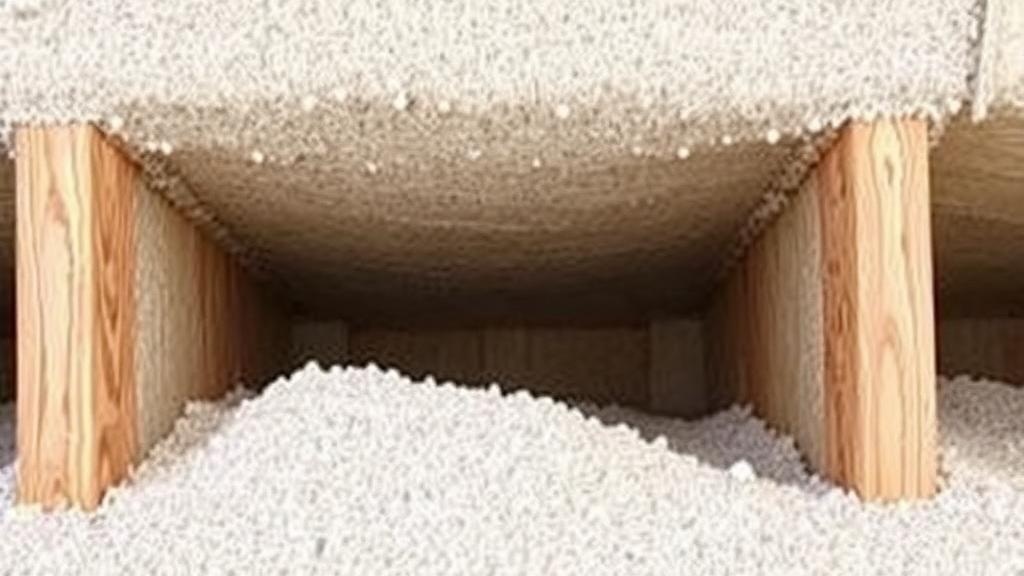
Buildings account for roughly 40 percent of global energy consumption and a substantial share of carbon dioxide emissions, and the hunt for insulation materials that are both effective and genuinely sustainable has become one of the most active frontiers in construction science. A team of French researchers has now reported a surprisingly simple answer to one of the field’s most stubborn problems: how to keep plant-based insulation from drinking up moisture and losing strength. Their solution is ordinary calcium carbonate, ground from natural limestone, added to a biocomposite made from hemp shives and potato starch. The work, published in Case Studies in Construction Materials, shows that a cheap, abundant mineral can transform the durability of a fully bio-based building material without sacrificing its insulating power.
Hemp shives, the woody core of the hemp stem left over after bast fibers are harvested, are an attractive raw material. They are lightweight, highly porous, and offer thermal conductivity around 0.048 W/m·K, making them excellent candidates for insulation panels. When bonded with gelatinized potato starch, hemp-shive composites have previously achieved thermal conductivities in the range of 0.06 to 0.07 W/m·K and impressive moisture-buffering values above 2.6 g/(m²·%RH). But the same porosity that makes them good insulators also makes them vulnerable. Water seeps into the open pore network, the hydrophilic starch binder swells, and over time the material can lose dimensional stability, mechanical integrity, and resistance to biological growth.
Earlier attempts to fix this weakness have relied on thermal modification of fibers, silane treatments, hot-water extraction, or synthetic hydrophobic coatings. These approaches work, but they add processing steps, energy demands, costs, and sometimes environmentally questionable chemistry. The new study takes a different route: instead of chemically altering the plant material, the researchers simply dispersed finely ground natural calcium carbonate throughout the matrix. The mineral powder, milled from Champagne-region limestone and composed of 94.6 percent calcium carbonate, was treated not as a passive filler but as a functional additive that reshapes the composite’s internal architecture.
Because the performance of such composites depends on several competing variables, the team avoided trial-and-error formulation. They applied Response Surface Methodology using a Central Composite Design, varying two parameters, the starch-to-fiber ratio and the calcium-carbonate-to-fiber ratio, across eleven experimental runs including replicated center points. Four responses were tracked simultaneously: bulk density, thermal conductivity, water absorption, and compressive strength. Quadratic regression models fitted to the data achieved coefficients of determination between 0.83 and 0.94, and analysis of variance confirmed that both factors and their interaction significantly shaped every property measured.
The models revealed a fascinating tug-of-war inside the material. Increasing starch raised water uptake, as expected from its hydroxyl-rich chemistry, but calcium carbonate pushed hard in the opposite direction, blocking capillary pathways and reducing the accessible internal surface. A significant negative interaction term showed that the mineral partially counteracts the binder’s hydrophilic tendency. Meanwhile, both components boosted compressive strength, with starch dominating through inter-particle bonding and calcium carbonate acting as a micro-reinforcement that stiffens the matrix and fills residual micropores. Density and thermal conductivity rose moderately with both additives, a predictable consequence of replacing trapped air with solid matter.
Multi-objective optimization using desirability functions converged on a formulation with a starch-to-fiber ratio of 0.30 and a calcium-carbonate-to-fiber ratio of 0.39. Validation experiments matched the predictions closely, with individual errors of 0.93 to 6.46 percent and an average deviation of just 3.72 percent, yielding a global desirability of 80 percent. The optimized composite reached a bulk density of 221 kg/m³, a thermal conductivity of 0.056 W/m·K, water absorption of 22 kg/m², and a compressive strength of 0.68 MPa, a compelling balance of insulation, strength, and moisture resistance.
Microscopy and porosimetry explained why the formulation works so well. Scanning electron micrographs of the reference material showed a heterogeneous, poorly bonded structure with large voids and smooth, uncoated hemp particles. In the optimized composite, calcium carbonate microspheres were embedded throughout the matrix, the binder film became continuous and evenly distributed, and fiber-matrix interfaces appeared far more cohesive. Mercury intrusion porosimetry quantified the transformation: total intrusion volume fell from 2.635 to 1.577 mL/g, total porosity dropped from 73.5 to 66.0 percent, and the median volumetric pore radius shrank from 0.452 to 0.401 micrometers. Ultrasonic pulse velocity nearly doubled, rising from 273 to 446 m/s, confirming dramatically improved internal cohesion.
The hydric results were equally striking. Capillary water absorption at long exposure times fell by roughly 29 percent compared with the references, from more than 30 kg/m² to 22 kg/m², and the wetting front penetrated only about 5 centimeters into the optimized panel. Surface wettability improved as well: the initial water contact angle climbed from around 50 to 54 degrees for the references to 87.26 degrees for the optimized composite, and the starch-calcium-carbonate binder gel itself showed a higher contact angle than pure starch gel. Crucially, the material did not become a vapor barrier. Water vapor permeability remained in the same range as other plant-fiber insulators, and the moisture buffer value actually reached the classification of excellent, meaning the wall material can still absorb and release humidity to regulate indoor air, while resisting liquid water ingress.
Acoustic and thermal stability tests rounded out the picture. Sound absorption curves for all formulations showed a characteristic peak near 1000 Hz, and the weighted absorption coefficient slightly improved from 0.30 to 0.36 with the mineral addition, indicating that pore refinement did not destroy the interconnected network responsible for acoustic dissipation. Thermogravimetric analysis showed the optimized composite retained 37.1 percent residual mass at 600 °C, compared with under 21 percent for the references, thanks to the mineral fraction and the endothermic decarbonation of calcium carbonate near 770 °C. Infrared spectroscopy confirmed the diagnostic carbonate bands in the optimized sample and suggested interfacial interactions, possibly hydrogen bonding, between the mineral surface and the hydroxyl-rich organic matrix.
The broader significance is that a mineral available almost anywhere, requiring no chemical synthesis, can deliver durability improvements that previously demanded elaborate surface treatments. The researchers caution that long-term service performance, including freeze-thaw cycling, wet-dry aging, biological attack, and fire behavior, still requires dedicated testing, and a full life-cycle assessment remains to be done. But the demonstration that ground limestone can simultaneously strengthen a hemp-starch insulation panel, cut its water uptake by nearly a third, preserve its breathability and moisture buffering, and even modestly improve its acoustic and thermal stability marks a meaningful step toward insulation materials that store carbon, breathe with the building, and survive decades of real-world weather.
Subject of Research: Multi-objective optimization of hemp-shive and starch biocomposites reinforced with natural calcium carbonate for moisture-resistant building insulation
Article Title: Natural CaCO₃ improves the moisture resistance and mechanical performance of hemp-starch biocomposites: A multi-objective optimization study
Article References: Balti, S., Maalouf, C., Moussa, T., Bliard, C., Lachi, M., Rousse, C., Alsedeh, O., Vazquez, P., Bogard, F., & Polidori, G. (2026). Natural CaCO₃ improves the moisture resistance and mechanical performance of hemp-starch biocomposites: A multi-objective optimization study. Case Studies in Construction Materials, 25, Article e06574. https://doi.org/10.1016/j.cscm.2026.e06574
Image Credits: AI Generated
DOI: 10.1016/j.cscm.2026.e06574
Keywords: hemp shives, calcium carbonate, potato starch, bio-based insulation, response surface methodology, moisture resistance, thermal conductivity, compressive strength, porosity, moisture buffering, sustainable construction, biocomposites
Cite Scienmag News
Denise Maddox. (October 1, 2026). Ground Limestone Makes Hemp-Starch Building Insulation Stronger and Water-Resistant. Scienmag. https://scienmag.com/ground-limestone-makes-hemp-starch-building-insulation-stronger-and-water-resistant/
Denise Maddox. "Ground Limestone Makes Hemp-Starch Building Insulation Stronger and Water-Resistant." Scienmag, 1 October 2026, https://scienmag.com/ground-limestone-makes-hemp-starch-building-insulation-stronger-and-water-resistant/. Accessed 1 October 2026.
Denise Maddox. "Ground Limestone Makes Hemp-Starch Building Insulation Stronger and Water-Resistant." Scienmag. October 1, 2026. https://scienmag.com/ground-limestone-makes-hemp-starch-building-insulation-stronger-and-water-resistant/


