


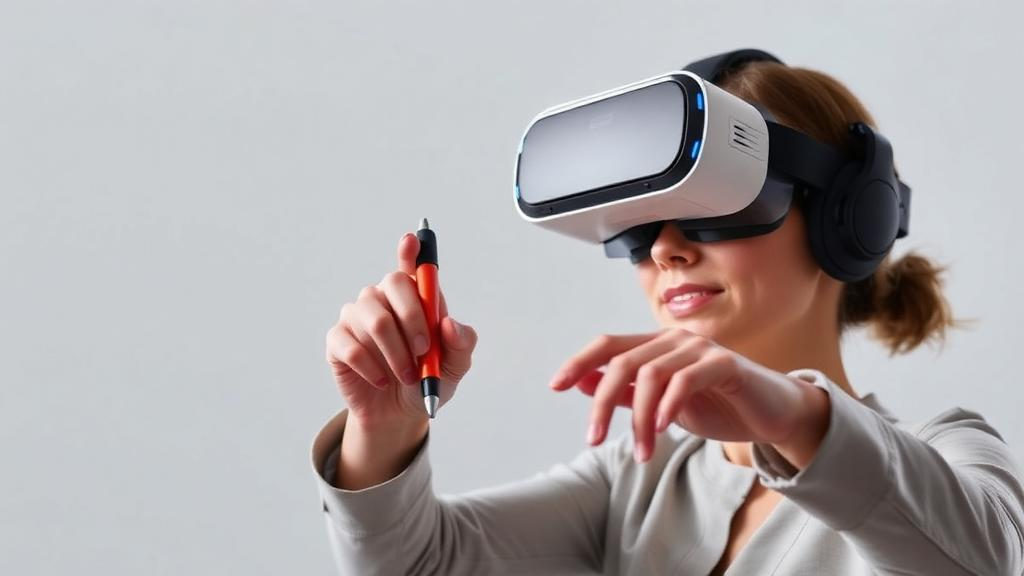
Virtual reality has long promised total immersion, yet one mundane task keeps yanking users out of their digital worlds: authentication. Whether paying inside a VR app store, unlocking confidential documents in a laboratory, or entering a restricted industrial area, users of standalone headsets such as the Meta Quest 3 or Pico 4 are still forced to peck at floating virtual keyboards or pull out a smartphone running a companion app. Both approaches break the sense of presence that defines the medium, introduce fatigue and typing errors, and add friction that grows worse with every complex password requirement. A team of researchers at Sapienza University of Rome, working with a colleague from Unitelma Sapienza, now argues that the solution may be as old as handwriting itself. Their prototype, called AirSign, lets users sign their name in the air, in full three dimensions, and verifies who they are without ever leaving the virtual environment.
The core idea is deceptively simple: treat a hand-drawn signature as a biometric trait, just as banks and document workflows have done for decades with pen and paper. What makes AirSign distinctive is how it captures that signature. Instead of confining users to a predefined two-dimensional plane, or demanding specialized peripherals such as data gloves or a Leap Motion sensor mounted on a desk, the system exploits hardware that modern headsets already carry. Users can sign either with motion controllers or, on devices that support it, with camera-based hand tracking. A single unified gesture, a pinch between the index finger and thumb, signals the intent to write. When the virtual fingertips touch, the system begins sampling the three-dimensional coordinates of the fingertip at the headset’s refresh rate, typically 90 to 120 hertz, and renders the resulting strokes in real time so the user receives immediate visual feedback.
Under the hood, every signature becomes a multivariate time series. Each sampled point stores a position vector and a velocity vector, the latter computed from the change in position between consecutive frames divided by the elapsed time. Because the hand-tracking cameras on consumer headsets rely on monocular RGB input without dedicated depth sensors, the raw trajectory is noisy. To tame the jitter, the researchers apply linear interpolation, smoothing each sampled position halfway toward the previous one. This acts as a first-order low-pass filter, balancing responsiveness against stability. Two normalization steps then make signatures comparable regardless of where and how the user was facing when signing: the entire trajectory is translated so its first point sits at the world origin, and it is rotated by a quaternion so that the user’s initial viewing direction aligns with a canonical axis. The result is a signature that can be drawn anywhere, at any orientation, and still be matched against stored templates.
Comparing two signatures captured at different speeds and lengths is the central algorithmic challenge, and it is where Dynamic Time Warping enters the picture. Simple Euclidean distance fails catastrophically when two otherwise identical trajectories are temporally shifted, because points that should correspond are compared with the wrong partners. DTW solves this by warping the time axis of one sequence to find an optimal non-linear alignment with the other, minimizing the cumulative local distance along an admissible warping path that respects boundary, continuity, and monotonicity constraints. The method’s key property for signature verification is its invariance to time shifts: identical but misaligned sequences yield a distance at or near zero. Classic DTW carries a quadratic cost in both time and memory, however, which is prohibitive on a battery-powered headset, so the team turned to FastDTW, a multilevel approximation that coarsens the series, projects a low-resolution warping path upward, and refines it within a constrained radius, achieving linear time and space complexity.
The engineering choices reveal how much practical constraint shapes such systems. An early client-server design was abandoned in favor of fully on-device processing, with signature data saved directly to the headset’s local file system. The DTW computation was rewritten in Rust after benchmarks showed the original Python implementation took 2.37 seconds to compare a 383-point signature with itself, while the Rust version finished in 0.03 seconds, roughly 79 times faster. On a tenfold larger sample of 3,830 points, the gap widened to 480-fold, with Rust completing in 0.13 seconds what Python needed more than a minute to do. Further optimizations, including a Sakoe-Chiba band that restricts the warping path to a diagonal window and a diagonal DTW variant that slashes memory use, cut processing time by more than half on a 70,000-point signature. Classification also runs asynchronously on a background thread, preventing the rendering loop from freezing, a detail that matters enormously in VR, where a stalled frame that no longer matches head movement can induce motion sickness.
Even the choice of which features to feed the matcher mattered. An initial feature set combining position, velocity, and acceleration produced puzzling misclassifications: a handwritten name and an arbitrary wave pattern were judged suspiciously similar to a figure eight, with average DTW distances low enough to slip beneath the acceptance threshold. Ablation analysis showed that acceleration data was injecting noise rather than discriminative power, so the team stripped it out, keeping only position and velocity. The revised feature set produced a much clearer separation between similar and dissimilar signatures, eliminated the false positives, and, as a bonus, shrank the data files and simplified the computation. It is a textbook example of how more sensors and more features do not automatically mean better biometrics.
To evaluate the system, the researchers recruited 28 volunteers, roughly 60 percent male and 40 percent female, aged between 20 and 40, none of whom had meaningful prior headset experience. Each participant produced 25 signatures under two input modalities, controllers and hand tracking, and two experimental conditions. In the fixed-signature scenario, everyone wrote the same word, AIRSIGNX, deliberately stressing the system’s ability to distinguish people who share an identical signature shape. In the custom-signature scenario, each user chose a personal symbol or name, mimicking real-world variability. The team measured false acceptance and false rejection rates across swept thresholds and derived Equal Error Rates, the operating point where the two error rates coincide. Custom signatures proved markedly easier to verify, with EERs as low as 0.030 to 0.061 depending on input method, corresponding to authentication accuracy of roughly 94 to 97 percent. The hostile fixed-signature scenario, which doubles as a simulation of a skilled forgery attack in which an attacker knows the target’s signature shape, yielded EERs between 0.097 and 0.165, still translating to accuracy between roughly 83.5 and 90 percent.
Two further findings stand out. First, when the template gallery was reduced from 20 signatures per user to just 5, error rates rose only marginally, with the custom-signature EER reaching 0.030 with controllers and 0.053 with hand tracking. That stability matters for practical deployment, because it suggests users could enroll quickly without degrading security. Second, controllers consistently outperformed hand tracking on the Area Under the Curve metric, with very large effect sizes in both scenarios, reflecting the spatial jitter, gesture-detection latency, and occasional tracking losses inherent to camera-based hand modeling. Yet for the metric that matters most in practice, the EER on custom signatures, the difference between input methods was statistically negligible. In other words, when inter-class variability is high, the noisier but more convenient hand-tracking mode authenticates just as reliably, especially after smoothing. Users themselves praised the pinch-to-write gesture as natural and ergonomic, with the only recurring complaint being a slight lag in detecting fingertip contact at the start and end of strokes.
The security analysis is framed with appropriate caution. The researchers consider three threat levels: zero-knowledge attacks by random impostors, captured by the custom-signature EER; shape-aware attacks by forgers who know what the victim writes, captured by the fixed-signature EER; and dynamics-aware attacks, which they defer to dedicated future adversarial testing. Including velocity profiles in the DTW calculation is hypothesized to resist spatial replay attacks, since replicating how fast a signature was drawn is substantially harder than copying its shape, but the team is explicit that this hypothesis still needs rigorous testing. On the performance side, the entire verification cycle, including normalization, feature extraction, and DTW matching, completes within 350 milliseconds and adds less than 2 percent power draw on a standalone Meta Quest 2, confirming that biometric authentication can run continuously without draining the battery or degrading frame rates.
The authors are candid about the study’s limits. Twenty-eight participants cannot represent the full demographic spectrum, all data was collected in a single session, and no head-to-head comparison with classifiers such as support vector machines or deep learning architectures was possible, partly because variable-length 3D time series resist fixed-length feature extraction and the sample size is too small to train neural models fairly. They position AirSign accordingly, not as a novel classification algorithm but as a systems-level contribution: the first demonstration that unconstrained, on-device, three-dimensional signature verification is feasible on ordinary consumer VR hardware. Future work will scale the user cohort, parallelize the DTW computation across CPU cores, refine index-thumb contact detection, mount a proper defense against forged signatures, and benchmark the approach against gaze, motion, and keystroke biometrics. If those steps succeed, the awkward floating keyboard may finally give way to something far more intuitive: simply signing your name into the air.
Subject of Research: VR-based 3D hand-written signature recognition for biometric user authentication in virtual reality
Article Title: AirSign: An innovative VR-based hand-written signature recognition
Article References: Frascarelli, G., Marini, M. R., De Marsico, M., Mecca, A., & Cinque, L. (2026). AirSign: An innovative VR-based hand-written signature recognition. Multimedia Tools and Applications, 85(10), Article 790. https://doi.org/10.1007/s11042-026-21951-x
Image Credits: AI Generated
DOI: 10.1007/s11042-026-21951-x
Keywords: virtual reality, biometrics, signature recognition, Dynamic Time Warping, hand tracking, authentication, Meta Quest, behavioral biometrics, Rust, Unity, human-computer interaction, cybersecurity
Cite Scienmag News
Denise Maddox. (October 1, 2026). Signing in Mid-Air: VR Headsets Learn to Verify Your Signature in 3D. Scienmag. https://scienmag.com/signing-in-mid-air-vr-headsets-learn-to-verify-your-signature-in-3d/
Denise Maddox. "Signing in Mid-Air: VR Headsets Learn to Verify Your Signature in 3D." Scienmag, 1 October 2026, https://scienmag.com/signing-in-mid-air-vr-headsets-learn-to-verify-your-signature-in-3d/. Accessed 4 October 2026.
Denise Maddox. "Signing in Mid-Air: VR Headsets Learn to Verify Your Signature in 3D." Scienmag. October 1, 2026. https://scienmag.com/signing-in-mid-air-vr-headsets-learn-to-verify-your-signature-in-3d/


