


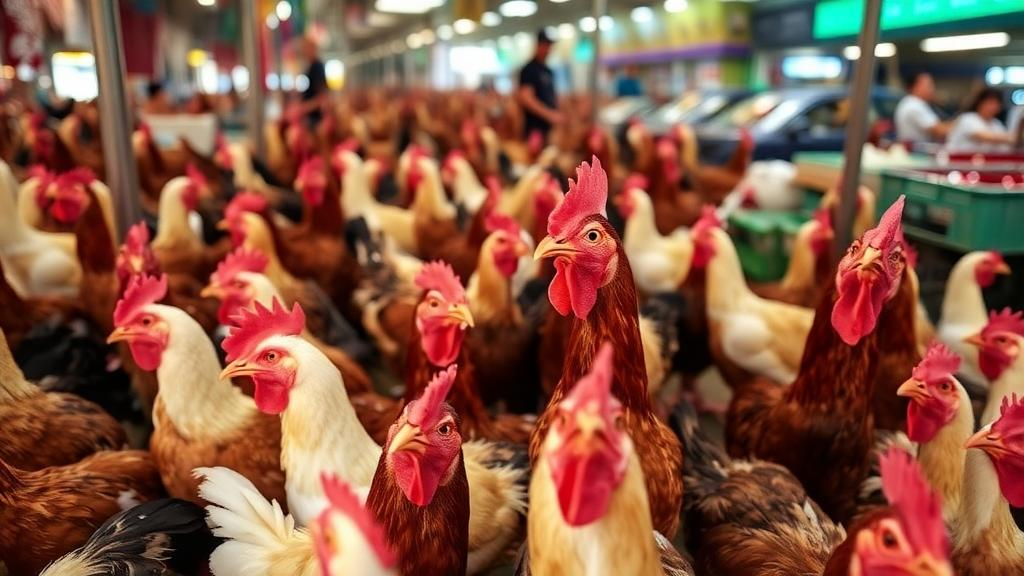
A three-year surveillance program in Quzhou City, in western Zhejiang Province, China, has found that poultry-associated environments—particularly live poultry markets and farms—harbor far more avian influenza virus than the migratory bird habitats that have long dominated public concern about the disease. The study, conducted by researchers at the Quzhou Center for Disease Control and Prevention together with colleagues at Soochow University and published in Virology Journal, is notable for simultaneously sampling three linked components of the virus’s ecology: wild birds, poultry environments, and the humans whose occupations place them in contact with both. The results point to live poultry trade settings as the most important interface for potential human exposure in the region.
Quzhou occupies a strategically significant position for avian influenza monitoring. The city lies along the East Asian-Australasian Flyway, one of the world’s great migratory bird corridors, which funnels billions of waterfowl and shorebirds between breeding grounds in Siberia and Alaska and wintering areas across East Asia, Southeast Asia, and Australasia each year. Stopover sites along such flyways are where migratory waterfowl—natural reservoirs of low pathogenic avian influenza viruses—mix with resident bird populations and with domestic poultry raised in their vicinity. Quzhou has also previously reported human cases of avian influenza, giving local health authorities a concrete reason to build a surveillance system that could trace the virus across the animal–environment–human continuum rather than examining each compartment in isolation.
Between 2023 and 2025, the research team carried out longitudinal surveillance across the city, collecting three categories of samples. The first comprised 2,020 samples from migratory birds, including fecal material and swabs gathered at sites the birds frequent. The second consisted of 920 environmental samples from poultry-associated settings, such as live poultry markets and farms—surfaces, water, and other materials that can accumulate viral contamination from infected or carrier birds. The third involved 171 serum samples from occupationally exposed workers, people whose jobs in the poultry industry bring them into regular contact with live birds or contaminated environments. Viral RNA was detected using real-time reverse-transcription PCR (RT-qPCR), a molecular technique that amplifies and quantifies viral genetic material; antibodies against avian influenza viruses were measured with hemagglutination inhibition (HI) assays, a classical serological method that tests whether a person’s antibodies can block the virus’s hemagglutinin protein from binding red blood cells.
The contrast between the two animal-side sample sets was stark. Among the 2,020 migratory bird samples, avian influenza virus RNA was detected in just 39 samples, a prevalence of 1.93 percent. Even where viral genetic material was present, the viral loads were so low that none of the positive samples could be subtyped—that is, the researchers could not determine which hemagglutinin (H) and neuraminidase (N) subtypes the viruses carried. Low viral load in fecal and swab samples from wild birds can reflect transient infections, dilution in large environmental volumes, or degradation of RNA between collection and testing, but the practical consequence is that wild birds contributed comparatively little detectable viral signal in this system.
Poultry-associated environments told a very different story. Of the 920 environmental samples from settings linked to poultry, 247 tested positive for avian influenza virus RNA—a positivity rate of 26.85 percent, roughly fourteen times higher than that observed in migratory bird samples. Subtyping succeeded for a portion of these positives and revealed a clear hierarchy of circulating strains. H9 was overwhelmingly dominant, identified in 122 samples. H7 appeared in six samples and H5 in three, while 115 positive samples remained unsubtyped. The prominence of H9 is consistent with the broader picture in Chinese poultry production, where H9N2, a low pathogenic avian influenza virus, circulates endemically in flocks and rarely causes obvious disease in birds, allowing it to spread silently and persistently through markets and farms. H5 and H7 subtypes, by contrast, include strains of greater concern because certain lineages have crossed into humans and caused severe illness.
The human component of the study provided the most consequential findings for occupational health. Among the 171 occupationally exposed workers tested, 23 carried antibodies against avian influenza viruses, a seroprevalence of 13.45 percent. Subtype-specific testing indicated that antibodies against H9N2 were the most common, detected in 17 individuals, while antibodies against H5N6 were found in 4. Seropositivity means these people had been infected at some point and mounted an immune response; because H9N2 infections in humans are typically mild or even asymptomatic, serological surveillance of this kind is often the only way to detect the true scale of spillover from poultry to people. The detection of H5N6 antibodies is particularly noteworthy given that H5N6 has caused severe and frequently fatal human infections in China in recent years.
To move beyond simple prevalence figures, the researchers used multivariate logistic regression to identify which characteristics of the workers were associated with a higher likelihood of seropositivity. This statistical approach adjusts for multiple factors simultaneously, isolating the independent contribution of each while controlling for confounding. The analysis produced one clear signal: workers engaged in catching and transporting live poultry had significantly higher odds of carrying avian influenza antibodies, with an adjusted odds ratio of 3.51 (95 percent confidence interval: 1.26 to 9.75; P = 0.016). In practical terms, these workers were roughly three and a half times more likely to show evidence of past infection than their counterparts after accounting for other measured factors. This finding aligns with the biology of transmission: catching and transporting live birds involves close, repeated contact with animals and with aerosols and dust generated in cramped market and transport conditions, the very routes by which avian influenza viruses are thought to infect humans.
The study’s One Health framing—recognizing that human, animal, and environmental health are interconnected—allowed the authors to draw an integrated conclusion that single-sector surveillance could not support. Because the same surveillance program covered wild birds, poultry environments, and exposed people, the comparison is internally consistent: within this city and time period, the environments where poultry are traded and raised, not the migratory birds passing overhead, represent the principal settings for viral circulation and the principal points of potential human exposure. The authors conclude that poultry-associated environments may serve as important reservoirs of avian influenza viruses in Quzhou and that occupational protection measures should prioritize workers in the live poultry trade, particularly those handling and moving live birds.
The findings carry implications for how surveillance resources are allocated. Monitoring migratory birds remains scientifically valuable for tracking the global movement of highly pathogenic lineages and for early warning, but the Quzhou data suggest that, at least in this setting, the intensity of viral circulation—and the risk to people—is concentrated in live poultry markets and farms. Environmental sampling in these settings, combined with regular serological testing of workers, could function as an early detection system for both endemic low pathogenic strains like H9N2 and for the emergence of higher-risk H5 or H7 viruses. The authors emphasize that continued surveillance integrating environmental and human data is warranted, and the study’s longitudinal design across three years provides a template for how such integrated monitoring can be sustained. As avian influenza viruses continue to evolve and occasionally spill over into human populations, studies of this kind—grounded in local data but designed around the full transmission chain—offer a practical model for identifying where interventions such as personal protective equipment, market hygiene practices, and vaccination of poultry would do the most good.
Subject of Research: Avian influenza virus surveillance across migratory birds, poultry environments, and occupationally exposed workers in Quzhou City, China
Article Title: Avian influenza surveillance among migratory birds, poultry, and occupationally exposed population in Quzhou City, China, 2023—2025
Article References: Wang, S., Yin, Z., Fang, Q., Fang, C., Chen, F., Yang, H., Huang, Y., & Zhan, B. (2026). Avian influenza surveillance among migratory birds, poultry, and occupationally exposed population in Quzhou City, China, 2023—2025. Virology Journal. https://doi.org/10.1186/s12985-026-03297-w
Image Credits: AI Generated
DOI: 10.1186/s12985-026-03297-w
Keywords: avian influenza, H9N2, H5N6, live poultry markets, migratory birds, One Health, surveillance, seroprevalence, zoonosis, occupational exposure, RT-qPCR, hemagglutination inhibition
Cite Scienmag News
William Thompson. (October 1, 2026). Live Poultry Markets, Not Wild Birds, Drive Avian Influenza Exposure Risk in Eastern China. Scienmag. https://scienmag.com/live-poultry-markets-not-wild-birds-drive-avian-influenza-exposure-risk-in-eastern-china/
William Thompson. "Live Poultry Markets, Not Wild Birds, Drive Avian Influenza Exposure Risk in Eastern China." Scienmag, 1 October 2026, https://scienmag.com/live-poultry-markets-not-wild-birds-drive-avian-influenza-exposure-risk-in-eastern-china/. Accessed 1 October 2026.
William Thompson. "Live Poultry Markets, Not Wild Birds, Drive Avian Influenza Exposure Risk in Eastern China." Scienmag. October 1, 2026. https://scienmag.com/live-poultry-markets-not-wild-birds-drive-avian-influenza-exposure-risk-in-eastern-china/


