


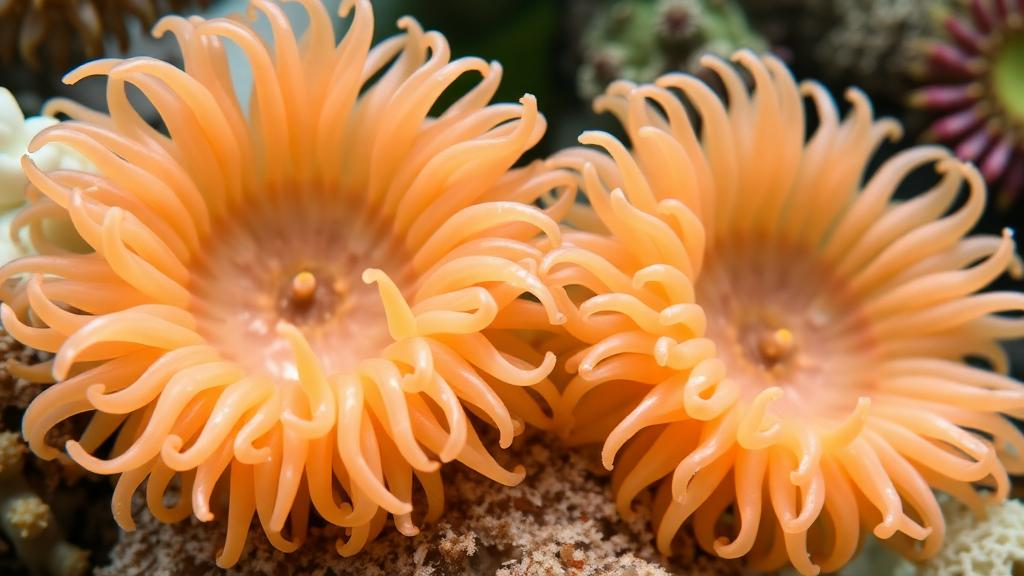
When ocean waters warm, the world’s corals and sea anemones do something dramatic: they eject the microscopic algae that live inside their tissues, turning ghostly white in a process known as bleaching. Scientists have long understood that this symbiont loss starves these animals of the sugars and amino acids their algal partners normally supply, shrinking them, slowing their growth and, in severe cases, killing them. But a new study suggests that bleaching does far more than simply weaken these animals. It appears to trigger a rapid, coordinated overhaul of their stinging arsenal, one that may be less about attrition and more about adaptation.
The research, published in the journal Coral Reefs, focused on the tropical sea anemone Isactinia citrina, a small photosymbiotic species found throughout the Indo-Pacific. Researchers at James Cook University in Cairns, Australia, kept 270 clonal anemones under controlled laboratory conditions for 35 days. Half were held at a comfortable 28 degrees Celsius, while the other half endured 32 degrees Celsius, a temperature high enough to induce significant bleaching. By the end of the experiment, the stressed anemones had lost a staggering 98.16 percent of their Symbiodiniaceae symbionts compared with the control animals, and they were visibly smaller, with lower wet weights and reduced oral disc diameters.
What makes this study unusual is that the team examined not just one but two interlocking components of the anemone’s venom ecology: the cnidae, the microscopic capsule-like organelles that deliver the sting, and the venom itself, the complex cocktail of toxins those capsules contain. Cnidarians are unique in possessing these specialised structures, produced by cells called cnidocytes. Roughly 30 morphologically distinct cnidae types exist across the phylum, grouped into nematocysts, spirocysts and ptychocysts, each fulfilling roles in prey capture, adhesion, defence or envenomation. The inventory of cnidae types and sizes within a given body region is known as the cnidom, and it varies between species, between body parts and across life stages.
Using bright field microscopy at 630-times magnification, the researchers photographed and identified the first 300 identifiable cnidae in tissue samples aspirated from both the tentacles and the body column of each anemone. They classified the capsules as large basitrichs (basitrich-I), small basitrichs (basitrich-II) or spirocysts. Because cnidom composition shifted slightly in the control animals over the course of the experiment, the team applied a clever statistical correction, calculating a Change Factor from the control group and applying it to the stressed animals’ baseline counts. This allowed them to isolate the effects of bleaching itself from ordinary temporal drift within the experiment.
The results were striking. In both the tentacles and the body column, bleached anemones showed a significantly greater proportion of large, venom-filled basitrichs than their photosymbiotic counterparts, with the shift occurring at the expense of the smaller basitrich-II type and, in the tentacles, the spirocysts. This finding runs counter to what a simple energy-starvation model would predict. An earlier study of the model anemone Exaiptasia diaphana found the opposite pattern: bleached animals shifted away from energetically costly penetrative cnidae and towards cheaper, toxin-free spirocysts, which the authors interpreted as an energy-saving strategy. In Isactinia citrina, however, the animals appear to be investing more, not less, in their venomous armament.
The size data added a further layer of intrigue. The team measured the length and width of thousands of undischarged capsules, more than 3,300 from tentacles and nearly 3,000 from body columns, and calculated capsule volume using a standard geometric formula, since volume is considered more ecologically relevant than linear measurements alone. Capsule volume matters because it influences the force and speed of discharge and determines how much venom a capsule can hold. In the tentacles of bleached anemones, basitrich-I and spirocyst volumes decreased significantly, by roughly 16.6 and 21.0 cubic micrometres on average respectively. Yet in the body column, the opposite occurred: basitrich-I and basitrich-II volumes increased significantly, by about 14.8 and 5.9 cubic micrometres.
This regional divergence is difficult to explain through energetic decline alone. Larger cnidae in the body column, where big basitrichs are thought to serve a predominantly defensive role, could represent a deliberate attempt to boost defensive capability at a time when the animal is compromised and vulnerable. Isactinia citrina relies on retracting into its body column when threatened, so enlarging the stinging cells in that region might deter predators or spatial competitors more effectively. Meanwhile, the modest reductions in tentacular cnidae size cannot be explained by body size scaling either, because previous work on this species found a negative correlation between anemone size and tentacular cnidae length. The authors suggest the tentacular shifts may reflect a prioritisation of the dual prey-capture functions that basitrichs provide, though they caution that the magnitude of change was small and its ecological significance remains to be confirmed.
The venom itself also changed. The team isolated clean cnidae from pooled ectodermal tissue, ruptured them with a bead beater, and analysed the liberated toxins using liquid chromatography coupled with high-resolution mass spectrometry at the University of Queensland’s Institute for Molecular Bioscience. Venom was separated into fractions below and above 3 kilodaltons, and artificial seawater blanks were processed in parallel to screen out background contamination. Total ion current and base peak chromatograms revealed clear differences between bleached and photosymbiotic venom profiles across both fractions. In the small-molecule fraction, 63 ions of interest were identified, ranging from 306 to 5,400 daltons; bleaching increased the intensity of ten of these and decreased 53. The most dramatic single change was a component of 590.29 daltons whose average intensity collapsed from about 241,000 counts per second to just 179, a negative 7.07 log-two fold change. In the larger fraction, all eight ions of interest decreased in intensity, with one component falling by a factor of roughly 100.
These venom components fall within the size range typical of low molecular weight toxins and neurotoxins, molecules that include pain-inducing agents such as serotonin and histamine, adenosine receptor antagonists such as caissarone, and peptide neurotoxins that disrupt voltage-gated sodium and potassium channels. Because such compounds jointly determine how effectively an anemone can immobilise prey and repel attackers, shifts in their relative abundance could meaningfully alter the animal’s ecological performance. Previous studies have shown that bleaching-induced changes in venom composition can translate into measurable changes in toxicity in fire corals and hydrozoans, and although toxicity was not directly tested here, the substantial fold changes observed make a similar effect in Isactinia citrina plausible.
Perhaps the most consequential finding is the speed of the response. Earlier experiments on cnidae changes used chemical or light-based stressors over periods of eight to 18 weeks, while venom changes under heat stress had been documented within 15 days. This study achieved ecologically relevant thermal bleaching within 35 days and detected parallel changes in cnidae abundance, cnidae size and venom composition, demonstrating that the entire venom ecology of a photosymbiotic cnidarian can be remodelled within a few weeks of stress onset. Given that bleaching events are becoming more frequent and severe worldwide, such rapid plasticity could reshape interactions between anemones and their prey, predators and competitors, with knock-on effects for reef communities. Whether these changes persist after recovery, revert to pre-bleaching states, or compound under repeated bleaching remains unknown. What the study makes clear is that physiological decline alone cannot explain what bleached anemones are doing. Instead, their enlarged defensive capsules and restructured venom may represent a purposeful survival strategy, a bet that a sharper sting is worth the cost when the world turns hostile.
Subject of Research: Effects of bleaching stress on the cnidae and venom ecology of the tropical sea anemone Isactinia citrina
Article Title: Attrition or adaptation? Bleaching stress drives changes in sea anemone cnidae and venom
Article References: Kaposi, K. L., Courtney, R. L., Wilson, D. T., Jones, A., Madio, B., & Seymour, J. E. (2026). Attrition or adaptation? Bleaching stress drives changes in sea anemone cnidae and venom. Coral Reefs. https://doi.org/10.1007/s00338-026-02969-x
Image Credits: AI Generated
DOI: 10.1007/s00338-026-02969-x
Keywords: sea anemone, coral bleaching, cnidae, venom, Symbiodiniaceae, cnidarians, Isactinia citrina, mass spectrometry, basitrichs, thermal stress, venom ecology, Coral Reefs
Cite Scienmag News
Violet Maxwell. (October 1, 2026). Bleached Sea Anemones Rebuild Their Stinging Cells and Venom in Weeks. Scienmag. https://scienmag.com/bleached-sea-anemones-rebuild-their-stinging-cells-and-venom-in-weeks/
Violet Maxwell. "Bleached Sea Anemones Rebuild Their Stinging Cells and Venom in Weeks." Scienmag, 1 October 2026, https://scienmag.com/bleached-sea-anemones-rebuild-their-stinging-cells-and-venom-in-weeks/. Accessed 1 October 2026.
Violet Maxwell. "Bleached Sea Anemones Rebuild Their Stinging Cells and Venom in Weeks." Scienmag. October 1, 2026. https://scienmag.com/bleached-sea-anemones-rebuild-their-stinging-cells-and-venom-in-weeks/


