


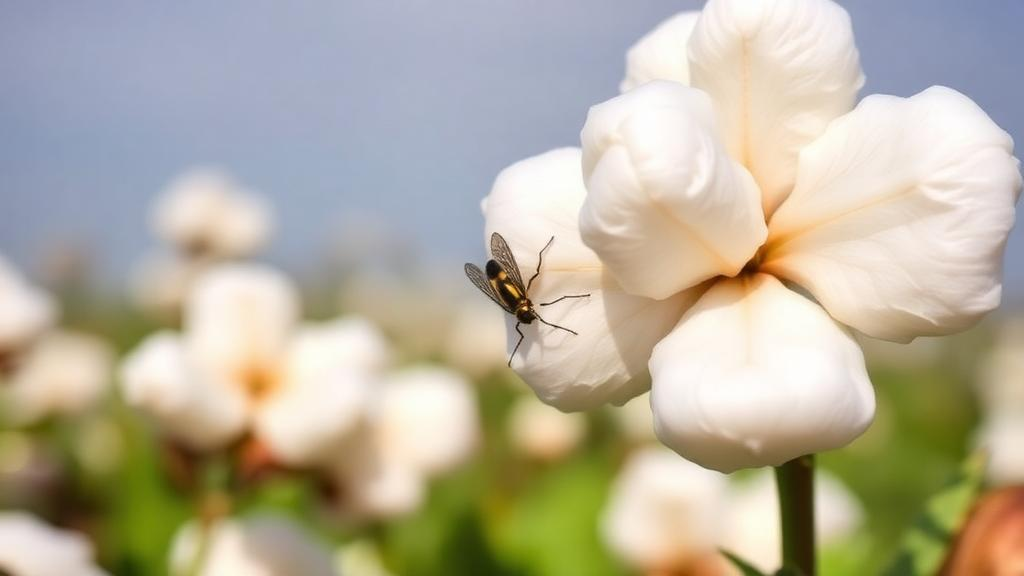
Few pests have shaped the fortunes of cotton farming in South Asia quite like the whitefly. The tiny, sap-sucking insect Bemisia tabaci drains nutrients directly from the plant’s phloem, excretes sticky honeydew that contaminates lint and ruins fiber quality, and vectors some of the deadliest viruses known to the crop. Now a two-year field study from India’s cotton belt has added a strikingly practical twist to the story: two of the most ordinary decisions a farmer makes—when to sow and how much nitrogen fertilizer to apply—can swing whitefly populations dramatically and reshape the entire season’s harvest.
The research, conducted at the research farm of ICAR-Central Institute for Cotton Research’s Regional Station in Sirsa, Haryana, in the semi-arid north Indian cotton zone, spanned the kharif seasons of 2018-19 and 2019-20. The site sits at roughly 202 meters above sea level, receives about 335 millimeters of annual rainfall concentrated in the July-to-September monsoon, and is underlain by sandy loam soils of Gangetic alluvium origin with a mildly alkaline pH of 8.2. In this setting, the team led by Rishi Kumar, Amarpreet Singh and Debashis Paul set out to answer a question that has long nagged agronomists: how do sowing date, genotype and nitrogen rate interact to drive whitefly dynamics and productivity in Gossypium hirsutum cotton?
The experimental design was deliberately ambitious. Using a split-split plot layout replicated three times, the researchers compared four planting dates—early, optimum, late and very late—across two genotypes, a Bt-II hybrid (NCS 9013) and a local American cotton variety (CSH 3129), each grown under both protected conditions, where recommended insecticides were sprayed, and unprotected conditions, where no chemical sprays were applied. Layered onto this were three nitrogen regimes: a dose below the recommended rate, the recommended dose itself, and a dose exceeding it, applied in two splits. Weekly monitoring of adult whiteflies began in early July, around the 27th Standard Meteorological Week, and continued until populations receded in early October. Counts were taken from the upper, middle and lower canopy of tagged plants before 10 a.m. to avoid disturbing the adults, with nymphs tallied using a hand lens.
The headline finding concerns timing. Cotton sown very late carried mean adult whitefly populations 9.2 to 14 percent higher than crops planted at the optimum time, with the gap widening precisely during the pest’s peak activity window around the 38th Standard Meteorological Week, when counts reached 15.82 and 21.67 whiteflies per three leaves in the two seasons respectively. In 2018-19, seasonal means per three leaves ranged from 12.24 whiteflies on optimum-sown cotton to 13.96 on very late plantings; in 2019-20 the corresponding figures were 14.08 and 15.68. Statistical tests confirmed that late and very late sowings supported significantly higher populations than optimum sowing during the peak weeks of both years.
The nymphal data tell an equally revealing story about how the pest tracks the crop’s phenology. Early in the season, at the 27th Standard Meteorological Week, very late-sown cotton—still spindly and poorly developed—actually hosted fewer nymphs, averaging 8.01 and 8.59 per three leaves across the two years. But as delayed crops put on vigorous growth and tender foliage, the pattern flipped: by the 33rd week, very late plots carried 13.36 and 10.96 nymphs per three leaves, overtaking their earlier-sown counterparts. Whiteflies, in other words, follow the freshest plant tissue. In the fragmented smallholder landscapes of north India, where early and late fields sit side by side without isolation, this creates a relay: adults abandon aging canopies and colonize younger, lusher crops as the season progresses, a dynamic the authors warn makes staggered sowing windows genuinely risky.
Genotype, by contrast, proved far less influential. The hybrid and the local variety supported statistically indistinguishable whitefly numbers, likely because both developed similar canopy architectures. Protected and unprotected plots also differed only numerically, not significantly—though populations hovered near the economic threshold of six adults per leaf, prompting two insecticide sprays in each season, using neem-based products and diafenthiuron, which knocked counts down immediately after application. The moderate overall pressure meant that chemical protection, while helpful, was not the decisive variable in this study.
Nitrogen, however, was. Plots fertilized above the recommended dose consistently hosted more whiteflies throughout the season, with seasonal means of 14.21 and 15.60 adults per three leaves in the high-nitrogen treatments during 2018-19 and 2019-20, compared with lows of 11.87 and 13.36 in plots receiving less than the recommended rate. Nymphal counts followed the same trajectory, with significantly higher numbers on high-nitrogen cotton during specific weeks in both years. The mechanism is well grounded in plant physiology: nitrogen fertilization raises the concentration of amino-nitrogen compounds in phloem sap, improving the nutritional quality of the diet for phloem-feeding insects and boosting their feeding preference, survival, growth, reproduction and population density. This is consistent with a long line of studies showing that excess nitrogen fuels outbreaks of homopteran pests such as aphids, scales and whiteflies, and it matters enormously in north India, where farmers habitually apply nitrogen well beyond recommended rates across a broad sowing window.
The yield consequences were stark. Early-sown cotton produced 32.00 and 32.75 quintals of seed cotton per hectare across the two years, and optimum-timed sowings delivered 30.94 and 32.50 quintals per hectare—both significantly outperforming late sowings at 27.77 and 27.85 quintals and very late sowings at just 19.66 and 21.63 quintals per hectare. Nitrogen rate showed no significant effect on yield in the first year but a significant one in the second, with higher doses lifting yields while simultaneously carrying a heavier whitefly burden. The yield advantage of early planting likely reflects greater translocation of photosynthates and earlier canopy establishment, giving the crop a head start before pest pressure peaks.
The findings resonate with a painful recent history. Delayed sowing was identified as a major contributor to the devastating whitefly outbreak of 2015-16 in north India, when poorly established crops succumbed rapidly to infestation. Ambient temperature, natural enemies and host plant condition are known to govern pest dynamics, and the new study shows how ordinary agronomic choices tip those balances. Interestingly, the picture is not universally simple: research from dryland cotton in Texas found higher banded-winged whitefly numbers on early plantings, a reminder that local climate and cropping systems shape the outcome. But in the irrigated north Indian system, where roughly 1.6 million hectares are sown between April and June depending on canal water availability, the evidence points firmly toward early, uniform sowing.
The practical message is refreshingly actionable. Timely planting of cotton genotypes, combined with nitrogen applied strictly at recommended doses, delivers both better yields and lower whitefly pressure—no additional cost, no additional sprays, just disciplined agronomy. Avoiding late sowing and resisting the temptation to over-fertilize could spare farmers the yield penalties of up to a third of the crop seen in very late plantings, while reducing the pesticide load and the risk of the kind of regional outbreaks that have twice convulsed the north Indian cotton economy within a decade. In the ongoing arms race against Bemisia tabaci, it turns out that the calendar and the fertilizer bag may be a farmer’s most underrated weapons.
Subject of Research: Effects of planting date and nitrogen fertilization on whitefly population dynamics and yield in cotton
Article Title: Planting dates and rate of nitrogen fertilization influences whitefly population dynamics and incidence in cotton (Gossypium hirsutum L.)
Article References: Kumar, R., Singh, A., & Paul, D. (2025). Planting dates and rate of nitrogen fertilization influences whitefly population dynamics and incidence in cotton (Gossypium hirsutum L.). Discover Ecology, 1(1), Article 11. https://doi.org/10.1007/s44396-025-00011-y
Image Credits: AI Generated
DOI: 10.1007/s44396-025-00011-y
Keywords: whitefly, Bemisia tabaci, cotton, planting date, nitrogen fertilization, pest management, seed cotton yield, Gossypium hirsutum, agronomy, entomology, India, sucking pests
Cite Scienmag News
Alan Morgan. (October 1, 2026). Late Planting and Excess Nitrogen Supercharge Cotton’s Worst Whitefly Outbreaks. Scienmag. https://scienmag.com/late-planting-and-excess-nitrogen-supercharge-cottons-worst-whitefly-outbreaks/
Alan Morgan. "Late Planting and Excess Nitrogen Supercharge Cotton’s Worst Whitefly Outbreaks." Scienmag, 1 October 2026, https://scienmag.com/late-planting-and-excess-nitrogen-supercharge-cottons-worst-whitefly-outbreaks/. Accessed 1 October 2026.
Alan Morgan. "Late Planting and Excess Nitrogen Supercharge Cotton’s Worst Whitefly Outbreaks." Scienmag. October 1, 2026. https://scienmag.com/late-planting-and-excess-nitrogen-supercharge-cottons-worst-whitefly-outbreaks/


