


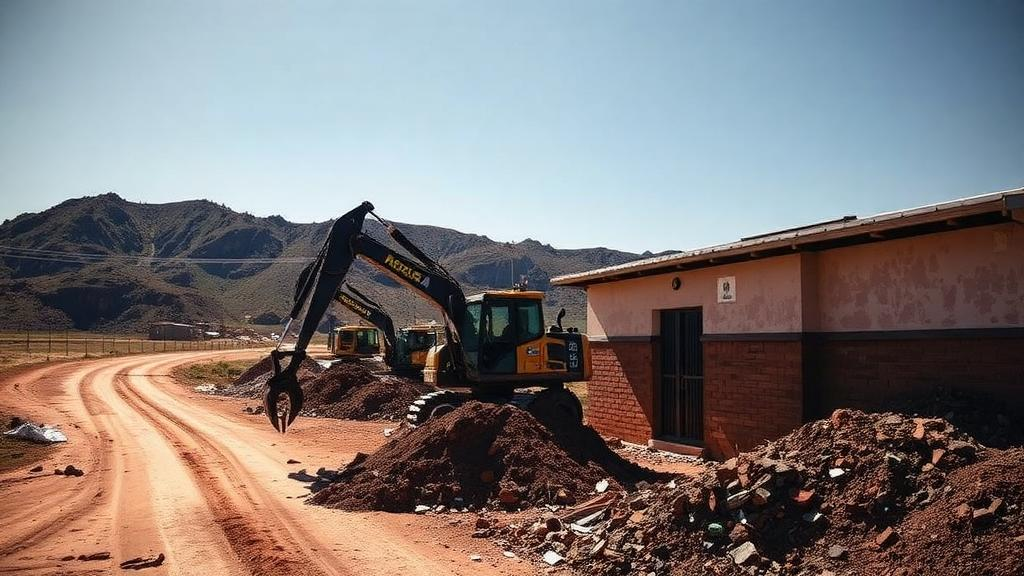
In the industrial town of Maputsoe, Lesotho’s second-largest economic center, an open waste dump sits on the banks of the Mohokare River, just beside a community high school and within reach of two villages. A new study published in Discover Toxicology has now provided the first scientific baseline of what that dumpsite is doing to the soil beneath and around it, and the findings are sobering. Researchers led by Katleho H. Ramasimong of the National University of Lesotho measured six heavy metals in soils collected from three locations around the dump and found that lead and cadmium, two of the most toxic metals known to environmental health, exceed natural background levels. Cadmium in particular was so enriched at one downhill sampling point that the site’s overall contamination degree crossed the threshold requiring urgent remediation.
The concern is not academic. Heavy metals are among the most problematic environmental pollutants because they are toxic, persistent, non-biodegradable, and capable of accumulating in living tissue. The human body has no efficient metabolic pathway to eliminate them. While iron, copper, and manganese are essential nutrients in trace amounts, lead and cadmium are dangerous even at low concentrations. Prolonged exposure to contaminated dust and soil has been linked to chronic bronchitis, emphysema, asthma, lung cancer, hypertension, atherosclerosis, cognitive decline, neurodegenerative disease, and chronic kidney disease. Cadmium carries an additional distinction: the International Agency for Research on Cancer classifies it as a Group 1 human carcinogen via inhalation, and it lodges in soft tissues such as the liver and kidneys with a biological half-life of ten to thirty-five years.
The Maputsoe dumpsite itself is an unregulated open yard established in an excavated pit, with no restrictions on access. It receives industrial, domestic, and hospital waste from a town ringed by textile, food, and cosmetics manufacturers. Runoff from the site drains toward the Mohokare River, and leachate can percolate downward toward groundwater. Informal scavenging by children and economically disadvantaged adults has been reported at the site, compounding the public health vulnerability. Despite this setting, no prior study had ever quantified metal contamination there, a gap the research team set out to close.
In October 2023, the team collected composite surface soil samples from zero to twenty centimeters depth at three purposively chosen points: S1, roughly 200 meters uphill in Phukalla village; S2, near the dump itself; and S3, slightly downhill of S2. Each sample was air-dried, ground, sieved through a two-millimeter mesh, and then extracted with a DTPA-TEA solution, a standard chemical cocktail used to pull out the phytoavailable fraction of trace metals, the portion plants can actually take up. The extracts were analyzed by Atomic Absorption Spectrometry on a PerkinElmer PinAAcle 500 instrument. Quality control was rigorous: calibration curves showed correlation coefficients of at least 0.999, detection limits ranged from 0.004 to 0.031 milligrams per liter, and spiked recovery tests returned rates between 83.77 percent for copper and 93.05 percent for cadmium.
The measured concentrations followed a consistent hierarchy across the site: iron highest at a mean of 373 milligrams per kilogram, then manganese at 41.98, copper at 31.58, lead at 29.59, chromium at 7.56, and cadmium at 3.05. Iron’s dominance is unsurprising given it is the largest component of the Earth’s crust, and copper, iron, manganese, and chromium all remained below their upper continental crust values at every location. The red flags were lead, which exceeded its background value at the downhill site S3, and cadmium, which was elevated at all three sampling points. When benchmarked against Dutch and Canadian soil quality guidelines, samples from S1 and S2 complied with acceptable limits, but cadmium at S3 surpassed both the Dutch target of 0.8 and the Canadian target of 1.4 milligrams per kilogram.
To translate raw concentrations into risk, the researchers applied five established geochemical indices, each answering a slightly different question. The contamination factor compares each metal to its crustal background, the degree of contamination sums those factors, the enrichment factor normalizes metals against the immobile reference element iron to isolate anthropogenic input, the geo-accumulation index quantifies pollution on a logarithmic scale, and the ecological risk factor weights contamination by each metal’s toxicity. The results converged on a single culprit. Cadmium’s contamination factor reached 15.47 at S3, its enrichment factor soared to 15,271, and its geo-accumulation value of 3.37 indicated heavy pollution. The degree of contamination at S3 hit 17.46, placing it in the considerable category that warrants urgent remediation, while S1 and S2 remained in the low range. Ecological risk values ranked the metals as cadmium, lead, copper, chromium, manganese, then iron, with cadmium posing considerable risk at S1, moderate risk at S2, and very high risk at S3, while every other metal stayed in the low-risk band.
Statistical analysis then pointed a finger at the likely source. Pearson’s correlation analysis revealed strong positive associations, at the p below 0.01 level, among manganese, lead, and cadmium, with correlation coefficients as high as 0.930 between manganese and cadmium. Principal component analysis, which condensed the six metals into two components explaining 88.8 percent of total variance, loaded those same three metals heavily onto the first component. Together, the patterns suggest a shared anthropogenic origin, and the researchers point to the textile industry, whose dyes, pigments, and finishing agents commonly contain metals, as the most probable contributor given the volume of textile waste visible at the dump. A separate strong correlation between iron and chromium, at r equal to 0.872, implies a distinct origin, plausibly chromium-based industrial processes such as stainless steel production and electroplating where iron occurs as a by-product. Copper behaved independently of all other metals, hinting at a mixed geogenic and anthropogenic provenance from sources like electronic waste, batteries, and plumbing materials.
The soil’s own chemistry shapes how these metals move. Total organic carbon and organic matter were highest at the uphill sites S1 and S2, which are grass-covered, and lowest at S3, which is strewn with broken glass. Iron and chromium correlated strongly with organic carbon, suggesting organic matter helps retain them. The soil at all three points is predominantly sandy, with sand fractions between 74 and 84 percent, a texture that generally favors leaching over retention. That matters because cadmium and lead can enter the food chain through plant uptake or migrate into surface and groundwater, creating chronic exposure pathways beyond direct contact with soil and dust. The authors note that metals binding to soil organic matter can render nearby land unsuitable for agriculture due to food chain contamination risk.
How does Maputsoe compare with other African and Asian dumpsites? The measured concentrations align with peri-urban dumpsites in Ghana but fall below those reported in Bulawayo, Zimbabwe, Kinshasa in the Democratic Republic of Congo, and Berlin, South Africa. Contamination levels were lower than those documented at the Savar Industrial Estate and Koye Bazar in Bangladesh, except for cadmium, which was similar. Cadmium’s geo-accumulation values exceeded those recorded at Aba in Nigeria but remained below those of the Aboabo dumpsite in Kumasi, Ghana. These comparisons place Maputsoe squarely within a wider pattern of unregulated dumpsites in rapidly industrializing regions, where waste management infrastructure has not kept pace with economic growth.
The study has limits the authors acknowledge: three sampling points cannot capture the full spatial variability of contamination, only soil was examined, and seasonal dynamics were not assessed. They recommend that future work extend sampling to nearby residences, schools, and agricultural zones, and evaluate downstream water bodies. Still, the baseline is now established, and the message to policymakers in the Leribe District is unambiguous. The team calls for immediate remediation at the most contaminated zone, with options including controlled landfill closure, phytoremediation, bioremediation, and soil washing, alongside continuous monitoring and policy reform. Given that cadmium can linger in human tissue for decades and lead persists in surface soils where children play, the cost of inaction at this riverside dump, a short walk from a school gate, will only grow with every season of continued dumping.
Subject of Research: Heavy metal contamination and ecological risk assessment of soils at the Maputsoe municipal dumpsite in Lesotho
Article Title: Assessment of heavy metal pollution at the urban Maputsoe dumpsite, Lesotho and the associated ecological risks
Article References: Ramasimong, K. H., Adeniji, A. O., Itanna, F., Mabaleha, M., Mots’oane, M. P., & Qadeer, A. (2025). Assessment of heavy metal pollution at the urban Maputsoe dumpsite, Lesotho and the associated ecological risks. Discover Toxicology, 2(1), Article 20. https://doi.org/10.1007/s44339-025-00039-5
Image Credits: AI Generated
DOI: 10.1007/s44339-025-00039-5
Keywords: heavy metals, soil contamination, dumpsite, cadmium, lead, ecological risk, Lesotho, textile industry, atomic absorption spectrometry, geo-accumulation index, enrichment factor, environmental pollution
Cite Scienmag News
Sloane Callahan. (October 1, 2026). Toxic Metals Build Up at Lesotho Dumpsite Next to a School, Study Warns. Scienmag. https://scienmag.com/toxic-metals-build-up-at-lesotho-dumpsite-next-to-a-school-study-warns/
Sloane Callahan. "Toxic Metals Build Up at Lesotho Dumpsite Next to a School, Study Warns." Scienmag, 1 October 2026, https://scienmag.com/toxic-metals-build-up-at-lesotho-dumpsite-next-to-a-school-study-warns/. Accessed 4 October 2026.
Sloane Callahan. "Toxic Metals Build Up at Lesotho Dumpsite Next to a School, Study Warns." Scienmag. October 1, 2026. https://scienmag.com/toxic-metals-build-up-at-lesotho-dumpsite-next-to-a-school-study-warns/


