


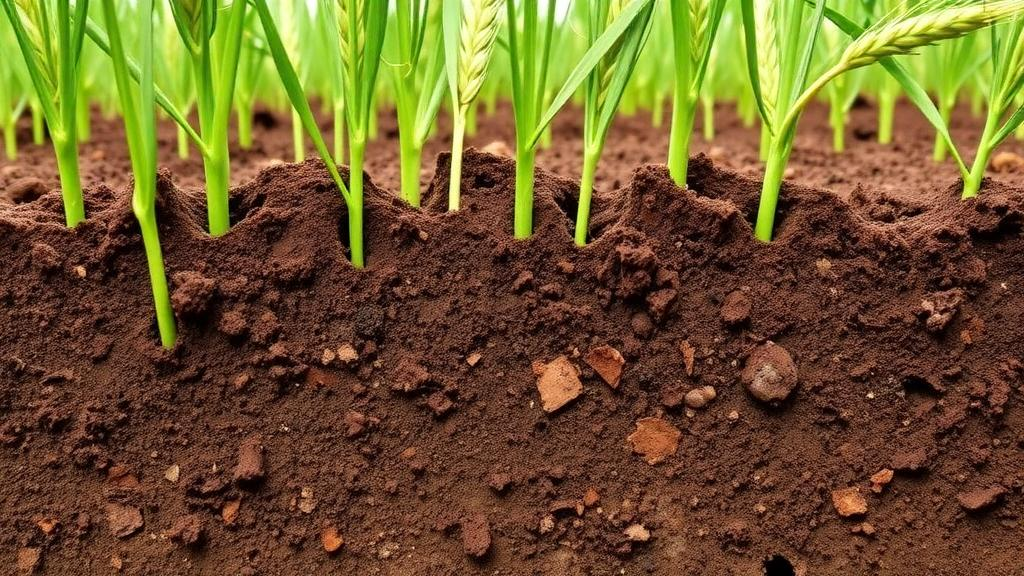
Beneath every wheat field lies an invisible economy. Fungi decompose crop residues, shuttle nutrients to plant roots, suppress pathogens, and occasionally attack the very crops they share the soil with. A new long-term study from the Loess Plateau of China, published in the journal Plant and Soil, now offers some of the clearest evidence yet that the intensive management practices used to squeeze more grain from dryland soils are quietly dismantling the fungal infrastructure on which those harvests depend. After more than fourteen years of contrasting tillage and fertilization regimes, researchers found that conventional tillage and heavy nutrient inputs do not simply change which fungi live in the soil; they alter the architecture of the entire fungal community in ways that erode the relationship between soil network stability and crop yield.
The research team, led by Gohar Ali and Yongjun Liu of Lanzhou University together with colleagues at Northwest Normal University and Tianshui Normal University, took advantage of a rare scientific asset: a field experiment that has been running continuously for over fourteen years on the semiarid Loess Plateau, one of the most extensively farmed and erosion-prone agricultural regions on Earth. The experiment crossed two tillage systems, conventional tillage and no-tillage, with a suite of fertilization treatments involving nitrogen, phosphorus, and manure, applied alone and in combination. Across three consecutive wheat-growing seasons, the team sampled soils, sequenced the fungal communities using molecular markers, assigned each fungal operational taxonomic unit to functional guilds such as saprotrophs, symbionts, and pathogens, and measured wheat yields.
The technical heart of the study lies in how the researchers moved beyond simple diversity counts. Ecologists have long debated whether biodiversity per se drives ecosystem function, or whether the stability and organization of ecological networks matter more. To probe this, the team constructed fungal co-occurrence networks for each treatment and quantified their stability using a cohesion-based index, a method that measures the balance of positive and negative correlations among taxa and thus captures how tightly, and in what manner, the community is wired together. This approach, grounded in earlier theoretical work showing that interaction strength governs microbial community stability, allowed the researchers to ask a sharper question than diversity metrics alone can answer: does the way fungi are connected to one another predict how much wheat a field produces?
The answer, remarkably, was yes, but with an important caveat. Across the three wheat-growing years, the stability of the fungal network, rather than overall fungal diversity, was positively associated with crop yield, and this association held independently of soil fertility. In other words, it was not simply how many fungal species were present, or how fertile the soil was, that best explained productivity, but how coherently the fungal community was organized. Yet the study also found that this stability-yield linkage was weakened under conventional tillage and varied from year to year, suggesting that intensive physical disturbance of the soil severs the connection between a well-organized fungal community and the yield benefits it would otherwise confer.
Tillage emerged as a particularly powerful filter. Conventional tillage, which repeatedly inverts and pulverizes the topsoil, favored saprotrophic fungi, the decomposers that thrive on freshly exposed organic matter, while reducing the diversity of symbiotic guilds, including the arbuscular mycorrhizal fungi that form mutualistic partnerships with crop roots, and of pathogenic guilds. This makes ecological sense: physical disruption homogenizes the soil environment, rewards fast-growing opportunists, and breaks the delicate hyphal networks that symbiotic fungi need to function. The finding aligns with a growing body of international evidence that agricultural intensification reduces microbial network complexity and diminishes keystone taxa in roots and soils, from European Chernozems to large-scale surveys of Chinese farmland.
Fertilization told a more nuanced, time-dependent story. On average, nutrient additions increased overall fungal diversity, but the guild-level consequences depended strongly on which cropping year the samples came from. The decline of symbiotic fungi and the enrichment of pathogens appeared only in the first cropping year of the study window, after which these effects faded. This temporal contingency is a caution against snapshot studies: a single-season survey could easily conclude that fertilization is benign or beneficial to fungal communities, missing transient windows in which nutrient enrichment tilts the balance away from plant-beneficial mutualists and toward disease-causing organisms, a pattern that has been documented in grassland systems where nitrogen and phosphorus fertilization consistently favor pathogenic over mutualistic fungi.
Perhaps the most striking single result concerns one fungal taxon. The composition of the saprotrophic community, and in particular the relative abundance of a Cladosporium species designated OTU1, was positively correlated with wheat yield across all three years. Cladosporium is a genus with a dual reputation: some species act as plant growth-promoting endophytes, while others have demonstrated biocontrol activity against wheat powdery mildew. The finding that the abundance of this single dominant decomposer tracked yield more closely than any whole-community diversity index underscores an emerging theme in microbial ecology: in intensively managed systems, the identity and abundance of a few dominant taxa can matter more for ecosystem function than richness in the tail of the distribution.
The study also revealed a sobering temporal pattern. Across the three consecutive wheat-growing years, overall fungal diversity, the relative abundances and richness of both symbiotic and pathogenic fungi, and the cohesion-based network stability index all declined. This simultaneous erosion of diversity and network coherence, observed under continuing intensive management, suggests that the biotic foundations of dryland wheat production are not static capital but a depreciating asset. If the trend continues, the authors argue, the capacity of the soil fungal community to support productivity could be progressively undermined, even where chemical fertility is maintained through ongoing fertilizer application.
The practical implications are direct. The researchers conclude that optimizing management to balance the abundance of dominant saprotrophs while preserving fungal network stability is critical for sustaining long-term productivity in dryland agroecosystems, and they point to reduced tillage intensity as a concrete lever. No-tillage systems in this experiment preserved a fungal community structure more conducive to stable, yield-linked networks, consistent with prior work showing that long-term no-tillage and organic inputs enhance the diversity and stability of soil microbial communities. For the millions of hectares of dryland wheat that feed populations across semi-arid Asia and beyond, the message is that yield is not produced by fertilizer and seed alone; it is co-produced by an underground network of fungi whose organization can be protected, or destroyed, by the plow.
What makes this study resonate beyond agronomy is its contribution to a fundamental ecological question: what aspect of biodiversity actually sustains ecosystem functioning in a changing world? By showing that network stability outperforms species diversity as a predictor of yield, and that intensive management weakens that predictive link, the work adds dryland agroecosystems to the list of systems, from grasslands to continental-scale farmland, where the architecture of microbial interaction networks, not merely the census of species, governs how ecosystems perform. As agriculture faces mounting pressure to intensify in drylands while adapting to climate change, the fungi threading through the soil may prove to be both the most vulnerable and the most essential partners in that effort.
Subject of Research: Effects of long-term tillage and fertilization on soil fungal communities, network stability, and wheat yield in a dryland agroecosystem
Article Title: Intensive management reshapes soil fungal communities and weakens network stability-yield linkages in a dryland agroecosystem
Article References: Ali, G., Xi, H., Peng, Z., Naz, A., Shi, G., Mao, L., & Liu, Y. (2026). Intensive management reshapes soil fungal communities and weakens network stability-yield linkages in a dryland agroecosystem. Plant and Soil. https://doi.org/10.1007/s11104-026-09171-6
Image Credits: AI Generated
DOI: 10.1007/s11104-026-09171-6
Keywords: soil fungi, tillage, fertilization, dryland agroecosystem, wheat yield, fungal networks, network stability, Loess Plateau, arbuscular mycorrhiza, saprotrophic fungi, Cladosporium, agricultural intensification
Cite Scienmag News
Alan Morgan. (October 1, 2026). Intensive Farming Disrupts Underground Fungal Networks That Sustain Wheat Yields. Scienmag. https://scienmag.com/intensive-farming-disrupts-underground-fungal-networks-that-sustain-wheat-yields/
Alan Morgan. "Intensive Farming Disrupts Underground Fungal Networks That Sustain Wheat Yields." Scienmag, 1 October 2026, https://scienmag.com/intensive-farming-disrupts-underground-fungal-networks-that-sustain-wheat-yields/. Accessed 1 October 2026.
Alan Morgan. "Intensive Farming Disrupts Underground Fungal Networks That Sustain Wheat Yields." Scienmag. October 1, 2026. https://scienmag.com/intensive-farming-disrupts-underground-fungal-networks-that-sustain-wheat-yields/


