


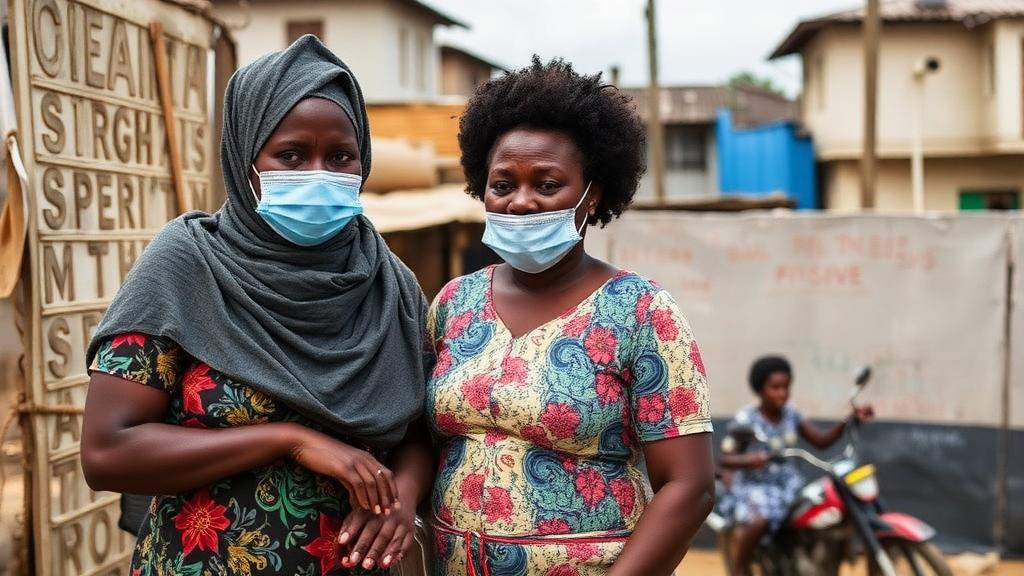
When COVID-19 swept through Lagos, one of Africa’s largest megacities with a population of roughly 20 million, the burden fell hardest on residents of crowded informal settlements. Yet according to a new study published in Discover Global Society, the Nigerian media largely told this story without its most important protagonists. Researchers analyzing news coverage from January 2020 to October 2021 found that women living in Lagos slums—who organized savings groups, ran skills-acquisition programs, and sustained communal care networks during lockdowns—were almost entirely absent from coverage, and when they did appear, they were cast as helpless victims waiting for rescue rather than as community leaders and economic actors.
The research team, led by Solomon Tommy of the University of Oklahoma together with colleagues at the University of Lagos, applied a qualitative critical media analysis to a corpus of news reports retrieved from more than 37 Nigerian online news outlets. After removing duplicates and screening for relevance, 17 unique reports from 10 distinct organizations remained for in-depth analysis. The authors are candid about what that small number signifies: the scarcity of slum-focused pandemic coverage itself reflects the under-representation the study set out to examine. Most of the coverage—13 of the 17 stories—appeared in 2020, during the initial outbreak and lockdown phase, and emphasized emergency framing, exposure, risk, and humanitarian need. Coverage of longer-term recovery and adaptation declined sharply in 2021.
The quantitative patterns within the sample are striking. Only one of the seventeen slum-focused pandemic reports centered women, and only two featured women as the dominant voice. Male voices appeared in sixteen reports, while women were quoted in ten and entirely absent in seven. When women were present, they were framed as victims in nine reports and as dependents in ten. Their agency was coded as present in just three reports, limited in eleven, and absent in three. In other words, the discursive space occupied by women was marginal even in stories ostensibly about the communities in which they live.
The study is grounded in three complementary theoretical frameworks. Framing theory, building on Robert Entman’s influential ‘selection and salience’ postulation, holds that media narratives shape public perception by selectively emphasizing certain aspects of reality while obscuring others—a ‘second level’ of agenda setting that concerns not just how much attention an issue receives but the direction of that attention. Feminist perspectives, particularly Kimberlé Crenshaw’s concept of intersectionality, provide the critical lens for examining how gender, socioeconomic status, and spatial marginalization compound one another. Development media theory, associated with Denis McQuail, serves as the normative benchmark: it prescribes that media should focus attention on developmental concerns and disadvantaged populations, making the Nigerian coverage a case study in the failure of that therapeutic duty.
Three dominant frames emerged from the analysis. The first is the dominance of official and male voices alongside the erasure of women’s narratives. In one representative story about an airline donating food to ‘less-privileged’ residents of Sabo, Makoko and Ajegunle, the only quoted voices belonged to the company and its officials; residents appeared solely as nameless, agency-less beneficiaries, described entirely through the eyes of their benefactors. The researchers, drawing on Teun van Leeuwen’s account of suppression and backgrounding through generalization, note that institutional actors were named and given identity while residents were subsumed under broad categories. Similar dynamics appeared in stories about NGO relief distribution, where organizational representatives determined communities’ needs while inhabitants lost voice and identity in exchange for aid.
The second frame is victimhood and dependency framing. In one BusinessDay report, women described their plight in stark terms: ‘We almost died of hunger; there were no palliatives for us… We are lying down helplessly with no food, no water and no drugs.’ The analysis highlights how passive language and the recurring negation ‘no… no… no…’ present women through a deficit prism, defined by what they lack rather than what they possess. Another Punch HealthWise story on maternal mortality in Makoko, the researchers argue, locates the problem in women’s reproductive bodies rather than in the socio-structural dysfunction—systemic disenfranchisement from healthcare infrastructure, underfunded public services, and spatial segregation—that actually raises the risk of childbirth in these areas. This, they contend, echoes what feminist theorist Elizabeth Grosz criticizes as biological essentialism, reducing women’s experience to bodily functions while excising their potential for political and social contribution.
The third frame is the dilution of gendered agency. The rare exception in the dataset, a story in The Cable about fish traders who sustain Lagos’s food supply, portrayed women as economic actors coping and organizing under constrained conditions, describing how they survived the lockdown on diminished earnings. Yet even this outlier, the authors note, attributed women’s exclusion from digital markets to their own ‘lack of education’ rather than to the systemic barriers created by governments and financial institutions—a rhetorical move that shifts blame from powerful actors onto the women themselves. The rarity of such agency-based narratives underscores how peripheral they are within mainstream coverage, where women’s organizing and women-led recovery initiatives are either ignored or treated as one-off curiosities.
The implications of this framing extend well beyond representation. First, the researchers argue, it produces discursive disempowerment and delegitimization: when media fail to platform women or frame them merely as passive aid recipients, they confer legitimacy on institutional actors while eroding recognition of women’s contributions to urban resilience, including the reproductive labor, communal care systems, and informal support infrastructures that sustained families and neighborhoods during and after lockdowns. Second, the constant foregrounding of governments, NGOs, and corporations as rescuers entrenches existing power imbalances, reinforcing what the authors call a self-fulfilling prophecy among marginalized populations about their capacity for self-progress and dampening demand for participatory, locally driven development. Third, repeated dependency frames erode women’s sense of self-deterministic efficacy, normalizing a system in which institutions dispense aid and women receive it.
The study also situates its findings in a global context. Comparable research on Bangladesh’s urban slums found that ‘the documentation of slum-dweller mobilisation and agency remains largely invisible,’ suggesting that the pattern is a Global South-wide phenomenon rather than a uniquely Nigerian one. Scholars cited in the study have shown that women are often depicted in passive victim roles during disasters and health crises while men appear as active leaders, and that such stereotypical framing influences women’s self-perceptions, public perceptions of women’s resilience, and external policy responses. Because media narratives perform an agenda-setting function, skewed coverage can hamper the policy reactions needed to tackle the socio-structural inequalities that sustain the status quo.
The authors conclude with a call for counter-hegemonic framing: women should be recognized as primary narrators of their own experiences, and newsrooms should adopt solutions journalism approaches that causally link vulnerability to structural injustice rather than to gendered deficiencies. With women constituting roughly half of Nigeria’s population, the researchers argue, perpetuating stereotypes that limit their capacity to contribute to positive change amounts to urban injustice. Genuine urban resilience during future pandemics, they contend, demands participatory and inclusive narratives that treat slum-dwelling women not as exemplars of urban decay awaiting rescue, but as essential partners in navigating the crises that cities like Lagos will inevitably face again.
Subject of Research: Media framing of gender, vulnerability and agency among women in Lagos slums during the COVID-19 pandemic
Article Title: Media constructions of gendered helplessness and the decentring of women in Lagos slums during the COVID 19 pandemic
Article References: Tommy, S., Ogwezzy-Ndisika, A. O., Faustino, B. A., & Aleshinloye, O. (2026). Media constructions of gendered helplessness and the decentring of women in Lagos slums during the COVID 19 pandemic. Discover Global Society, 4(1), Article 243. https://doi.org/10.1007/s44282-026-00578-1
Image Credits: AI Generated
DOI: 10.1007/s44282-026-00578-1
Keywords: media framing, COVID-19, Lagos slums, gender, women's agency, urban resilience, Nigeria, critical discourse analysis, victimhood framing, informal settlements, feminist media studies, development journalism
Cite Scienmag News
Kristina Jarvis. (October 1, 2026). How Nigerian Media Erased Women’s Pandemic Heroics in Lagos Slums. Scienmag. https://scienmag.com/how-nigerian-media-erased-womens-pandemic-heroics-in-lagos-slums/
Kristina Jarvis. "How Nigerian Media Erased Women’s Pandemic Heroics in Lagos Slums." Scienmag, 1 October 2026, https://scienmag.com/how-nigerian-media-erased-womens-pandemic-heroics-in-lagos-slums/. Accessed 1 October 2026.
Kristina Jarvis. "How Nigerian Media Erased Women’s Pandemic Heroics in Lagos Slums." Scienmag. October 1, 2026. https://scienmag.com/how-nigerian-media-erased-womens-pandemic-heroics-in-lagos-slums/


