


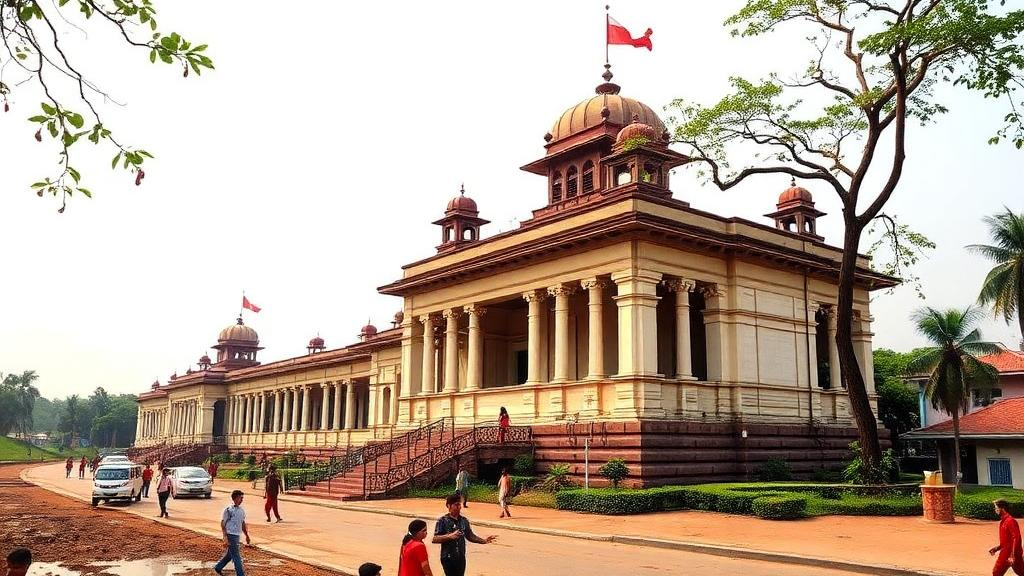
Between 1906 and 1917, the districts of East Bengal became the stage for one of the most intense and least celebrated chapters of anti-colonial resistance in British India. While historians have long treated Calcutta as the undisputed nerve center of revolutionary nationalism, a new study published in Discover Global Society argues that this metropolitan focus has obscured a far more geographically distributed story. Drawing on colonial administrative records, court proceedings, police files, contemporary newspapers, and revolutionary memoirs, the research reconstructs how underground networks in Dhaka, Chittagong, Comilla, Rangpur, Narayanganj, Mymensingh, Jessore, and Faridpur carried out armed robberies of government treasuries, raids on police stations, and clandestine arms collection for more than a decade. The findings challenge the conventional Calcutta-centric narrative and reposition East Bengal as a central, not peripheral, arena of the freedom movement.
The study is grounded in two theoretical frameworks that together explain why resistance flared so fiercely in this particular region. The first is center-periphery theory, which describes how political and economic power concentrates in a dominant region while other areas remain marginalized and dependent. From the mid-eighteenth century, Calcutta served as the administrative and commercial heart of British Bengal, attracting railways, industries, schools, and cultural institutions. East Bengal, despite its fertile rice, indigo, and jute lands, remained an extraction zone: raw materials flowed out to feed the mills and export houses near Calcutta, while employment, education, and political influence stayed firmly in the center. The jute mills that generated enormous profits for British and Bengali elites were all located near the colonial capital, never in the districts where the crop was actually grown.
This structural imbalance was compounded by social and educational disparities. The bhadralok elite of Calcutta dominated administration, literature, and nationalist politics, while the largely rural and Muslim-majority population of East Bengal was frequently portrayed as backward and excluded from decision-making. Students who wanted higher education often had to travel to Calcutta. The only moment when East Bengal gained administrative importance came with the 1905 Partition of Bengal, when Dhaka briefly became the capital of the new province of Eastern Bengal and Assam. Calcutta’s elites, fearing a loss of control, pressured the government into overturning the partition in 1911, and East Bengal’s peripheral status was restored. The researchers argue that this accumulated resentment left a durable consciousness of inequality, one that echoed decades later when East Pakistan, and later Bangladesh, confronted a new dominant center in West Pakistan.
The second framework, frustration-aggression theory, explains the psychological mechanism linking deprivation to violence. According to this model, when groups perceive that their political, social, and economic expectations are systematically blocked, frustration converts into anger and, ultimately, aggressive action. In colonial East Bengal, revolutionaries were denied political rights, economic opportunity, and social freedoms, and constitutional politics repeatedly failed to deliver change. The result was a turn toward direct action: raids on police stations, plundering of government treasuries, and sudden assaults on colonial officials. The study documents how this logic played out year by year, beginning with attempted robberies in Rangpur and Dhaka districts in 1906 and escalating through the following decade.
The quantitative record assembled by the researchers is striking. In June 1908, revolutionaries carried out one of the largest operations of the period, a raid on the Nawabganj police station in Dacca district, attributed to Pulin Das, head of the Anushilan Samiti. Four people were killed, several were injured, one revolutionary died, and roughly 25,867 rupees were looted. By 1909, rebels were extracting the largest sums from Dhaka, Faridpur, and Tippera, including 34,000 rupees from Rajendrapur and 27,827 rupees from Manikganj. Those captured faced penalties ranging from rigorous imprisonment to exile and death. The colonial state responded with a wave of repressive legislation: the Prevention of Sedition Meetings Act of 1907, the Newspapers Act of 1908, and the India Press Act of 1910, alongside deportations under Regulation III of 1818. In November 1908, nine prominent leaders of East Bengal, including Aswini Kumar Dutta and Pulin Behari Das, were arrested.
Yet repression alone cannot explain why East Bengal sustained resistance so effectively, and this is where the study’s analysis of geography and infrastructure becomes compelling. The region’s extensive river systems, wetlands, forests, and dispersed rural settlements made continuous colonial surveillance both difficult and expensive. Rivers and waterways allowed revolutionaries, weapons, and confidential information to move between districts with far less scrutiny than road transport would have permitted. Forests and remote villages provided secure locations for secret meetings, political training, and refuge. Rather than viewing these landscapes as mere backdrops, the researchers treat them as strategic assets that enabled decentralized operations and limited the effectiveness of British intelligence.
Colonial infrastructure itself became an unwitting ally of the revolutionaries. Railways, telegraph lines, and river transport were built to serve imperial extraction and military mobility, not rural development, and the resulting administrative gap between commercial centers and the countryside left large areas under-policed and under-governed. The colonial state relied heavily on local intermediaries for revenue collection and order, an indirect system that often failed to ensure real control. Organizations such as the Anushilan Samiti and Jugantar exploited these weaknesses, using village networks and informal communication channels to recruit members, circulate political literature, and coordinate operations beyond the reach of colonial authorities. Ironically, the very railways designed to move jute and troops also moved activists, arms, and pamphlets across district lines.
The paradox of colonial education emerges as a central theme. Official census and gazetteer records show that male literacy in Dacca reached 19.1 percent in 1901, well above the Bengal average of 10.4 percent, and the expansion of colleges and entrance schools created a broad institutional base for an educated service class. Teachers, pleaders, clerks, students, and journalists formed a stratum whose aspirations were tied to the colonial state, yet whose advancement was blocked by racial discrimination and exclusion from higher authority. The Ilbert Bill controversy of 1883 exposed the racial foundations of imperial governance and shattered educated Indians’ faith in British liberal pretensions. When the 1905 partition sharpened debates over representation and regional identity, sections of this educated middle class abandoned moderate constitutionalism and supplied recruits, organizers, and ideological energy to underground societies such as the Dacca Anushilan Samiti.
Cultural and religious networks provided the connective tissue that bound these elements together. Schools, temples, madrasas, community festivals, and local associations, all beyond effective colonial control, became informal arenas for political discussion. Folk songs, devotional music, storytelling, and local theatre carried moral critiques of oppression in forms accessible to largely illiterate rural audiences, while vernacular pamphlets and underground presses spread nationalist messages in Bengali. Reform movements such as the Brahmo Samaj and the Faraizi Movement, though not revolutionary organizations themselves, cultivated disciplined networks of socially conscious individuals and fostered critical engagement with colonial authority. Revolutionary writers also revived the memory of figures like Titumir, Sitaram Ray, and Siraj-ud-Daulah, presenting resistance to foreign domination as part of Bengal’s own historical tradition rather than an imported ideology.
The movement was also shaped by global currents. Japan’s victory over Russia in 1905 demonstrated that an Asian power could defeat a European one, while the Iranian Constitutional Revolution, the Young Turk Movement, Irish nationalism, and the Russian Revolutions supplied organizational models and ideological confidence. The First World War exposed Britain’s vulnerabilities and intensified economic hardship in India, which revolutionaries read as evidence that colonial rule was neither permanent nor invincible. Vernacular newspapers connected local readers to these international struggles, embedding East Bengal’s uprising within a wider transnational network of anti-imperial thought. The study’s authors acknowledge limitations, including incomplete statistical records and the underexplored roles of women and lesser-known activists, but their central conclusion stands: East Bengal’s revolutionary fervor grew from the interaction of marginalization, geography, frustrated education, and cultural solidarity, and any account of India’s freedom struggle that ignores the periphery misses half the story.
Subject of Research: The role of educational governance, socioeconomic structures, and geography in shaping revolutionary anti-colonial activities in East Bengal, 1906–1917
Article Title: The role of educational governance and socioeconomic structures in shaping revolutionary activities in East Bengal
Article References: Akter, S., Zayed, N. M., Islam, K. M. A., Ani, N. A., Bipasha, M. S., Nitsenko, V., & Pustovar, V. (2026). The role of educational governance and socioeconomic structures in shaping revolutionary activities in East Bengal. Discover Global Society, 4(1), Article 242. https://doi.org/10.1007/s44282-026-00604-2
Image Credits: AI Generated
DOI: 10.1007/s44282-026-00604-2
Keywords: East Bengal, colonialism, revolutionary nationalism, Anushilan Samiti, Jugantar, center-periphery theory, colonial education, Partition of Bengal, Dhaka, anti-colonial resistance, frustration-aggression theory, British India
Cite Scienmag News
Courtney Benton. (October 1, 2026). How Colonial Schools and Rivers Turned East Bengal Into a Revolutionary Hotbed. Scienmag. https://scienmag.com/how-colonial-schools-and-rivers-turned-east-bengal-into-a-revolutionary-hotbed/
Courtney Benton. "How Colonial Schools and Rivers Turned East Bengal Into a Revolutionary Hotbed." Scienmag, 1 October 2026, https://scienmag.com/how-colonial-schools-and-rivers-turned-east-bengal-into-a-revolutionary-hotbed/. Accessed 4 October 2026.
Courtney Benton. "How Colonial Schools and Rivers Turned East Bengal Into a Revolutionary Hotbed." Scienmag. October 1, 2026. https://scienmag.com/how-colonial-schools-and-rivers-turned-east-bengal-into-a-revolutionary-hotbed/


