


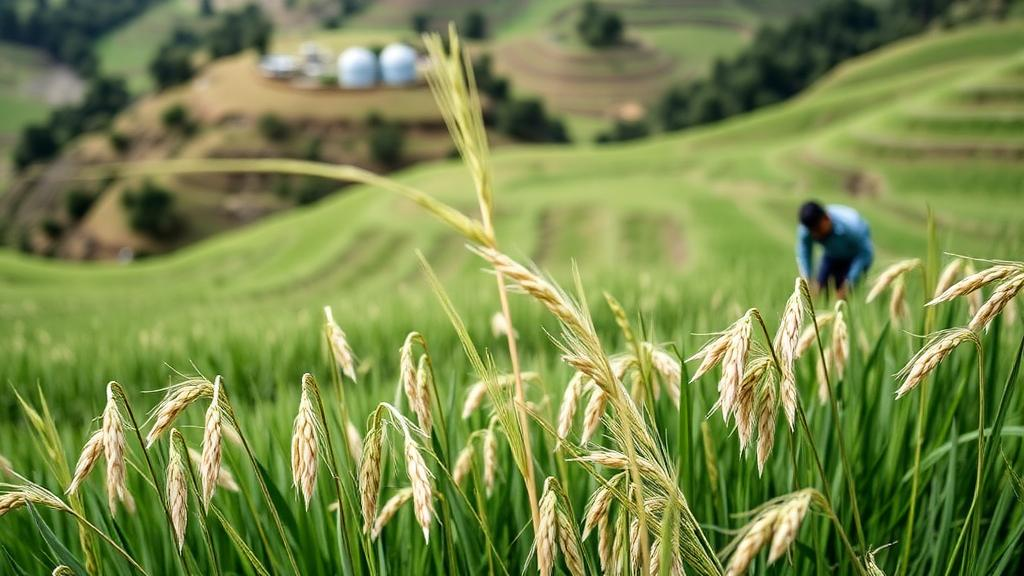
Rice is the staple food for billions of people, yet breeding varieties that perform reliably across wildly different landscapes remains one of agriculture’s stubborn challenges. A new multi-environment study published in the Indian Journal of Genetics and Plant Breeding has taken on that challenge in one of the world’s most demanding settings: the hill ecologies of the North-Western Himalayas. A team led by Najeeb R. Sofi of the Mountain Research Centre for Field Crops at Sher-e-Kashmir University of Agricultural Sciences and Technology of Kashmir evaluated rice genotypes bred for medium to high altitudes, ranging from 900 to 1,900 metres above sea level, and used a trio of sophisticated statistical frameworks to separate genuinely superior varieties from those that merely look good in one lucky season.
The scale of the study is notable. Over five consecutive kharif cropping seasons, from 2016 to 2020, researchers recorded two critical traits, days to 50 percent flowering and grain yield, across five locations: Khudwani and Wadura in Jammu and Kashmir, Malan in Himachal Pradesh, Almora in Uttarakhand, and Pombay. These sites span three Indian hill states and represent sharply contrasting combinations of altitude, temperature, rainfall patterns, and growing-season length. The genotypes fell into groups named after their breeding centres: KHDVAR from Jammu and Kashmir, MLNVAR from Himachal Pradesh, and ALMVAR from Uttarakhand, alongside national, zonal, and local check varieties that served as benchmarks.
The first analytical step was a combined analysis of variance, and its message was unambiguous. Genotype, environment, and the interaction between them all had highly significant effects on both flowering time and grain yield, with statistical confidence at the one percent level. Crucially, the environment itself was the dominant force, accounting for roughly 33 percent of the total variation in grain yield. That single number explains why hill rice breeding is so difficult: the growing conditions at a given site in a given year matter more than the genetic identity of the plant, and a variety that thrives in one valley can disappoint in the next one over.
To disentangle this complexity, the team deployed the Additive Main Effects and Multiplicative Interaction model, known as AMMI. This approach combines conventional analysis of variance for the main effects with principal component analysis of the interaction terms, producing what breeders call interaction principal component axes. The results were strikingly clean: the first interaction principal component, IPC1, captured 92.7 percent of the interaction sum of squares for grain yield. In practical terms, almost the entire pattern of genotype-by-environment interaction could be visualized and interpreted along a single axis, a level of parsimony that makes the biplots generated from the analysis genuinely useful for decision-making rather than merely decorative.
The AMMI biplots told a clear story about regional adaptation. The local check, zonal check, and the KHDVAR group from Jammu and Kashmir emerged as superior performers at Khudwani and Wadura, the Kashmir Valley sites. Meanwhile, MLNVAR and ALMVAR, bred at Malan and Almora respectively, were better adapted to their home environments in Himachal Pradesh and Uttarakhand. This pattern of local adaptation is exactly what breeders would expect when varieties have been selected over generations of trials at their respective stations, but quantifying it rigorously across five seasons gives the recommendation far more weight than anecdotal field impressions ever could.
The researchers then turned to GGE biplot analysis, a related graphical method that focuses on the genotype main effect plus the genotype-by-environment interaction effect, deliberately excluding the environment main effect to highlight which genotypes win where. This analysis grouped the five test sites into two mega-environments. In the first, comprising Khudwani, Pombay, and Wadura, the zonal check and local check were the winning genotypes. In the second, covering Malan and Almora, the national check took the crown. Mega-environment delineation is one of the most consequential outputs of this kind of analysis, because it tells breeding programs where they can share varieties and where they must develop location-specific ones.
Stability, the ability of a genotype to deliver consistent performance regardless of environment, was assessed alongside adaptation. Here the ALMVAR group stood out as the most stable genotype across the trial network, holding its performance steady whether conditions were favourable or harsh. At the opposite extreme, the national check proved highly unstable for both flowering time and yield, fluctuating dramatically between locations. For farmers in marginal hill environments, where a single failed season can threaten household food security, stability can matter as much as peak yield, and the identification of a reliably stable group is among the study’s most practically valuable findings.
The third analytical pillar, Best Linear Unbiased Prediction or BLUP, brought a mixed-model perspective to the data. Unlike the biplot methods, BLUP uses restricted maximum likelihood to estimate genotype effects while properly accounting for the random structure of environments and years, shrinking estimates toward the mean to avoid overreacting to single-season flukes. The BLUP predictions confirmed the biplot conclusions and added precision to the rankings: the local check topped the yield table at 5.29 tonnes per hectare, followed by the zonal check at 5.05 tonnes per hectare, while KHDVAR was confirmed as broadly adapted across the network rather than dependent on any single site.
The convergence of three independent statistical frameworks on the same set of conclusions is what gives this study its authority. AMMI excels at describing the structure of interaction, GGE biplots excel at visualizing which genotype wins in which environment and at defining mega-environments, and BLUP excels at producing unbiased, shrinkage-adjusted estimates of genetic merit. When all three point to the same candidates, breeders can act with confidence. In this case, the local check, the zonal check, and the KHDVAR group emerged as promising candidates for cultivation across the North-Western Himalayan region, with KHDVAR’s broad adaptation making it especially attractive for programs that cannot afford location-specific seed systems.
The implications extend well beyond the trial fields. Mountain agriculture faces intensifying pressure from climate variability, with erratic monsoons, shifting temperature regimes, and shortened growing windows threatening the delicate rice systems of the Himalayan foothills. Studies like this one demonstrate that the statistical machinery exists to match varieties to landscapes with real precision, and that multi-year, multi-location testing is not a luxury but a necessity in heterogeneous ecologies. For the hill farmers of Jammu and Kashmir, Himachal Pradesh, and Uttarakhand, the message is concrete: varieties proven stable and high-yielding across five seasons and five environments are now identified, and the path from trial plot to farmer’s field is shorter than it has ever been. As food systems worldwide grapple with environmental uncertainty, the humble rice paddies of the Indian hills are showing how rigorous quantitative genetics can turn ecological complexity from an obstacle into a roadmap.
Subject of Research: Genotype-by-environment interaction and stability analysis of rice genotypes across Indian Himalayan hill ecologies
Article Title: Multi-Environment Analysis of Rice (Oryza Sativa L.) Genotypes Under Indian Hill Ecologies
Article References: Sofi, N. R., Dar, M. S., Mir, S., Shikari, A. B., Bharadwaj, N., Aditya, J. P., Basanadrai, D., Khan, G. H., Hussain, A., Nisa, N.-U., & Naik, Z. (2026). Multi-Environment Analysis of Rice (Oryza Sativa L.) Genotypes Under Indian Hill Ecologies. Indian Journal of Genetics and Plant Breeding, 86(2), 117-128. https://doi.org/10.1007/s44489-026-00017-0
Image Credits: AI Generated
DOI: 10.1007/s44489-026-00017-0
Keywords: rice, genotype-environment interaction, AMMI, GGE biplot, BLUP, grain yield, stability analysis, Himalayas, plant breeding, multi-environment trials, India, Oryza sativa
Cite Scienmag News
Alan Morgan. (October 1, 2026). Rice Genotypes Ranked for Stability Across India’s Himalayan Hill Farms. Scienmag. https://scienmag.com/rice-genotypes-ranked-for-stability-across-indias-himalayan-hill-farms/
Alan Morgan. "Rice Genotypes Ranked for Stability Across India’s Himalayan Hill Farms." Scienmag, 1 October 2026, https://scienmag.com/rice-genotypes-ranked-for-stability-across-indias-himalayan-hill-farms/. Accessed 1 October 2026.
Alan Morgan. "Rice Genotypes Ranked for Stability Across India’s Himalayan Hill Farms." Scienmag. October 1, 2026. https://scienmag.com/rice-genotypes-ranked-for-stability-across-indias-himalayan-hill-farms/


