


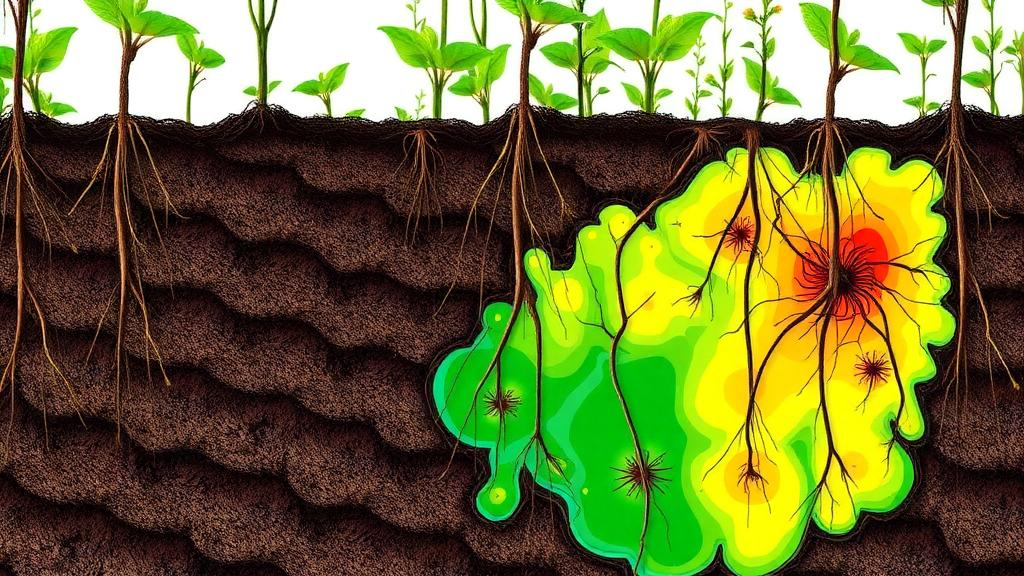
Heavy metal contamination of river basins is one of those slow-motion environmental crises that rarely makes headlines until crops fail or water supplies are declared unsafe. Yet across the industrializing world, cadmium, lead, chromium, and other toxic metals quietly accumulate in the soils and sediments that feed entire watersheds. A new study published in Environmental Management by Prabhat Dwivedi and Brijesh Kumar Yadav of the Indian Institute of Technology Roorkee offers a strikingly different way of seeing this problem. Instead of treating vegetation as a uniform blanket exposed identically to pollution, the researchers built a framework that asks a deceptively simple question: how deep do a plant’s roots go, and does the contamination reach them? The answer, their work shows, changes everything about where and when ecological risk materializes across a contaminated landscape.
The conceptual backbone of the study is the classic source-pathway-receptor model, a staple of environmental risk assessment that traces a pollutant from its origin, through the environmental media that transport it, to the living thing it ultimately harms. What makes the new framework novel is its depth-specific treatment of the receptor. Rather than assessing ecological risk for vegetation in general, the authors split the plant community into shallow-rooted and deep-rooted systems, designated S-VER and D-VER respectively. Shallow-rooted vegetation, including most annual crops and grasses, draws water and nutrients from upper soil horizons where surface runoff, atmospheric deposition, and irrigation with contaminated water deliver their loads. Deep-rooted vegetation, such as trees and perennial species, taps subsurface layers where metals arrive more slowly through leaching and groundwater movement. By separating these two worlds, the framework captures a dimension of vulnerability that conventional assessments simply average away.
To quantify risk, the researchers combined three components: contamination source intensity, environmental pathway intensity, and vegetation receptor vulnerability. Each component was scored across the river basin and then integrated using the entropy weighting method, an information-theoretic technique that assigns weights to variables based on how much variability and discriminating power they carry. The elegance of entropy weighting lies in its objectivity. Where a variable differs sharply from place to place or season to season, it receives a larger weight because it conveys more information about actual risk patterns; where a variable is nearly uniform, it is down-weighted. This reduces the subjective judgment that plagues many multi-criteria risk assessments and allows the data itself to shape the final risk map.
The study area is the Hindon River basin in northern India, a Yamuna tributary draining a densely populated, rapidly industrializing stretch of western Uttar Pradesh. The Hindon has long been documented as carrying heavy loads of industrial effluent, untreated sewage, and agricultural runoff, and prior work by the same group had already characterized the dynamics of heavy metals in its waters using hydrological modeling and field monitoring. For the new framework, the team performed an integrated environmental risk assessment for both pre-monsoon and post-monsoon seasons of 2023, establishing baseline conditions across the basin before layering on the vegetation-specific analysis. This seasonal pairing matters enormously in monsoon-driven landscapes, because the annual deluge reshapes hydrological pathways, flushing contaminants from some zones and redistributing them into others.
The results reveal two fundamentally different risk behaviors. Shallow-root vegetation risk, or S-VER, emerged as moderate in magnitude but highly seasonal, tracking the surface hazards that dominate its exposure. This variability was most pronounced in the agricultural production and ecological function zones of the basin, precisely the areas where crops and natural vegetation intermingle and where monsoon dynamics most strongly modulate contaminant transport. When the monsoon arrives, surface flows intensify, irrigation patterns shift, and the metals sitting in topsoil and surface water are mobilized in ways that directly buffet shallow root systems. Deep-root vegetation risk, by contrast, remained comparatively stable at low-to-moderate levels across both seasons. Its exposure is governed by subsurface contamination, which changes far more slowly, reflecting the gradual leaching of metals downward and the buffering capacity of deeper soil profiles.
Perhaps the most consequential finding is geographic. The lower Hindon basin surfaced as a major ecological risk hotspot for both shallow- and deep-rooted vegetation. The explanation is cumulative: contaminants generated by upstream industry and agriculture accumulate as they travel downstream, so the lower reaches receive the integrated pollution burden of the entire basin. At the same time, vegetation in these downstream zones exhibits reduced resilience, meaning the plants there have less capacity to withstand additional stress. The combination of maximal contaminant loading and diminished biological buffering makes the lower basin a double jeopardy zone, and the framework makes this convergence visible in a way that scattered water quality measurements never could.
Critical to the credibility of any risk model is independent validation, and here the authors turned to satellites. They used the normalized difference vegetation index, or NDVI, a widely used remote sensing measure calculated from the way vegetation reflects red and near-infrared light. Healthy, vigorous canopies reflect strongly in the near-infrared and absorb red light for photosynthesis, producing high NDVI values; stressed or declining vegetation shows the opposite signature. The study found an inverse relationship between NDVI-derived vegetation response and the modeled ecological risk, meaning that where the framework predicted high risk, the greenness of the landscape was measurably degraded. This agreement between a model built from contamination data and an observational signal captured from orbit provides strong evidence that the depth-specific risk scores correspond to real biological outcomes on the ground.
The technical machinery underlying the framework also deserves attention because it is designed for replication. The entropy weighting method has gained traction in environmental evaluation precisely because it converts heterogeneous indicator data into defensible composite scores without requiring analysts to hand-tune importance coefficients. Combined with geographic information systems for spatial mapping and seasonal monitoring for temporal resolution, the approach yields risk surfaces that watershed managers can read almost like diagnostic images: hotspots appear where they are, and the distinction between S-VER and D-VER tells remediation planners whether the problem lives in the topsoil or in the deeper subsurface. That distinction has direct practical consequences, because surface contamination can often be addressed through soil amendments, phytoremediation with shallow-rooted accumulators, or changes in irrigation practice, while subsurface contamination demands longer-term strategies targeting groundwater and leaching pathways.
The broader significance of the work lies in its challenge to a pervasive assumption. Most ecological risk assessments implicitly treat vegetation exposure as uniform, which flattens the reality that a wheat field and an orchard sharing the same contaminated basin experience pollution through entirely different channels. By building root depth into the architecture of risk assessment, Dwivedi and Yadav have created what they describe as a targeted diagnostic tool for watershed management and localized ecological remediation in contaminated river basins. For rapidly developing regions where heavy metal contamination threatens crop productivity, food safety, and long-term ecological security, such tools are not academic luxuries. They determine where scarce remediation dollars go and whether interventions arrive before irreversible damage is done.
There are also instructive limits to what the framework can say. Its validation rests on NDVI, which is sensitive to vegetation stress from many causes, including drought, heat, and land use change, so disentangling the metal-specific signal from other stressors remains an ongoing challenge. The entropy weights are data-driven, which is a strength, but they inherit the quality and coverage of the underlying monitoring networks, and in many contaminated basins those networks are sparse. Seasonal snapshots from a single year cannot capture multi-year trends in subsurface metal accumulation, which is precisely the slow variable that governs deep-rooted risk. Still, the direction of travel is clear. By fusing classical contaminant hydrology with information-theoretic weighting and satellite validation, the study sketches a template that other stressed river basins, from the Liaohe in China to industrialized tributaries worldwide, could adapt. The deeper lesson is conceptual: risk is not a single number draped over a landscape, but a layered story written at different depths, and only by reading every layer can managers protect both the shallow roots that feed us this season and the deep roots that anchor ecosystems for decades.
Subject of Research: Depth-specific ecological risk assessment of heavy metal contamination to shallow- and deep-rooted vegetation in a river basin
Article Title: A Source-pathway-receptor Framework for Quantifying Ecological Risk to Shallow- and Deep-rooted Vegetation under Heavy Metal Contamination
Article References: A Source-pathway-receptor Framework for Quantifying Ecological Risk to Shallow- and Deep-rooted Vegetation under Heavy Metal Contamination. (n.d.). https://doi.org/10.1007/s00267-026-02587-x
Image Credits: AI Generated
DOI: 10.1007/s00267-026-02587-x
Keywords: heavy metal contamination, ecological risk assessment, source-pathway-receptor, shallow-rooted vegetation, deep-rooted vegetation, entropy weighting method, NDVI, Hindon River basin, river basin management, soil contamination, phytoremediation, Environmental Management
Cite Scienmag News
Violet Maxwell. (October 1, 2026). New Risk Map Reveals How Heavy Metals Strike Plant Roots at Different Depths. Scienmag. https://scienmag.com/new-risk-map-reveals-how-heavy-metals-strike-plant-roots-at-different-depths/
Violet Maxwell. "New Risk Map Reveals How Heavy Metals Strike Plant Roots at Different Depths." Scienmag, 1 October 2026, https://scienmag.com/new-risk-map-reveals-how-heavy-metals-strike-plant-roots-at-different-depths/. Accessed 1 October 2026.
Violet Maxwell. "New Risk Map Reveals How Heavy Metals Strike Plant Roots at Different Depths." Scienmag. October 1, 2026. https://scienmag.com/new-risk-map-reveals-how-heavy-metals-strike-plant-roots-at-different-depths/


