


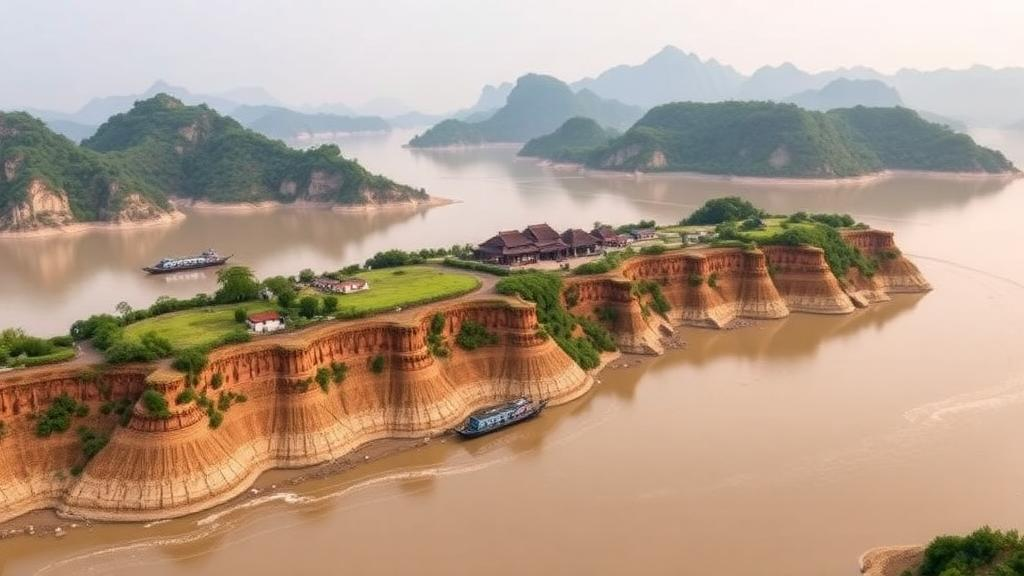
One of the most enduring questions in archaeology is why some landscapes become cradles of civilization while others do not. In the Lower Yangtze River region of eastern China, the answer may lie partly in the slow retreat of water from land that was once dominated by rivers, lakes, and coastal wetlands. A new study published in Science China Earth Sciences, led by Professor Jia Xin of the Institute of Environmental Archaeology at Nanjing Normal University, reconstructs thousands of years of environmental change at the Xuecheng archaeological site and shows how declining water levels progressively created new habitable ground, guiding where prehistoric communities lived, how they moved, and ultimately how complex society took root in the region.
The Xuecheng site preserves an unusually complete cultural record spanning the Majiabang, Songze, and Liangzhu cultural sequences, from approximately 7,000 to 4,000 years before present. These three cultures represent successive stages of prehistoric development in the Lower Yangtze, from early sedentary villages to the socially stratified Liangzhu society famous for its sophisticated water management and jade craftsmanship. Because the site contains remains from all three periods in a single geomorphological setting, it offers researchers a rare opportunity to track the relationship between landscape evolution and human settlement decisions across nearly three millennia without the confounding effects of comparing different locations.
To reconstruct that relationship, the team deployed a comprehensive multi-proxy toolkit. Sediment lithology, grain-size distributions, and geochemical compositions revealed the physical and chemical character of deposits through time. Magnetic susceptibility helped distinguish soil-forming intervals from episodes of deposition, while diatom assemblages and fossil pollen provided direct evidence of aquatic environments and vegetation change. AMS radiocarbon dating anchored the sequence in time, and high-precision RTK elevation measurements allowed the researchers to map the microtopography of the site with centimeter-scale accuracy. By integrating these lines of evidence, the team could link each cultural phase to a specific environmental scenario, effectively producing a time-lapse reconstruction of the landscape and its occupants.
The results show that the terrace on which Xuecheng sits had already formed by approximately 20,000 years ago, during the last glacial period, and retained a distinctive structure: a relatively elevated central area surrounded by lower terrain. This topographic template proved decisive for later human occupation. Around 6,000 years before present, the site was still influenced by nearby waterfront conditions, and the earliest inhabitants of the Majiabang culture confined themselves to the top of the terrace, the only reliably dry ground available. Their settlement pattern was therefore not a matter of preference alone but a direct response to the hydrological limits of the landscape.
As water levels declined and land expanded outward from the terrace, human activities spread correspondingly. By approximately 5,300 years before present, during the Songze period, occupation extended across a broader area of the terrace as newly exposed ground became available for habitation and activity. The correlation between terrestrialization and settlement expansion is striking: as the boundary between water and dry land retreated, the footprint of human activity followed it. This pattern suggests that prehistoric communities were not passive victims of environmental change but attentive observers of it, repeatedly repositioning themselves to exploit the freshest habitable terrain as it emerged.
The most intriguing shift came after approximately 5,000 years before present, when Liangzhu-period inhabitants began moving in the opposite direction. Rather than clinging to elevated ground, they gradually relocated toward the lower front-edge areas of the terrace, closer to water bodies. The researchers interpret this as a deliberate adaptation: by the Liangzhu period, water had become a resource to be near rather than a hazard to avoid, whether for agriculture, transport, or daily subsistence. The movement downslope reflects a mature understanding of the landscape, in which proximity to water conferred advantages that outweighed the risks of lower, wetter ground.
The end of the sequence is equally instructive. By approximately 4,000 years before present, continued terrestrialization and a progressive reduction in surface water availability appear to have undermined the very conditions that had made the site attractive. As the landscape dried and water sources receded, the settlement was abandoned. In this light, the same hydrological process that created and sustained the site over three millennia ultimately contributed to its demise, a reminder that environmental change is neither inherently beneficial nor harmful to human communities; its consequences depend on the direction of change and the adaptive capacity of the society experiencing it.
Synthesizing these observations, the researchers propose what they call a Settling by Water adaptation model. The model holds that prehistoric communities in the Lower Yangtze actively adjusted their settlement locations and activity areas in response to ongoing hydrological and landscape changes, tracking the shifting interface between land and water. Rather than a single dramatic event forcing migration, the record at Xuecheng reveals a continuous, incremental negotiation between people and their environment, with each generation recalibrating where to live based on the terrain and water conditions it inherited. This dynamic view of human-environment interaction contrasts with simpler narratives in which climate change merely destroys or displaces populations.
The broader implications extend well beyond a single site. The researchers argue that long-term land expansion following the stabilization of Holocene sea levels created extensive new habitable spaces across the Lower Yangtze region. This progressive opening of the landscape, they suggest, supported population growth, facilitated social complexity, and contributed to the developmental trajectory that culminated in early Chinese civilization in the region. In other words, the stage on which Liangzhu society and its successors performed was itself a product of environmental evolution, gradually constructed by falling water levels and accumulating sediment over thousands of years.
The study also carries a message for the present. As modern societies confront rising seas, shifting rainfall patterns, and changing river systems, the Xuecheng record demonstrates that human communities have long histories of adapting to hydrological transformation through mobility, flexibility, and careful reading of the landscape. The prehistoric inhabitants of the Lower Yangtze did not simply endure environmental change; they anticipated it, followed it, and positioned themselves to benefit from it, until the change outpaced their options. Understanding those long-term adaptation strategies, the researchers note, offers valuable perspective on the challenges of living with environmental change today, and underscores that the fate of a settlement is written as much in the movement of water as in the decisions of the people who dwell beside it.
Subject of Research: Holocene hydrological landscape evolution and prehistoric human settlement adaptation at the Xuecheng site in the Lower Yangtze River
Article Title: Water-level decline created new habitable landscapes and shaped the trajectory of prehistoric human settlement and civilization development in the Lower Yangtze River
Article References: Water-level decline created new habitable landscapes and shaped the trajectory of prehistoric human settlement and civilization development in the Lower Yangtze River. (n.d.). Original publication
Image Credits: AI Generated
DOI: Not provided
Keywords: Xuecheng site, Lower Yangtze River, environmental archaeology, Majiabang culture, Songze culture, Liangzhu culture, Holocene, water-level decline, settlement adaptation, geoarchaeology, human-environment interaction, early Chinese civilization
Cite Scienmag News
Courtney Benton. (October 1, 2026). Falling Yangtze water levels opened new land and guided prehistoric settlement. Scienmag. https://scienmag.com/falling-yangtze-water-levels-opened-new-land-and-guided-prehistoric-settlement/
Courtney Benton. "Falling Yangtze water levels opened new land and guided prehistoric settlement." Scienmag, 1 October 2026, https://scienmag.com/falling-yangtze-water-levels-opened-new-land-and-guided-prehistoric-settlement/. Accessed 1 October 2026.
Courtney Benton. "Falling Yangtze water levels opened new land and guided prehistoric settlement." Scienmag. October 1, 2026. https://scienmag.com/falling-yangtze-water-levels-opened-new-land-and-guided-prehistoric-settlement/


