


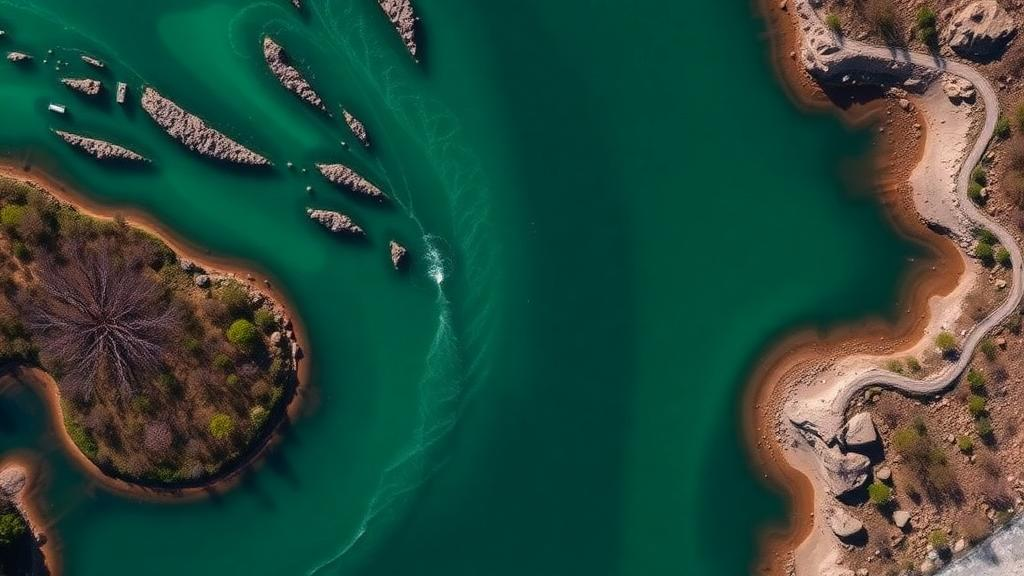
In the steep, rain-soaked mountains of Türkiye’s Eastern Black Sea region, rivers race down narrow valleys toward the coast, carrying with them the chemical fingerprints of mining, industry, and everyday human activity. A new year-long study of freshwater sediments has now shown that whether those metals end up concentrated in a fast-flowing stream or a still reservoir depends less on how much pollution enters the water than on how the water moves. The research, published in Environmental Geochemistry and Health, compared sediment contamination across three neighboring freshwater systems and found that hydrodynamic conditions, the physics of flowing versus standing water, play a decisive role in where toxic metals accumulate and how much ecological risk they pose.
A team led by Koray Özşeker of the Institute of Marine Sciences and Technology at Karadeniz Technical University sampled surface sediments seasonally between December 2024 and 2025 from Muratlı Reservoir, a lentic or still-water system, and two lotic or flowing systems, the Arılı and Çağlayan streams. Four sampling stations were established in each ecosystem, allowing the researchers to track spatial and temporal patterns in metal concentrations across an entire annual cycle. Seven potentially toxic elements were measured with inductively coupled plasma mass spectrometry, one of the most sensitive analytical techniques available for trace metals: copper, lead, zinc, nickel, arsenic, cobalt, and chromium.
The results revealed striking differences among the three systems. Arılı Stream emerged as the most heavily contaminated site, with copper concentrations ranging from 53.5 to 120.5 micrograms per gram, zinc from 142.8 to 215 micrograms per gram, arsenic from 19.3 to 66 micrograms per gram, and chromium reaching as high as 164 micrograms per gram. Lead, nickel, and cobalt followed similar elevated patterns. In contrast, Çağlayan Stream showed its own distinctive signature, with notably high values for copper, lead, and zinc, the lead range extending from 37.1 to 92.6 micrograms per gram, while the remaining elements stayed within moderate levels. Muratlı Reservoir, despite being the largest water body in the comparison, recorded the lowest and most variable concentrations, with copper between 43.6 and 72.3 micrograms per gram and zinc between 83 and 138 micrograms per gram.
These contrasts are not random. In flowing streams, sediment is continuously reworked by currents, and fine particles that bind metals most efficiently are either swept downstream or deposited only in sheltered pockets where velocity drops. Reservoirs, by contrast, act as sediment traps, but the study suggests that the hydrodynamic regime of Muratlı Reservoir, shaped by inflows, water-level management, and internal circulation, redistributes and dilutes metal-bearing particles rather than concentrating them uniformly. The findings underscore a principle that sediment geochemists have long recognized but rarely tested side by side in adjacent lotic and lentic systems: the same pollutant load can produce very different sedimentary archives depending on the energy of the water column above it.
Seasonality added a second layer of complexity. Metal concentrations rose during summer and autumn across the systems, a pattern the researchers link to hydrological and climatic conditions characteristic of the Black Sea region. Heavy rainfall in this mountainous terrain drives erosion and sediment transport, while lower flows and warmer temperatures in the dry season can alter metal partitioning between water, suspended particles, and bed sediment. Seasonal dynamics of this kind mean that a single sampling campaign can dramatically understate or overstate contamination, which is why the study’s twelve-month, four-season design matters for interpreting risk.
To translate raw concentrations into ecological meaning, the team applied geochemical contamination indices and consensus-based freshwater sediment quality guidelines, tools that compare measured levels against thresholds above which adverse biological effects are expected in benthic organisms. The integrated assessment identified arsenic and lead as the primary elements of concern, with zinc and nickel acting as secondary contributors that still carry potential ecological implications. Arsenic is particularly troubling because of its toxicity and its capacity to move between sediment and pore water under changing redox conditions, while lead is a classic legacy pollutant with no biological function and well-documented neurotoxic effects.
The implications extend beyond the benthic invertebrates that live in and on these sediments. Metals bound to sediment particles do not stay put indefinitely. Resuspension during floods, bioturbation by bottom-dwelling organisms, and chemical changes in the sediment can all remobilize metals into the overlying water, where they enter food webs and may ultimately reach fish consumed by humans. Previous work by some of the same authors has traced ecological pathways of heavy metal pollution through entire river basins in the southeastern Black Sea, from riverbeds to lakes and estuaries, and the new comparative dataset strengthens the case that sediment management must account for how water moves through a catchment, not just how much metal is discharged into it.
The study’s regional context is significant. The Eastern Black Sea mountains host one of the world’s most notable metallogenic belts, with copper, lead, and zinc mineralization that has been mined for centuries, and the region’s rivers drain steep catchments where natural geochemical background levels can be elevated even before human activity is considered. Distinguishing geogenic contributions from anthropogenic enrichment is precisely what the geochemical index approach is designed to do, and the researchers emphasize that contamination and ecological risk proved to be system dependent, meaning that a uniform regulatory threshold applied across all freshwater bodies would misrepresent the true hazards in each.
For policymakers and water managers, the message is clear and actionable. The authors call for continuous monitoring, effective pollution control, and sustainable sediment management tailored to the hydrodynamic character of each ecosystem. Reservoirs and streams require different sampling strategies, different risk models, and potentially different remediation approaches, because the physical processes that concentrate or disperse metals operate on fundamentally different terms in each. As climate change intensifies rainfall extremes and hydropower development continues to reshape flow regimes across mountain regions worldwide, understanding how hydrodynamics govern the fate of toxic metals in sediments will only grow in importance for protecting freshwater ecosystems and the communities that depend on them.
Subject of Research: Heavy metal contamination and ecological risk in freshwater sediments under contrasting hydrodynamic conditions
Article Title: Influence of hydrodynamic conditions on heavy metal distribution and ecological risk in freshwater sediments: a comparative study of reservoir and stream ecosystems
Article References: Influence of hydrodynamic conditions on heavy metal distribution and ecological risk in freshwater sediments: a comparative study of reservoir and stream ecosystems. (n.d.). https://doi.org/10.1007/s10653-026-03481-5
Image Credits: AI Generated
DOI: 10.1007/s10653-026-03481-5
Keywords: heavy metals, freshwater sediments, hydrodynamics, reservoir, streams, ecological risk, arsenic, lead, sediment quality guidelines, Black Sea region, seasonal dynamics, ICP-MS
Cite Scienmag News
Violet Maxwell. (October 1, 2026). Rivers and Reservoirs Tell Different Toxic Metal Stories, Black Sea Sediment Study Finds. Scienmag. https://scienmag.com/rivers-and-reservoirs-tell-different-toxic-metal-stories-black-sea-sediment-study-finds/
Violet Maxwell. "Rivers and Reservoirs Tell Different Toxic Metal Stories, Black Sea Sediment Study Finds." Scienmag, 1 October 2026, https://scienmag.com/rivers-and-reservoirs-tell-different-toxic-metal-stories-black-sea-sediment-study-finds/. Accessed 1 October 2026.
Violet Maxwell. "Rivers and Reservoirs Tell Different Toxic Metal Stories, Black Sea Sediment Study Finds." Scienmag. October 1, 2026. https://scienmag.com/rivers-and-reservoirs-tell-different-toxic-metal-stories-black-sea-sediment-study-finds/


