


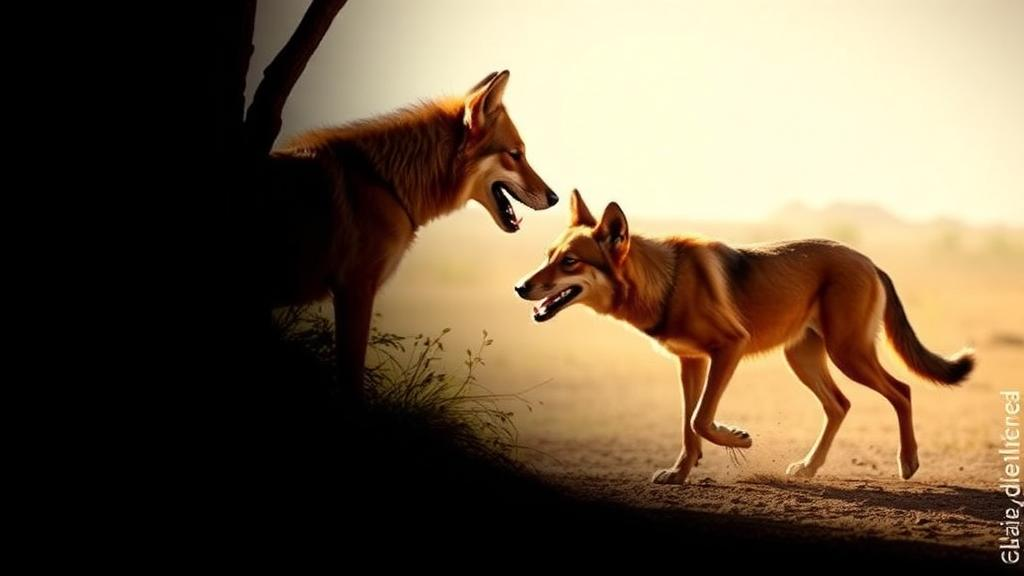
On a quiet road at the boundary of two territories in Myall Lakes National Park on the mid-coast of New South Wales, Australia, three male dingoes from one pack attacked and killed the dominant male of a neighbouring pack. The killing, witnessed and filmed by local land managers in March 2022, was followed a month later by the death of the dominant male from the attacking pack himself, apparently at the jaws of his own former packmates. This extraordinary sequence of events, documented by researchers from the Myall Lakes Dingo Project and published in Ecology and Evolution, offers one of the most detailed accounts yet of how a social carnivore society unravels and rebuilds itself after lethal conflict between neighbouring groups.
Dingoes are Australia’s apex terrestrial predator and, like wolves, live in family-based packs typically anchored by a socially dominant breeding pair. Packs breed annually between March and June, and offspring from previous years often remain with the natal group, sometimes helping to rear subsequent litters. In undisturbed populations, dingo territories are usually clearly defined with limited overlap between neighbours. Yet direct observations of aggression between packs are exceedingly rare for this wide-ranging and cryptic species, which has left scientists largely in the dark about how dingo societies respond when dominant animals die, whether through natural mortality or through the broadscale lethal control that is practised across much of the Australian continent.
The study site sits on Worimi Country in the Great Lakes region, where researchers have monitored dingo packs since 2019. Individual dingoes were trapped in large walk-in cages baited with fish or kangaroo meat, anaesthetised by a wildlife veterinarian using a medetomidine-ketamine combination delivered via blow dart, and fitted with GPS collars recording hourly locations. Home ranges were estimated using 95% minimum convex polygons applied to the collar data, a well-established technique for canid pack range estimation. In parallel, a network of twenty-two trail camera stations, each pairing two cameras roughly 2,500 metres apart and positioned to capture both flanks of passing animals, allowed researchers to identify individual dingoes by their unique sock patterns and distinctive markings across three defined periods: before, during, and after the conflict.
The two focal packs, known as the Mungo Brush pack (MB) and the Stewart and Lloyds pack (SL), held adjacent territories. On 27 March 2022, at the very start of the breeding season, three MB males, the dominant UOM1701 and two subdominants, UOM2001 and UOM2002, killed PCM1601, the dominant male of the SL pack, on a road just inside the MB pack’s own range. A subdominant SL male, SLM2005, was later found dead nearby and is assumed to have died in the same incident. Notably, the MB pack left both carcasses uneaten. Although cannibalism has been documented in dingoes in desert environments, the researchers argue that the unconsumed carcasses support the interpretation that these deaths resulted from intraspecific territorial conflict rather than predation for food.
The violence did not end there. On 9 May 2022, the dominant MB male UOM1701 was found dead on a beach within his own pack’s pre-conflict range, bearing neck bite wounds consistent with a dingo attack. The killing itself was unobserved, but the researchers consider it most probable that one or both of his former subordinates, UOM2001 or UOM2002, were responsible, since both survived the period and went on to assume dominance in the two packs. Tellingly, researchers had already recorded a tense encounter at a scent-marking site in April, in which UOM1701 closely and aggressively shadowed UOM2001 when the younger male appeared interested in overmarking the scent of the SL pack’s dominant female, behaviour the researchers interpret as suggestive of a power struggle between the two.
Camera trap data revealed how dramatically the conflict destabilised movement patterns. Across 215 independent detections, dingoes were proportionally far more likely to be recorded outside their home range during the conflict period: 42.6% of detections fell outside pack boundaries during the conflict, compared with just 9.1% before and 26.9% after. Daily detection rates per living dingo also dropped after the conflict, suggesting that surviving animals were moving differently, associating differently, or both. The dominant female of the SL pack was seen with MB pack males eight times from the onset of the conflict, and all three adult MB males were photographed alongside the dominant females of both packs on separate occasions over four weeks, while the two females themselves were never seen together and maintained spatial segregation.
The reproductive fallout was equally striking. Each of the three MB males was observed mating with the SL dominant female SLF1501 during the territorial re-establishment period. On 21 April 2022, UOM2001, previously a subordinate, was filmed breeding with SLF1501 while the still-dominant UOM1701 was present, an unambiguous signal that the old hierarchy had collapsed. SLF1501 produced a litter that year, though paternity remains unknown, and UOM2002 helped rear the pups, a pattern the researchers suggest may reflect the benefits females can gain from confusing paternity among multiple males. UOM2002 subsequently formed a dominant pair with SLF1501 and is assumed to have sired her litters in 2023, 2024 and 2025. UOM2001 was also photographed mating with the MB pack’s dominant female, although she produced no litter in that or any subsequent season.
Perhaps the most consequential finding concerns the roles of the sexes in holding territory together. After the dust settled, both packs reverted to their pre-conflict home ranges, with the new dominant pairs, UOM2002 with SLF1501 in the SL territory and UOM2001 with UOF1801 in the MB territory, remaining stable through to August 2026. Crucially, it was the dominant females who stayed put while the males moved between packs, hinting that female dingoes may anchor home range stability and extent to a greater degree than males. This echoes patterns described in other territorial systems, where female territories track resource availability and male territories track females, and it identifies a significant gap in dingo research: the contribution of females to territorial dynamics remains understudied.
The observations align with a broader literature on what happens when dominant carnivores die. In red foxes, the death of a dominant male preceded considerable social disruption, with many more subordinate individuals sighted in the vacant territory. In coyotes, a neighbouring stable pack shifted its territory into space vacated after a dominant male’s death. The dingo case adds a vivid Australian data point: social disruption, particularly during the breeding season, creates opportunities for subordinates, and the resulting period of realignment can render the behaviour of remaining animals deeply unpredictable.
That unpredictability carries real weight for wildlife management. Indiscriminate lethal control of dingoes through poison baiting is practised widely across Australia, and the death of dominant individuals can trigger exactly the kind of social instability documented here, making ranging patterns less predictable and potentially producing undesirable management outcomes, including increased breeding by previously suppressed animals and shifts in territory boundaries. The authors caution that their observations, drawn from a single conflict between two packs, may not represent every dingo population, and that outcomes could differ where dominant females rather than males are killed. Even so, the episode demonstrates that dingo packs are not static hierarchies but fragile social systems, in which the loss of a single dominant animal, whether at the teeth of rivals or at the hands of managers, can set off a cascade of killings, mate swaps and territorial reshuffling that reverberates for years.
Subject of Research: Inter-pack conflict and social reorganisation in contiguous dingo packs following the deaths of dominant males
Article Title: Observations of Inter‐Pack Conflict and Pack Instability in Contiguous Dingo Packs
Article References: Alting, B. F., Pitcher, B. J., Campbell‐Ward, M. L., & Jordan, N. R. (2026). Observations of Inter‐Pack Conflict and Pack Instability in Contiguous Dingo Packs. Ecology and Evolution, 16(9), Article e74376. https://doi.org/10.1002/ece3.74376
Image Credits: AI Generated
DOI: 10.1002/ece3.74376
Keywords: dingoes, inter-pack conflict, territoriality, dominance hierarchy, canid social structure, GPS collaring, camera traps, scent marking, lethal control, Myall Lakes, breeding season, Australia
Cite Scienmag News
Drew Townsend. (October 1, 2026). When Dingo Packs Collide: Rare Killings Reveal a Social Order in Flux. Scienmag. https://scienmag.com/when-dingo-packs-collide-rare-killings-reveal-a-social-order-in-flux/
Drew Townsend. "When Dingo Packs Collide: Rare Killings Reveal a Social Order in Flux." Scienmag, 1 October 2026, https://scienmag.com/when-dingo-packs-collide-rare-killings-reveal-a-social-order-in-flux/. Accessed 1 October 2026.
Drew Townsend. "When Dingo Packs Collide: Rare Killings Reveal a Social Order in Flux." Scienmag. October 1, 2026. https://scienmag.com/when-dingo-packs-collide-rare-killings-reveal-a-social-order-in-flux/


