


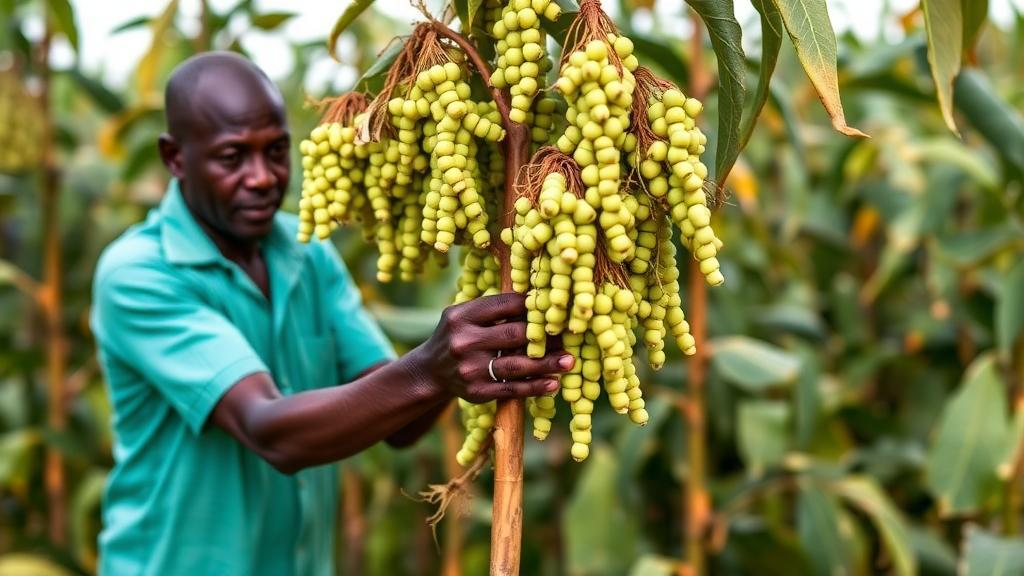
In the sun-scorched savannahs of northern Ghana, a humble legume is quietly holding together the region’s farming systems, and a new study suggests that the future of the crop depends less on laboratory breakthroughs than on listening to the farmers who grow it. Pigeon pea (Cajanus cajan), the world’s sixth most important pulse crop, thrives on marginal soils, tolerates drought, and can fix up to 235 kilograms of atmospheric nitrogen per hectare, enriching fields that would otherwise be depleted. Yet yields in northern Ghana languish at 600 to 700 kilograms per hectare, far below the continental average of roughly 1083 kilograms. A team of Ghanaian researchers set out to discover why, surveying 272 smallholder pigeon pea farmers across four districts to map exactly what growers plant, what they want, and what stands in their way.
The study, conducted in the Tolon, Mion, Nanumba North, and Gushegu districts, targeted communities in the Guinea Savannah agro-ecological zone, where a single rainy season runs from April or May through October. Working from a sampling frame of 900 pigeon pea-growing households compiled with the help of agricultural extension agents from Ghana’s Ministry of Food and Agriculture, the researchers used proportional allocation and simple random sampling to select 60 households in Tolon, 63 in Bimbilla, 54 in Mion, and 95 in Gushegu. Structured questionnaires, pre-tested with 15 farmers outside the study area and administered in Dagbani or English, captured socio-economic profiles, cropping practices, trait preferences, and production constraints. The team analyzed the responses with IBM SPSS software, using frequencies, cross-tabulations, Chi-square tests, and Pearson correlation analyses to tease out patterns in the data.
The demographic picture that emerged is one familiar across much of sub-Saharan Africa. Nearly four in five respondents were men, and the dominant age group was 40 to 49 years, followed by those aged 30 to 39. Formal education was scarce: almost two-thirds of farmers had never attended school, and only 7.4 percent had completed secondary education. Crop production was the primary occupation for 82.7 percent of respondents, and 77.2 percent were married. These characteristics matter for breeding programs, the authors argue, because low educational attainment can slow the adoption of new technologies, and because women, though less involved in field production, dominate postharvest activities such as threshing, winnowing, and marketing. Any strategy to lift pigeon pea productivity, the study implies, must account for who actually handles the crop at each stage of the value chain.
The most striking agronomic finding was the near-universality of intercropping. Ninety-six percent of surveyed farmers grew pigeon pea alongside other crops, with maize the most common companion at 45.2 percent, followed by groundnut at 19.8 percent, yam at 13.9 percent, and sorghum at 13.2 percent. Only 4 percent practiced sole cropping. The researchers found a statistically significant association between land ownership and cropping system, with farmers on family land forming the overwhelming majority of intercroppers, 144 out of 150. This suggests that deeply rooted, multi-generational land arrangements reinforce traditional mixed-cropping patterns. The ecological logic is compelling: pigeon pea’s nitrogen fixation reduces dependence on inorganic fertilizer for companion cereals, and intercropping with yam even provides stakes that help curb deforestation.
When asked what they wanted in a new variety, farmers delivered a remarkably consistent verdict. Early maturity topped the list at 91.91 percent, a preference shaped by the short rainy season of the northern savannah and the benefits of rapid returns, drought escape, and compatibility with companion crops. High yield came second at 72.79 percent, followed by disease resistance at 57.35 percent, pest resistance at 55.15 percent, and drought tolerance at 50.37 percent. Improving soil fertility appealed to 30.88 percent, fitting into existing cropping systems to 22.79 percent, and high biomass to 17.65 percent. For consumption, taste dominated at 55.2 percent, ahead of storage durability at 36 percent and short cooking time at 8.9 percent. In the market, 75 percent of farmers prioritized varieties that fetch higher prices, with larger grain size a distant second at 19.9 percent.
The correlation analysis added a layer of technical nuance that could reshape how breeders think about the crop. Pest and disease resistance were strongly and positively correlated (r = 0.76), indicating that farmers perceive these biotic threats as intertwined and that genetic gains against one may reinforce the other. High yield correlated positively with early maturity (r = 0.45), pest resistance (r = 0.30), and disease resistance (r = 0.34), painting a picture of a compatible suite of traits that farmers favor together. Soil fertility improvement tracked closely with high biomass (r = 0.48), underscoring demand for dual-purpose varieties that deliver both grain and ecosystem services. But the analysis also exposed a genuine trade-off: fit into existing cropping systems was negatively correlated with early maturity (r = -0.39) and drought tolerance (r = -0.32), hinting that current intercropping arrangements may depend on longer-duration varieties and that introducing shorter, hardier types could require adjustments in agronomic practice.
Perhaps the study’s most consequential insight concerns the trait of cropping-system fit itself. While farmers across the board prioritized early maturity and yield, the emphasis on fitting into existing systems split sharply along practice lines: not a single sole-cropping farmer prioritized it, whereas a significant proportion of intercroppers did. In a region where 96 percent of growers intercrop, the authors conclude, compatibility with cereal-legume systems is a non-negotiable prerequisite for adoption. A new variety must not merely perform well in isolation; it must possess a non-competitive growth habit and phenology that synchronizes with staple cereals like maize so that the productivity of companion crops is not disrupted. The researchers recommend that breeding programs establish dedicated selection environments that mimic farmers’ actual intercropped fields, treating system compatibility as a primary selection criterion rather than an afterthought.
The constraint rankings told an equally pointed story. The single greatest barrier reported by farmers was the lack of improved varieties, cited by 39.7 percent of respondents, followed by low yield at 21.3 percent and poor seed quality at 11.4 percent. Storage pest susceptibility accounted for 8.5 percent, late maturity for 7.0 percent, high input costs for 5.5 percent, poor taste for 4.0 percent, and poor fodder quality for 2.9 percent. The dominance of the seed-access problem points to a systemic failure in the variety dissemination pipeline rather than a purely technical one. Previous research from northern Ghana has similarly flagged the unavailability of improved cultivars, the long maturity of local landraces, flower drop, and weak organoleptic qualities as chronic limitations, and the new survey confirms that the bottleneck persists.
The authors translate these findings into a multi-level roadmap. For national breeders and institutions such as the Council for Scientific and Industrial Research, the data define a core trait package of early maturity, high yield, and intercropping compatibility for demand-driven variety development. For policymakers and development partners, the results justify investment in participatory breeding, ‘mother-baby’ trials, and decentralized, farmer-led seed multiplication to attack the seed shortage directly. For extension agents, the evidence supports promoting adopted varieties alongside best-practice advice on intercropping mixes, with messaging that highlights the dual grain-and-soil benefits farmers already value. The study’s limitations are acknowledged: the four districts, while capturing meaningful agro-ecological variation, may not represent all pigeon pea-growing areas, and self-reported survey data carry recall and social desirability risks that the team mitigated through pre-testing and skilled local enumerators.
What makes this research resonate beyond Ghana is its demonstration that adoption is decided in the field, not the greenhouse. Pigeon pea’s credentials as a climate-resilient, protein-rich, soil-building crop are well established, from its methionine, lysine, and tryptophan content to its roles as forage, fuelwood, and green manure. But the study shows that even the most agronomically impressive variety will fail if it matures too late for the savannah rains, competes with the maize it is meant to nourish, or lacks the taste and shelf life that keep it moving through local markets. As breeding programs across Africa grapple with climate stress and food insecurity, the Ghanaian survey offers a deceptively simple formula: breed for the system, not just the plant, and let the farmers who will sow the seed define success.
Subject of Research: Farmer-driven trait prioritisation and production constraints in pigeon pea cropping systems in northern Ghana
Article Title: Pigeon pea production in northern Ghana: farmer perspectives on cropping practices, trait prioritisation, and constraints for guiding breeding programs
Article References: Imoro, B. S., Koasi, B. E., Addae-Frimpomaah, F., Ahiakpa, J. K., & Karikari, B. (2026). Pigeon pea production in northern Ghana: farmer perspectives on cropping practices, trait prioritisation, and constraints for guiding breeding programs. BMC Agriculture, 2(1), Article 1. https://doi.org/10.1186/s44399-025-00023-9
Image Credits: AI Generated
DOI: 10.1186/s44399-025-00023-9
Keywords: pigeon pea, Cajanus cajan, northern Ghana, intercropping, plant breeding, trait preferences, smallholder farmers, seed systems, nitrogen fixation, food security, participatory breeding, Guinea Savannah
Cite Scienmag News
Alan Morgan. (September 30, 2026). Farmers Reveal What Pigeon Pea Breeding Must Deliver in Northern Ghana. Scienmag. https://scienmag.com/farmers-reveal-what-pigeon-pea-breeding-must-deliver-in-northern-ghana/
Alan Morgan. "Farmers Reveal What Pigeon Pea Breeding Must Deliver in Northern Ghana." Scienmag, 30 September 2026, https://scienmag.com/farmers-reveal-what-pigeon-pea-breeding-must-deliver-in-northern-ghana/. Accessed 30 September 2026.
Alan Morgan. "Farmers Reveal What Pigeon Pea Breeding Must Deliver in Northern Ghana." Scienmag. September 30, 2026. https://scienmag.com/farmers-reveal-what-pigeon-pea-breeding-must-deliver-in-northern-ghana/


