


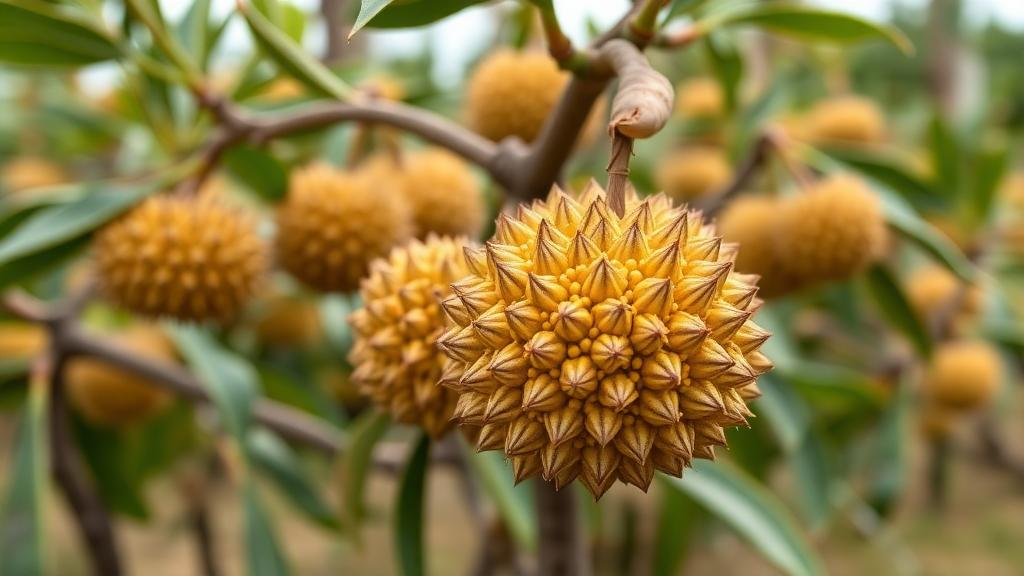
Durian is not a crop you can afford to lose casually. A single tree needs five to seven years before it bears fruit and a decade to reach peak productivity, so when Phytophthora palmivora causes trunk canker, root rot or seedling dieback, the loss is measured in years rather than seasons. Yet disease monitoring in the durian orchards of Malaysia, Thailand and Indonesia remains stubbornly manual: workers walk hilly, densely vegetated plantations inspecting trees by eye, a process that is labour-intensive, hard to scale and highly subjective, since early symptoms look different to a tired observer than to a fresh one. Automated detection with deep learning promises a fix, and on curated benchmarks such systems routinely report accuracies above 98 percent. A new study published in Smart Agricultural Technology asks a more uncomfortable question: what happens to those numbers when the detector actually leaves the laboratory?
The study, carried out by Lin Ding Shan, examines a complete disease-detection pipeline deployed on a Raspberry Pi 5, a low-cost single-board computer carried by a worker on a walking inspection round of a few hours. The choice of operational form matters. Mature durian trees reach 15 to 30 metres, so a fixed ground camera would see only trunks and low foliage; the canopy where foliar symptoms appear is out of reach. Instead, the operator supplies mobility and framing while the detector supplies diagnostic judgement. That design makes three questions decisive: whether the reported accuracy is inflated by faults in the dataset, whether a class scoring zero failed because of the model or the annotation, and whether the device can sustain inference for a whole round without suspending itself to cool down. Each failure, the paper argues, costs the grower something concrete.
The first finding concerns data leakage, and it is striking. The author subjected the dataset of 995 training and 126 validation images to a formal integrity audit using exact MD5 hashing and perceptual hashing to detect near-identical images across the train/validation boundary. The audit found one byte-identical image and 117 near-duplicate pairs spanning the split, tracing to an augmentation-before-split workflow: augmented variants of source photographs were generated first, and the enlarged pool was then divided, placing siblings on both sides of the boundary. The remedy was deliberately narrow. Holding the trained model and weights fixed, the 32 implicated validation images were removed and the evaluation repeated. The Algal_leave class fell from an average precision of 0.806 to 0.597, a 35 percent relative inflation, and aggregate mAP@0.5 dropped from 0.402 to 0.367. The audit did not merely revise a figure; it withdrew a finding, halving an apparent annotation-protocol effect that the leaked data had manufactured.
Instance-to-image tracing exposed a second, subtler problem. The 54 validation instances of Phomopsis traced to a single photograph, the 26 Leaf_rot instances to five images from one 39-second capture session, and root_disease to a single instance on a single image. Eighty-five percent of the Leaf_rot validation evidence derived from six seconds of near-continuous footage of one scene. Grouping all 1,121 exported images into source components by filename, hash identity and perceptual similarity yielded roughly 750 distinct source photographs, meaning the effective sample size was about a third smaller than the nominal image count. In such a dataset, a per-class instance count is not a measure of diversity, and any per-class score built on it is statistically fragile.
The second investigation dismantled the original explanation for rare-class suppression. The initial study had attributed near-total failure on rare classes to insufficient model capacity in the small YOLOv8n detector. To test that, the author retrained three architecture families under a single controlled environment: YOLOv8s across five random seeds, YOLOv11s and the transformer-based RT-DETR-l across three each. The result was unambiguous. Leaf_rot scored exactly 0.000 with zero variance in every one of the eight YOLO runs, and Phomopsis never exceeded 0.005, even though RT-DETR-l, with three times the parameter count of YOLOv8s and the highest aggregate score of any architecture tested, was in play. Meanwhile the difference between architectures, 0.017 in mAP@0.5, sat far below the seed-to-seed variation of 0.118 within a single architecture. Architecture moved the aggregate within its own noise band without touching the classes the aggregate was meant to diagnose.
The retraining on a corrected, source-level leak-free partition then revealed why. Leaf_rot, dead at zero on the original partition, returned 0.399 on the re-partitioned one with the same architecture and configuration. The label existed and the signal was learnable; the zero was a property of the validation sample. The author proposes a candidate diagnostic category for this, an evaluation-space failure, alongside label-space failure, where a class was never assigned a label at all, and feature-space failure at threshold. Anthracnose exemplifies the first: it carries zero validation instances because it was absorbed into the visually similar Algal_leave during annotation. Phomopsis exemplifies the second: lowering the confidence threshold recovered a detection on genuinely symptomatic tissue, showing some signal was present. The three modes demand opposite remedies, and a capacity-only diagnosis directs engineering effort at the wrong problem.
The third investigation is the one most likely to surprise edge-computing practitioners. Sustained inference on a Raspberry Pi drives the processor die toward its thermal limits, and the platform responds at two distinct levels: hardware frequency throttling, which reduces the clock, and a software thermal cut-off, which suspends inference outright at 82 degrees Celsius. The literature has largely conflated them. Across five duty-cycle configurations, each run for roughly three hours and replicated four weeks later, the study separated them decisively. Continuous inference triggered 99 protective cut-offs in three hours, roughly once a minute; a 15-second sleep interval still triggered 41; a 30-second interval triggered none. Yet throttling itself cost only 2.6 percent of median inference latency, 419 milliseconds under continuous operation against 408 milliseconds under a schedule that never throttled at all. The mechanism the field conventionally optimises is nearly costless here; the one it ignores is what ends the deployment.
The energy measurements added a counterintuitive twist. Mean power fell 28.2 percent from continuous operation to the longest sleep interval, but energy per inference rose 39.4 percent, from 3.27 to 4.56 joules, because the roughly 2.2-watt idle floor is paid throughout every sleep window while producing nothing. Continuous operation is the most energy-efficient way to perform a fixed number of inferences, and it is also the configuration that cannot sustain them. A 30-second sleep interval costs 23.7 percent more energy per detection and removes the cut-offs. The author’s design criterion follows directly: choose the shortest sleep interval for which the cut-off count is zero, and accept the throttling that remains. Under the tested indoor conditions that interval is 30 seconds, delivering 66.7 percent effective monitoring coverage, though a warmer third round showed the margin is thin and outdoor deployment should treat these figures as lower bounds.
Translated to the orchard, the numbers acquire human weight. In a recorded 2.25-hour field session, the device spent 91.2 percent of its time with the throttling flag set and peaked at 81.5 degrees Celsius, and 27 inferred cut-off events cost 135 seconds of suspended monitoring, about 1.66 percent of the round. At a walking speed of 1.2 metres per second along rows spaced 10 metres apart, that amounts to roughly 16 trees of about 970 encountered being walked past unexamined, with no signal indicating when. The author suggests a cheaper intervention than hardware changes: surface the suspension state to the operator, so a worker can hold position for the five seconds a cut-off costs rather than continue past a tree the node is not examining. The dataset lesson is equally operational. A grower shown the uncorrected 0.806 would calibrate trust against a performance level the system does not attain and under-inspect precisely the classes it reports most confidently.
The study is candid about its limits: one dataset, one device, one software stack, indoor thermal characterisation with a single outdoor session, no independent test partition, and no field accuracy evidence at all. But its methodological prescriptions travel well beyond durian. Split before augmenting; audit the train/validation boundary with exact and perceptual hashing before reporting per-class metrics; report instance counts alongside the number of distinct source photographs behind them; and distinguish protective suspension from frequency throttling when characterising an edge device. The deeper message is that aggregate metrics conceal exactly the failures that decide whether a deployment works, whether that failure is a leaked image inflating a score, a class silenced by its validation sample, or a processor quietly stopping to cool while trees go uninspected. For agricultural AI moving from benchmark to field, the quantity to design against is not the one that slows the device down. It is the one that stops it.
Subject of Research: Edge-deployed deep learning disease detection in durian, covering dataset integrity auditing, rare-class failure diagnosis and thermal duty-cycle scheduling on a Raspberry Pi 5
Article Title: Thermal cut-off, not frequency throttling: Duty-cycle scheduling and a dataset-integrity audit for on-farm edge disease detection in durian
Article References: Shan, L. D. (2026). Thermal cut-off, not frequency throttling: Duty-cycle scheduling and a dataset-integrity audit for on-farm edge disease detection in durian. Smart Agricultural Technology, 15, Article 102526. https://doi.org/10.1016/j.atech.2026.102526
Image Credits: AI Generated
DOI: 10.1016/j.atech.2026.102526
Keywords: durian, edge computing, Raspberry Pi 5, plant disease detection, data leakage, perceptual hashing, thermal throttling, duty-cycle scheduling, YOLO, RT-DETR, Phytophthora palmivora, precision agriculture
Cite Scienmag News
Alan Morgan. (September 30, 2026). Thermal cut-off, not throttling, decides whether edge AI survives a durian orchard. Scienmag. https://scienmag.com/thermal-cut-off-not-throttling-decides-whether-edge-ai-survives-a-durian-orchard/
Alan Morgan. "Thermal cut-off, not throttling, decides whether edge AI survives a durian orchard." Scienmag, 30 September 2026, https://scienmag.com/thermal-cut-off-not-throttling-decides-whether-edge-ai-survives-a-durian-orchard/. Accessed 30 September 2026.
Alan Morgan. "Thermal cut-off, not throttling, decides whether edge AI survives a durian orchard." Scienmag. September 30, 2026. https://scienmag.com/thermal-cut-off-not-throttling-decides-whether-edge-ai-survives-a-durian-orchard/


