


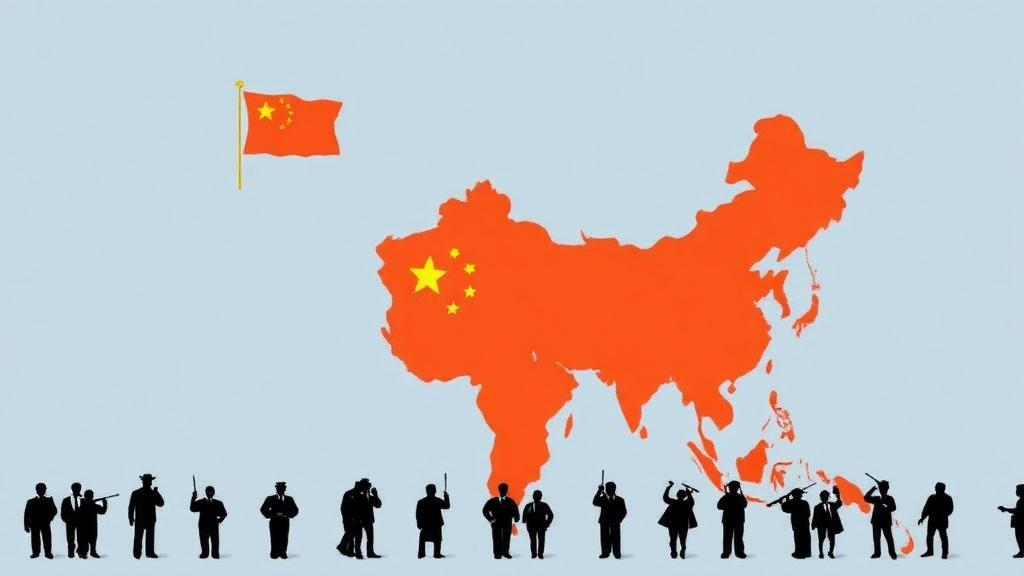
A new analysis published in the journal Global Public Policy and Governance argues that despite the most dramatic turbulence in United States–China relations in decades, Beijing’s response to what the author calls Trumpism will remain strikingly conservative: gradual reform and incremental change of the existing global regime rather than an attempt to overturn it. The study, written by Yijia Jing of Fudan University’s Institute for Global Public Policy, examines China’s global strategies through a three-dimensional analytical framework of relative national strength, institutional learning capability, and crisis-induced opportunity windows. Its central conclusion is that a painful process of mutual recognition and compromise between the two powers will evolve and shape the future global order, and that the apparent tipping point toward equal footing between Washington and Beijing does not signal a revolutionary break with the post-World War II system.
The timing of the analysis is significant. In 2025, China became unprecedentedly tough in the trade war launched by the Trump administration, with mutually announced retaliatory tariffs spiraling to 145 percent in April, a level that, if implemented, would have meant complete economic decoupling between the world’s two largest economies. The technology war intensified in parallel: while the United States continued to tighten its chip trade embargo, China responded with export controls on rare earths, a sector where it holds dominant global processing capacity. In early September, China put forward a Global Governance Initiative at the Shanghai Cooperation Organization Summit, held a grand military parade marking the 80th anniversary of the victory in the anti-fascist war, and announced that it would no longer seek the special and differential treatments reserved for developing countries in future World Trade Organization negotiations. Taken together, these actions appeared to signal a firm belief in Beijing that the world is moving inexorably toward multipolarization.
Yet the historical record that Jing traces suggests continuity rather than rupture. Since the post-1978 reform and opening up, China’s global strategies have been formed and carried out under a global framework dominated by the United States. China was, on the whole, a user, defender and reformer of the post-war order, experiencing gradual learning, integration and innovation that made it a deep stakeholder in the system. The phrase balance of financial terror was coined to describe the irreversible interdependence formed between the two countries, even though China was clearly the weaker party. Under that power asymmetry, Beijing typically adopted what the paper describes as a swallow anger and keep quiet attitude toward American provocations and sanctions, including the 1999 bombing of the Chinese Embassy in Yugoslavia by five American precision-guided missiles. Deng Xiaoping’s dictum to keep a low profile and never take the lead governed Chinese diplomacy for decades, even as successive leaders from Jiang Zemin’s peaceful rise to Hu Jintao’s harmonious world signaled growing awareness of China’s global role.
The shift in the relationship came in stages. China’s entry into the WTO in 2001 embedded it in existing governance structures, and its cooperation with the United States at the first G20 summit in Washington in 2008 helped stabilize the global financial order. But as China’s GDP surpassed Japan’s in 2010 and incremental development within the existing trade framework ran into limits, Beijing proposed the Belt and Road Initiative in 2013 and led the creation of the Asian Infrastructure Investment Bank and the New Development Bank. These China-led mechanisms, which the United States declined to join and warned its allies against joining, augmented American tension. During Trump’s first term, containment of China became a basic consensus of both American political parties and the elite, forging what the paper, citing Graham Allison, frames as a Thucydides trap, manifested not only in the trade war but also in the small yard and high fence technology restrictions of the Biden administration. American pressure in turn fortified China’s determination to strengthen autonomy and reduce dependence on the United States, economically and technically.
The first dimension of Jing’s framework, comprehensive national strength, provides the material foundation for this strategic posture. Between 2000 and 2021, China’s total economic output measured by GDP rose from approximately 11.8 percent of the US level to 76 percent, according to World Bank data cited in the study, and although the ratio fell back to 64.7 percent in 2023, China’s growth rate remains significantly higher. In purchasing power parity terms, IMF figures show China’s economy surpassed that of the United States in 2014. China is the world’s largest trading country, the primary manufacturing base, the second largest foreign investor, and the only competitor of the United States in artificial intelligence, with the China-based DeepSeek large language model appearing just one year after ChatGPT. Ironically, the paper notes, China’s success within the existing system, particularly the WTO, has been a source of Trumpism’s antipathy toward the very institutions the United States built after World War II.
China’s tough but restrained responses to the tariff and tech wars, Jing argues, can be explained by three pragmatic concerns. First, Trumpism challenges fundamental interests of China’s national development: the trade war could raise the costs of Chinese manufacturing across the board, while sanctions on high-tech enterprises, including the 2018 detention of Huawei CFO Meng Wanzhou in Canada and steadily tightening chip export controls, could seriously damage China’s development in advanced fields at a time of sluggish real estate growth, tight employment, mounting local debt and aging pressures. Second, the two economies remain deeply interdependent, in a way fundamentally different from the mutually divided systems of the Cold War. When China announced strict rare earth export controls on October 9, Trump immediately threatened an additional 100 percent tariff effective November 1, illustrating how quickly each side is made aware of its exposure. Third, maintaining the existing international economic system is beneficial to China, which must continue reorganizing its industrial, supply and value chains on a global scale and therefore has an interest in countering trade protectionism and safeguarding multilateral trade.
The second dimension, institutional learning and innovation, shows how China’s engagement has deepened over four decades. China restored its membership in the World Bank and IMF in 1980 and gradually expanded its influence and voting rights, then established the New Development Bank in Shanghai in 2014 with an equal-investment governance structure, and the AIIB in Beijing in 2015, modeled on the World Bank. The AIIB now counts 110 members, including every permanent member of the Security Council except the United States and 16 G20 countries. In climate governance, the 2015 Paris Agreement rested substantially on Sino-American cooperation, and after Trump first exited the accord, China reconfirmed its commitments and held cooperative dialogues with the European Union, later pledging at the 75th UN General Assembly to peak carbon emissions by 2030 and achieve carbon neutrality by 2060. The paper observes an irony: China has become a defender of the current international system while the United States has become a dismantler.
The third dimension concerns crisis-induced windows of opportunity. Past global shocks have repeatedly strengthened China’s position: the 1997 Southeast Asian Financial Crisis and the 2007 Global Financial Crisis both improved China’s standing in global economic governance. Trumpism itself, with its American centrism, transactional approach and disregard of rules, constitutes a crisis of global governance that aggravates governance deficits and raises world expectations for Chinese responsibility. Global impressions of the two countries have shifted in opposite directions, and Trump’s second-term win contributed to negative votes against pro-Trump candidates in Canadian and Australian elections. When the Trump administration withdrew from international organizations and agreements, China consolidated its position within the United Nations system and affirmed its commitments, with its four major global initiatives since 2021 each carrying distinct Chinese values and norms.
The conclusion Jing draws is that China’s responses to Trumpism will continue to promote gradual reforms of the global governance system, while relations with the United States move toward mutual assurance on an equal footing. The meeting between Presidents Xi and Trump in Busan on October 30, 2025, and a follow-up call on November 24, indicated a strategic compromise born of Trump’s informed awareness of China’s will and capability, with a provisional one-year ceasefire suggesting a higher chance of a grand bargain and reviving speculation about a G2-based global order. Yet the paper warns that the shift of global power will not be smooth or even peaceful, and that reckless pursuit of unrealistic goals by either side could bring unforeseen crisis moments. Jing further suggests that China’s incremental domestic reform philosophy, which starts from local experiments and seeks Pareto improvements rather than zero-sum outcomes, has been naturally extended to its global strategies, making China’s engagement continuous, adaptive and irreversible. Achieving effective mutual understanding and coordination between the rising and the established power, the analysis concludes, will be the biggest variable in the future of global governance.
Subject of Research: China's global governance strategies under US Trumpist foreign policy pressures
Article Title: Trumpism and China’s global strategies: a tipping point?
Article References: Jing, Y. (2025). Trumpism and China’s global strategies: a tipping point?. Global Public Policy and Governance, 5(4), 401-410. https://doi.org/10.1007/s43508-025-00138-4
Image Credits: AI Generated
DOI: 10.1007/s43508-025-00138-4
Keywords: Trumpism, China, United States, global governance, trade war, tariffs, US-China relations, Belt and Road Initiative, AIIB, multilateralism, Thucydides trap, incremental reform
Cite Scienmag News
Courtney Benton. (September 30, 2026). Why China Is Betting on Gradual Reform, Not Revolution, in the Global Order. Scienmag. https://scienmag.com/why-china-is-betting-on-gradual-reform-not-revolution-in-the-global-order/
Courtney Benton. "Why China Is Betting on Gradual Reform, Not Revolution, in the Global Order." Scienmag, 30 September 2026, https://scienmag.com/why-china-is-betting-on-gradual-reform-not-revolution-in-the-global-order/. Accessed 30 September 2026.
Courtney Benton. "Why China Is Betting on Gradual Reform, Not Revolution, in the Global Order." Scienmag. September 30, 2026. https://scienmag.com/why-china-is-betting-on-gradual-reform-not-revolution-in-the-global-order/


