


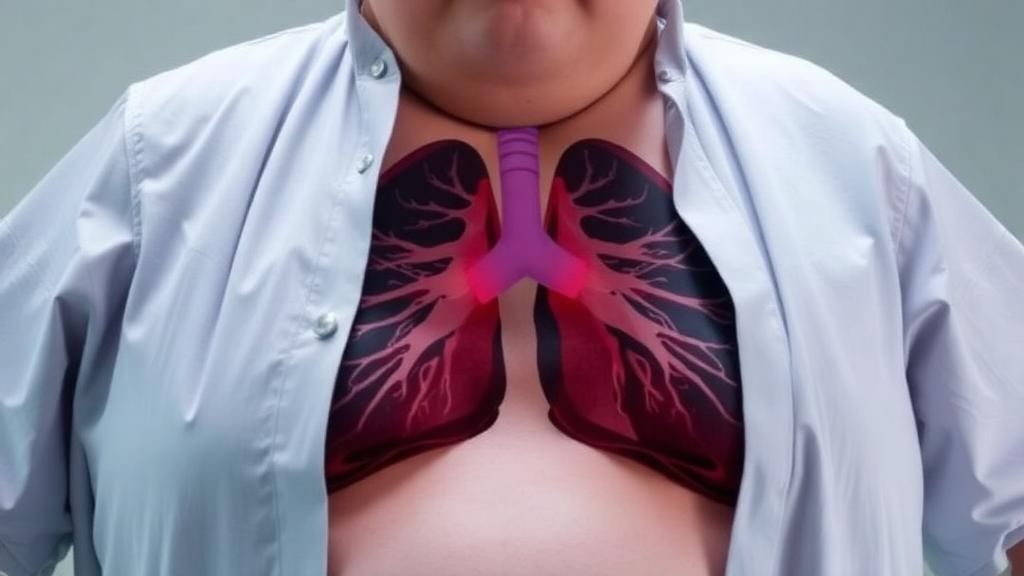
Patients with severe obesity who develop acute respiratory distress syndrome, or ARDS, present intensive care physicians with one of the most mechanically challenging scenarios in modern critical care. A correspondence published in Intensive Care Medicine by Damien Barrau, Sami Hraiech and Christophe Guervilly of the Assistance Publique-Hôpitaux de Marseille and Aix-Marseille Université examines how severe obesity alters chest wall elastance in ARDS and argues that this physiological reality demands a more personalized approach to mechanical ventilation. Their commentary arrives amid a growing debate in the intensive care community about whether esophageal balloon catheters, which allow clinicians to estimate pleural pressure at the bedside, should be routinely deployed to guide ventilator settings in individual patients rather than relying on population-based defaults.
ARDS is a life-threatening form of acute lung injury in which the air sacs of the lungs become inflamed and filled with fluid, dramatically reducing the tissue available for gas exchange. The stiffness of the respiratory system, measured as elastance, reflects how much pressure is required to deliver a given volume of air. Crucially, this total elastance is the sum of two distinct components: the lung itself and the chest wall, which includes the rib cage, the diaphragm and the abdomen. Standard ventilator management in ARDS has historically treated the respiratory system as a single unit, adjusting tidal volumes and pressures according to predicted body weight and plateau pressure thresholds. This approach implicitly assumes that the contribution of the chest wall remains relatively uniform across patients, an assumption that severe obesity decisively violates.
In patients with severe obesity, the massive accumulation of adipose tissue around the thorax and abdomen, together with the upward displacement of the diaphragm by intra-abdominal fat, substantially increases chest wall elastance. The chest wall becomes stiffer and resists expansion more strongly, which means that a larger fraction of the pressure generated by the ventilator is consumed in deforming the chest wall rather than in aerating the lung. As a consequence, clinically measured pressures at the airway opening can appear alarmingly high even when the lung itself is only mildly injured, or conversely, the true stress borne by the lung parenchyma may be underestimated if the clinician assumes that all measured pressure reflects lung injury. This partitioning problem lies at the heart of the argument advanced by the Marseille team.
The physiological consequences of elevated chest wall elastance in obese patients with ARDS are far-reaching. Transpulmonary pressure, the pressure difference across the lung that actually determines lung stress and strain, cannot be directly measured at the airway. It must be inferred by subtracting an estimate of pleural pressure, typically obtained with an esophageal balloon catheter, from the airway pressure. When chest wall elastance is high, pleural pressure rises, and the airway pressure needed to achieve adequate oxygenation and alveolar recruitment increases accordingly. A ventilator strategy calibrated to airway pressures alone may therefore deliver insufficient tidal volumes and inadequate positive end-expiratory pressure to an obese patient whose lungs are, in fact, recruitable, leading to derecruitment, atelectasis and worsening hypoxemia.
The Marseille authors situate their commentary within an ongoing discussion prompted by a recent debate in the same journal on whether the esophageal balloon catheter should be deployed to personalize ventilation of ARDS. Esophageal manometry is not a new technique; it has been used in respiratory physiology for decades. Yet its adoption in routine intensive care remains limited, partly because of concerns about technical complexity, the expertise required for correct placement and interpretation, and the absence until recently of large randomized trials demonstrating outcome benefits. The correspondence by Barrau and colleagues underscores that in specific patient populations, severe obesity chief among them, the assumptions underlying conventional ventilator titration break down in ways that esophageal measurements can reveal.
Supporting evidence for the physiological argument comes from earlier work cited by the authors. A study by Behazin and colleagues published in the Journal of Applied Physiology demonstrated that morbid obesity is associated with respiratory restriction and elevated pleural and esophageal pressures, providing direct experimental confirmation that the chest wall, rather than the lung, accounts for much of the measured stiffness in this population. In parallel, a multicenter study by Coudroy and colleagues published in Anesthesiology investigated the prevalence of complete airway closure according to body mass index in patients with ARDS, documenting that higher body mass index is associated with a greater frequency of complete airway closure, a phenomenon that further complicates pressure interpretation and ventilator management at the bedside.
Complete airway closure deserves particular attention because it illustrates how obesity transforms the mechanical behavior of the respiratory system in ARDS. When the airways close completely at a certain lung volume, the pressure measured at the airway no longer communicates with the alveoli until the closing pressure is exceeded. In obese patients, the elevated pleural pressures generated by the heavy chest wall and abdomen can promote such closure, meaning that a substantial portion of each delivered breath may initially serve simply to reopen collapsed airway segments. Clinicians unaware of this mechanism may misinterpret high measured pressures as evidence of overdistension or severe lung injury and may inappropriately reduce ventilatory support, when in fact the underlying problem is the mechanical load imposed by the chest wall.
The clinical stakes of these considerations are considerable. Obesity is a rapidly growing condition worldwide, and patients with severe obesity constitute an increasing share of intensive care admissions, including admissions for ARDS triggered by pneumonia, sepsis and other causes. If ventilator protocols designed around average chest wall mechanics systematically misjudge the lung stress experienced by obese patients, then a large and expanding group of critically ill individuals may receive suboptimal care. Personalized ventilation guided by esophageal manometry offers a way to partition respiratory system elastance into its lung and chest wall components, allowing clinicians to titrate positive end-expiratory pressure and tidal volume according to transpulmonary pressures that reflect what the lung tissue itself is actually experiencing.
The correspondence does not claim that esophageal manometry is a panacea. Interpreting esophageal pressure requires attention to the position of the catheter, the effects of patient positioning and the influence of abdominal pressure, and measurements obtained in the supine, sedated and paralyzed patient differ from those in upright spontaneous breathing. Nevertheless, the authors’ central message is that ignoring chest wall elastance in severe obesity risks systematic error, whereas measuring it offers the possibility of tailoring ventilator settings to the individual patient’s physiology. In their view, the question is no longer whether chest wall mechanics matter in obese patients with ARDS, but whether the tools to measure them should be deployed more widely to translate that understanding into practice.
As the debate over personalized ventilation continues, the contribution from the Marseille intensive care team adds a clear physiological anchor. Severe obesity elevates chest wall elastance, redistributes the pressure generated by the ventilator away from the lung and toward the chest wall, and thereby distorts the conventional interpretation of airway pressures in ARDS. Whether esophageal balloon catheters become a routine part of ARDS management will depend on ongoing research, training and the accumulation of clinical evidence, but for patients with severe obesity the case for looking beyond the airway pressure gauge has rarely been more compelling.
Subject of Research: The effect of severe obesity on chest wall elastance and personalized mechanical ventilation in ARDS
Article Title: Severe obesity and chest wall elastance in ARDS
Article References: Barrau, D., Hraiech, S., & Guervilly, C. (2026). Severe obesity and chest wall elastance in ARDS. Intensive Care Medicine. https://doi.org/10.1007/s00134-026-08624-x
Image Credits: AI Generated
DOI: 10.1007/s00134-026-08624-x
Keywords: ARDS, severe obesity, chest wall elastance, mechanical ventilation, esophageal manometry, transpulmonary pressure, pleural pressure, airway closure, critical care, respiratory mechanics, positive end-expiratory pressure, intensive care medicine
Cite Scienmag News
Daisy Hatcher. (September 30, 2026). Severe Obesity Reshapes Chest Wall Mechanics in ARDS, Experts Argue for Personalized Ventilation. Scienmag. https://scienmag.com/severe-obesity-reshapes-chest-wall-mechanics-in-ards-experts-argue-for-personalized-ventilation/
Daisy Hatcher. "Severe Obesity Reshapes Chest Wall Mechanics in ARDS, Experts Argue for Personalized Ventilation." Scienmag, 30 September 2026, https://scienmag.com/severe-obesity-reshapes-chest-wall-mechanics-in-ards-experts-argue-for-personalized-ventilation/. Accessed 30 September 2026.
Daisy Hatcher. "Severe Obesity Reshapes Chest Wall Mechanics in ARDS, Experts Argue for Personalized Ventilation." Scienmag. September 30, 2026. https://scienmag.com/severe-obesity-reshapes-chest-wall-mechanics-in-ards-experts-argue-for-personalized-ventilation/


