


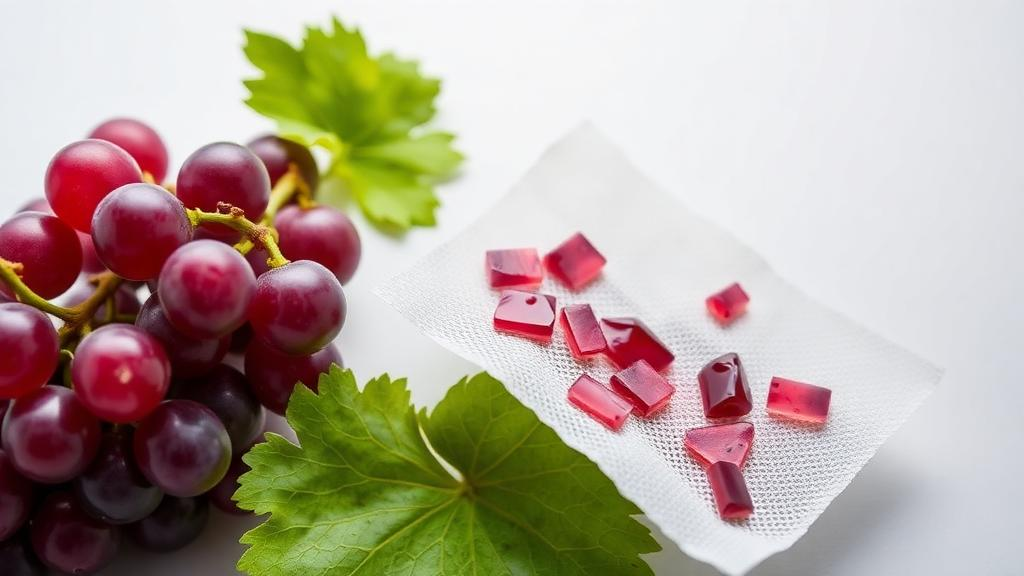
Every year, the global wine industry crushes millions of tonnes of grapes and discards a mountain of leftover skins, seeds, and stems known as pomace. Most of this material ends up as low-value compost or landfill, yet it is rich in oils and phenolic compounds with genuine biological activity. A team of researchers from the Universidad de Sonora in Mexico and Purdue University in the United States has now found a strikingly elegant use for this waste stream: they have embedded oil extracted from grape pomace into ultrafine biodegradable fibers and shown that the resulting mats could serve as the basis for a new generation of bioactive wound dressings. The work, published in Polymer Bulletin, transforms a winery byproduct into a material that can scavenge destructive radicals and kill a panel of dangerous wound-infecting bacteria on contact.
The core of the innovation lies in a manufacturing technique called electrospinning, which has become one of the most versatile tools in biomedical materials science. In electrospinning, a polymer solution is loaded into a syringe and subjected to a high electric field. As the charge builds at the tip of the needle, it overcomes the surface tension of the liquid and ejects a fine jet that whips violently through the air, stretching and drying until it lands as a fiber hundreds of times thinner than a human hair. Layer upon layer of these fibers accumulate into a soft, porous mat whose architecture closely mimics the fibrous structure of the extracellular matrix that cells naturally inhabit. For wound care, this architecture is highly desirable: the tiny interconnections between fibers allow oxygen exchange and fluid handling while presenting an enormous surface area for therapeutic action.
The polymer chosen as the carrier was polylactic acid, or PLA, a biodegradable polyester derived from plant sugars such as corn starch. PLA is already a familiar material in medicine, appearing in dissolvable sutures, screws, and drug delivery systems, because it breaks down in the body into lactic acid, a naturally occurring metabolite. The researchers’ idea was to use electrospun PLA as a structural scaffold and to load it with grape pomace oil, abbreviated GPO, which they had previously characterized as a source of lipophilic bioactive compounds from Mexican Cabernet Sauvignon pomace. The oil carries fatty acids and antioxidant species that, in principle, could protect wounded tissue from oxidative stress while discouraging bacterial colonization.
To test the concept, the team fabricated PLA mats containing grape pomace oil at four different concentrations: zero, five, ten, and twenty percent by weight per volume of the spinning solution. Scanning electron microscopy of the resulting mats revealed fibers with diameters ranging from roughly 401 to 911 nanometers, squarely within the nanofiber regime that wound dressing researchers prize. The oil concentration had a clear and systematic effect on morphology. As the GPO content increased, the fibers became thicker, rougher, and more prone to fusing together at their contact points, a sign that the oil was altering the conductivity and evaporation dynamics of the spinning jet. This kind of morphological tuning matters, because fiber diameter and surface texture influence how a dressing interacts with cells, exudate, and bacteria.
Confirming that the oil was genuinely encapsulated rather than simply smeared on the surface required a battery of analytical techniques. Fourier transform infrared spectroscopy detected the characteristic vibrational fingerprints of the oil’s fatty acid chains within the composite mats. Ultraviolet-visible spectroscopy and color measurement showed changes consistent with the presence of the oil’s chromophores, and differential scanning calorimetry revealed shifts in the polymer’s thermal transitions, indicating that the embedded oil was interacting with the PLA matrix at the molecular level. Together, these measurements established that electrospinning had successfully locked the bioactive oil inside the fibers, a nontrivial achievement given that volatile and oily additives often migrate or are lost during solvent evaporation.
The physical behavior of the mats in aqueous environments is critical for any wound dressing, and here the team mapped out a nuanced picture. All of the formulations displayed hydrophobic surfaces, with water contact angles between 100 and 132 degrees, meaning droplets bead up rather than soak in immediately. Porosity, meanwhile, decreased from 89 percent in the pure PLA mat to 77 percent at the highest oil loading, reflecting the thicker, more fused fiber network. Interestingly, the intermediate formulation containing ten percent GPO showed the highest swelling capacity, absorbing water to reach 422 percent of its original mass. This balance of water repellency at the surface with substantial internal swelling suggests the mats can manage wound exudate without dissolving or collapsing, a combination that supports the moist wound healing environment clinicians favor.
The biological performance of the mats is where the study becomes genuinely exciting. In antioxidant assays using the ABTS radical, the GPO-loaded mats scavenged up to 69 percent of the radicals presented to them, a direct demonstration that the oil’s antioxidant compounds remained active after encapsulation and could, in principle, counteract the oxidative damage that accompanies inflammation in wounded tissue. Even more striking were the antibacterial results. The mats inhibited four clinically significant pathogens commonly found in infected wounds: Staphylococcus aureus, a notorious cause of skin and soft tissue infections; Enterococcus faecalis, a hardy survivor in chronic wounds; Klebsiella pneumoniae, an increasingly drug-resistant threat; and Proteus mirabilis, a frequent culprit in urinary and wound infections. Importantly, the researchers traced this activity to a contact-killing mechanism, meaning bacteria are destroyed when they touch the fiber surface rather than through the release of soluble antibiotics into the environment.
A contact-killing mechanism carries real clinical appeal. Because the antimicrobial action is localized to the dressing itself, there is less concern about systemic exposure, the selection of resistant strains elsewhere in the body, or the ecological disruption associated with broad-spectrum antibiotics. At the same time, the approach avoids the heavy-metal nanoparticles, such as silver, that dominate the antimicrobial dressing market but raise questions about cytotoxicity and environmental persistence. A plant-derived oil embedded in a biodegradable polymer offers a gentler profile, provided it does not harm the patient’s own cells. On that front, the study delivered one of its most reassuring findings: in hemocompatibility testing, all of the formulations caused hemolysis of less than 0.5 percent, far below the thresholds generally considered safe, indicating that the mats do not damage red blood cells.
The broader significance of the work extends beyond wound care into the economics of sustainability and the circular economy. Grape pomace is generated in enormous quantities by wineries worldwide, and its disposal represents both a cost and a lost opportunity. Previous studies have explored grape seed extracts and pomace-derived phenolics in electrospun fibers for food packaging, tissue scaffolds, and other dressings, but this study is notable for using the oil fraction specifically, valorizing a component that is often left behind after phenolic extraction. The researchers, led by Marcos Leon-Bejarano, had earlier demonstrated that Mexican Cabernet Sauvignon pomace is a viable source of oil and lipophilic bioactive compounds, and the new work closes the loop by converting that oil into a functional biomedical material. A waste product from one industry thus becomes raw material for another, with potential value multiplication at every step.
Considerable work remains before grape pomace oil-loaded PLA mats reach a clinic. The study was conducted entirely in vitro, without animal or human testing, and questions of long-term biodegradation behavior, controlled release kinetics, mechanical durability under real dressing conditions, and efficacy against mature bacterial biofilms will all need systematic answers. Regulatory pathways for plant-extract-loaded medical devices add further complexity. Yet the foundational results are compelling: a simple, scalable electrospinning process yields mats that combine the structural virtues of nanofibrous scaffolds with measurable antioxidant power, broad antibacterial activity against four troublesome pathogens, and excellent blood compatibility, all from a material that would otherwise rot in a landfill. As antibiotic resistance tightens its grip and the demand for sustainable biomaterials grows, the image of a wound dressing spun from wine waste is exactly the kind of convergence of environmental and medical ingenuity that modern materials science promises.
Subject of Research: Development of grape pomace oil-loaded electrospun PLA nanofiber mats as bioactive antibacterial wound dressings
Article Title: Grape pomace oil loaded PLA electrospun fibers: characterization and evaluation as promising novel bioactive wound dressing
Article References: Grape pomace oil loaded PLA electrospun fibers: characterization and evaluation as promising novel bioactive wound dressing. (n.d.). https://doi.org/10.1007/s00289-026-06727-5
Image Credits: AI Generated
DOI: 10.1007/s00289-026-06727-5
Keywords: grape pomace oil, PLA, electrospinning, nanofibers, wound dressing, antibacterial, antioxidant, biomaterials, biodegradable polymers, winery byproducts, contact-killing, hemocompatibility
Cite Scienmag News
Bethany Barker. (September 30, 2026). Wine Waste Becomes Wound Care: Grape Pomace Oil Spun Into Antibacterial Nanofiber Dressings. Scienmag. https://scienmag.com/wine-waste-becomes-wound-care-grape-pomace-oil-spun-into-antibacterial-nanofiber-dressings/
Bethany Barker. "Wine Waste Becomes Wound Care: Grape Pomace Oil Spun Into Antibacterial Nanofiber Dressings." Scienmag, 30 September 2026, https://scienmag.com/wine-waste-becomes-wound-care-grape-pomace-oil-spun-into-antibacterial-nanofiber-dressings/. Accessed 30 September 2026.
Bethany Barker. "Wine Waste Becomes Wound Care: Grape Pomace Oil Spun Into Antibacterial Nanofiber Dressings." Scienmag. September 30, 2026. https://scienmag.com/wine-waste-becomes-wound-care-grape-pomace-oil-spun-into-antibacterial-nanofiber-dressings/


