


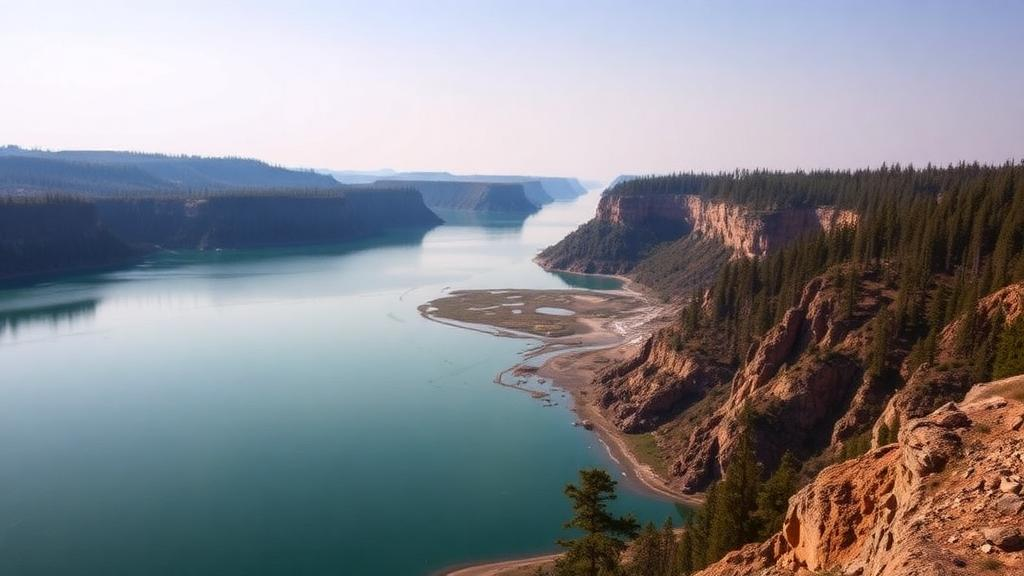
Inland waters cover less than three percent of the planet’s land surface, yet a sweeping new assessment confirms they punch far above their weight in the climate system. A review published in Nature Reviews Earth & Environment compiles and reconciles the best available global estimates of carbon dioxide, methane and nitrous oxide emissions from rivers, streams, lakes and reservoirs, arriving at a total of roughly 8.2 petagrams of CO2-equivalent per year over a 100-year time horizon, with a 90 percent confidence range of 6.5 to 10.6. That figure places the world’s freshwater networks among the most consequential, and historically most neglected, sources of greenhouse gases in the global budget.
The scale of the number becomes even more striking when set against the terrestrial carbon sink. Drawing on modelling and budget analyses, the authors estimate that inland water emissions have grown by approximately 2.8 petagrams of CO2-equivalent per year since the Industrial Revolution, a rise equivalent to offsetting about one-third of the carbon that land ecosystems currently absorb from the atmosphere. In other words, a substantial fraction of the climate benefit delivered by forests and soils is being quietly cancelled out by the gas escaping from the water that threads through and pools across those same landscapes.
Technically, the emissions arise from a combination of microbial and geochemical processes. Carbon dioxide largely diffuses out of water that is supersaturated with the gas, produced when dissolved organic and inorganic carbon, much of it exported from soils, is mineralized by aquatic microbes or released through photochemical reactions driven by sunlight. Methane originates primarily in anoxic sediments, where methanogenic archaea break down organic matter, and reaches the atmosphere either by diffusion or, far more explosively, by ebullition, the release of bubbles that can bypass oxidation in the water column. Nitrous oxide, the third and most potent gas per molecule, is generated mainly through denitrification and nitrification in nitrogen-rich sediments and waters, processes that intensify wherever agricultural runoff and wastewater deliver excess nitrogen to streams and lakes.
Mapping the global pattern of these fluxes reveals a geography of hotspots that defies simple intuition. The largest emitters are the low-latitude river networks, including the vast tropical basins where warm temperatures, high organic carbon loads and extensive floodplain connectivity fuel year-round microbial activity, together with the countless small lakes scattered across the Northern Hemisphere. Small water bodies matter disproportionately because their shallow depths and large sediment-to-volume ratios promote both methane production and bubble release. High latitudes, the tropics and very small ponds and streams therefore play a major role in global fluxes, yet these are precisely the environments that remain under-represented in observational datasets, a gap that has historically biased global estimates.
The review also highlights how measurement practice shapes the numbers. Calculating carbon dioxide partial pressure from pH and alkalinity, a common shortcut, has been shown to substantially overestimate CO2 in acidic, organic-rich freshwaters, one reason earlier global budgets varied so widely. Modern approaches increasingly rely on direct flux measurements, automated loggers, drones and satellite-based mapping of water bodies, and on process-based models that resolve the temperature sensitivity of methane production, which laboratory and ecosystem studies show is consistent from microbial to landscape scales. Diel cycles matter too: nocturnal emissions of CO2 from rivers can be markedly higher than daytime fluxes, meaning campaigns that sample only in daylight risk systematic underestimates.
Reservoirs add a distinctly anthropogenic dimension. When land is flooded behind a dam, decomposing vegetation and inundated soils release a pulse of carbon, and reservoirs continue to emit methane and CO2 for decades, with emissions shaped by reservoir age, latitude, nutrient status and the extent of drawdown zones. Water-level fluctuations accelerate and amplify methane release, and spatially resolved measurements in tropical reservoirs reveal elevated ebullition near river inflows and in highly productive zones. The G-res modelling framework now allows planners to estimate the biogenic greenhouse gas footprint of a reservoir before construction, and studies of Amazon hydropower show that strategic dam siting, avoiding high-carbon floodplain valleys, could substantially reduce emissions from the sector.
Looking backward, the industrial era transformed inland waters from a largely natural flux into a growing anthropogenic one. Increased terrestrial carbon export, driven by land-use change, soil erosion and altered hydrology, has raised the carbon delivered to rivers and lakes, while nitrogen and phosphorus pollution have stimulated the microbial processes behind methane and nitrous oxide production. Eutrophication in particular is expected to increase methane emissions from lakes and impoundments through the twenty-first century, and urban river networks, fed by wastewater and organic-rich runoff, have emerged as intense, localized methane sources with distinct methanogenic pathways stimulated by substrate enrichment.
Climate change itself is now the dominant projected driver of future increases. Warming raises microbial respiration and methanogenesis, lengthens ice-free seasons, and alters hydrology in ways that expand floodplain inundation in some basins while fragmenting and drying river networks in others, a process that paradoxically can enhance emissions by stranding organic-rich sediments in disconnected reaches. In the Arctic, thawing permafrost is expanding thermokarst lakes that vent millennial-aged carbon, and methane emissions from northern lakes and ponds have been shown to scale with the amount of permafrost carbon thawed since the 1950s, a feedback loop that links freshwater emissions directly to the trajectory of global warming.
Yet the review is not a counsel of despair. Because a large share of the anthropogenic increase traces back to nutrient pollution, pollution control offers a concrete lever: reducing nitrogen and phosphorus inputs to waterways would slow the microbial engines of methane and nitrous oxide production. Careful dam planning, informed by tools such as G-res and by evidence that emissions decline with reservoir age and depend on the carbon stock flooded, can limit the footprint of future hydropower and irrigation infrastructure. Salinity, too, has emerged as an unexpected brake, with widespread restriction of methane emissions observed in saline small water bodies, hinting at biogeochemical controls that could refine future projections.
The authors conclude that global inland water greenhouse gas emissions will keep rising through the twenty-first century, mainly under the pressure of climate change, but that the magnitude of that rise is not fixed. Closing the observational gaps in the tropics, the high latitudes and the world’s smallest water bodies is the immediate scientific priority, because these are the systems where a single campaign of measurements can most change the global picture. For policymakers, the message is sharper still: any credible accounting of the land carbon sink, and any credible plan to protect it, must now include the rivers, lakes and reservoirs that lace the terrestrial biosphere together, because the pipe connecting land carbon to the atmosphere runs straight through them.
Subject of Research: Greenhouse gas emissions from global inland waters including rivers, lakes and reservoirs
Article Title: Importance, drivers and trends of inland water greenhouse gas emissions
Article References: Lauerwald, R., Bastviken, D., Battin, T., Ciais, P., Tian, H., Allen, G. H., Abril, G., Catalan, N., Deemer, B. R., Marzadri, A., Prairie, Y., Tank, S. E., Zhuang, Q., Ran, L., Canadell, J. G., & Regnier, P. (2026). Importance, drivers and trends of inland water greenhouse gas emissions. Nature Reviews Earth & Environment. https://doi.org/10.1038/s43017-026-00818-7
Image Credits: AI Generated
DOI: 10.1038/s43017-026-00818-7
Keywords: inland waters, greenhouse gases, carbon dioxide, methane, nitrous oxide, carbon cycle, lakes, rivers, reservoirs, eutrophication, climate change, permafrost
Cite Scienmag News
Violet Maxwell. (September 30, 2026). Rivers and Lakes Now Emit Greenhouse Gases at a Scale That Offsets a Third of the Land Carbon Sink. Scienmag. https://scienmag.com/rivers-and-lakes-now-emit-greenhouse-gases-at-a-scale-that-offsets-a-third-of-the-land-carbon-sink/
Violet Maxwell. "Rivers and Lakes Now Emit Greenhouse Gases at a Scale That Offsets a Third of the Land Carbon Sink." Scienmag, 30 September 2026, https://scienmag.com/rivers-and-lakes-now-emit-greenhouse-gases-at-a-scale-that-offsets-a-third-of-the-land-carbon-sink/. Accessed 4 October 2026.
Violet Maxwell. "Rivers and Lakes Now Emit Greenhouse Gases at a Scale That Offsets a Third of the Land Carbon Sink." Scienmag. September 30, 2026. https://scienmag.com/rivers-and-lakes-now-emit-greenhouse-gases-at-a-scale-that-offsets-a-third-of-the-land-carbon-sink/


