


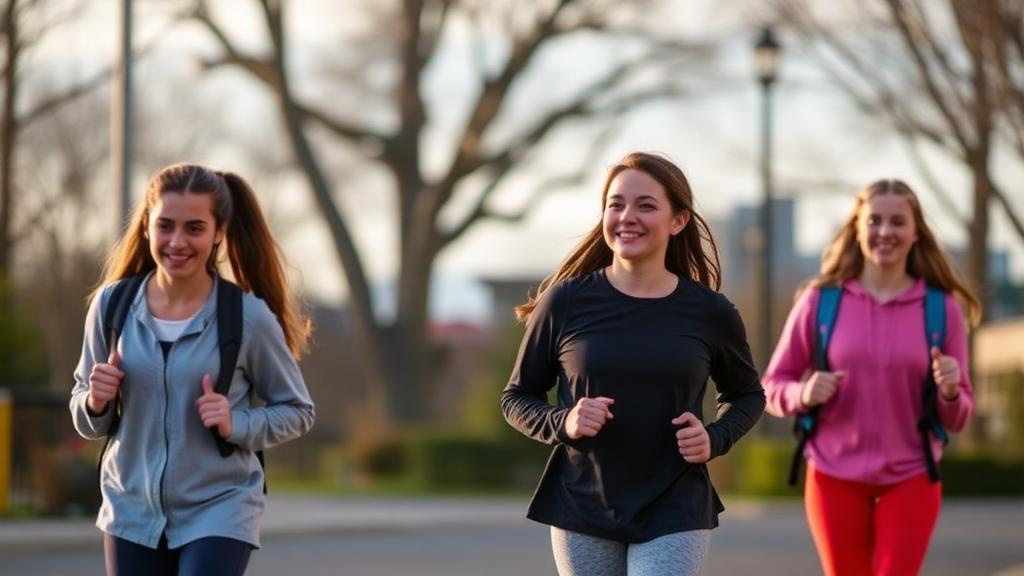
When it comes to making teenagers happier, the answer may not lie in pushing them harder on the sports field, but in helping them simply move a little more throughout the day. A new study from Australian researchers, published in the Journal of Activity, Sedentary and Sleep Behaviors, has found that light physical activity — the kind of gentle movement that includes strolling between classes, helping with chores, or pottering around the house — was the only movement behaviour significantly linked to higher happiness scores in adolescents. Even more striking, the researchers calculated that swapping just 30 minutes of sitting time for light activity was associated with a measurable boost in happiness, while the reverse shift was linked to a decline. In an era when adolescent wellbeing is declining worldwide, the finding offers an unusually accessible prescription: small, achievable changes to daily routines may matter more than dramatic overhauls.
The study, led by Gunchmaa Nyam of Deakin University’s Institute for Physical Activity and Nutrition, drew on baseline data from the TransformUs Secondary effectiveness trial, collected between August 2023 and December 2024. Seven secondary schools across Victoria, Australia, were recruited to capture a diverse mix of government, independent and Catholic schools from metropolitan and regional areas. Of 545 students invited, 193 consented to participate, and after strict quality control of accelerometer data and questionnaire responses, the final analytical sample comprised 124 adolescents aged 13 to 17, with a mean age of 14.8 years. Roughly half of the participants were male, and participants wore wrist-mounted ActiGraph GT9X accelerometers for seven consecutive days, 24 hours a day, providing an objective record of how every minute of their day was spent.
The technical rigour of the measurement is central to the study’s credibility. Accelerometer data were processed using the GGIR package in R, which performed automatic calibration, detection of non-wear time, imputation of invalid data and sleep detection. Participants were only included if they provided at least 16 hours of valid wear time on at least three days, and sleep was estimated using an automated algorithm based on wrist movement variability. Movement intensities were classified using validated age-specific thresholds: sedentary time below 35.6 milligravities, light physical activity between 35.6 and 201.4, moderate activity up to 707.0, and vigorous activity above that. On average, participants accumulated 6.0 valid days of wear, with the devices covering 68 percent of each 24-hour period — a level of objective detail that sidesteps the recall errors and social desirability bias that plague self-reported activity questionnaires.
What the devices revealed was a portrait of modern adolescence that few families would find surprising. On average, the teenagers spent 680.9 minutes — nearly 11.3 hours, or 47.3 percent of the day — in sedentary behaviour. Sleep accounted for 473.0 minutes, or about 7.8 hours. Light physical activity filled 250.7 minutes, roughly four hours, while moderate-to-vigorous physical activity, the intensity most public health guidelines emphasise, occupied a mere 35.3 minutes — just 2.5 percent of the day, and well short of the 60 minutes daily recommended by the Australian 24-Hour Movement Guidelines. The authors note that fewer than 5 percent of Australian adolescents meet all three movement guidelines, a statistic that underscores how far typical routines have drifted from what health authorities consider optimal.
To assess wellbeing, the researchers used the EPOCH Measure of Adolescent Wellbeing, a validated 20-item questionnaire capturing five domains of positive psychological functioning: engagement, perseverance, optimism, connectedness and happiness. Unlike traditional mental health measures that focus on symptoms of illness, EPOCH captures flourishing — the hedonic dimensions of wellbeing such as happiness and optimism, and the eudaimonic dimensions such as engagement and perseverance. Students rated each item on a five-point scale from “Almost never” to “Almost always.” The sample reported moderate to high wellbeing overall, with connectedness scoring highest at 4.35, followed by happiness at 3.92, perseverance at 3.62, optimism at 3.61 and engagement at 3.39.
The analytical approach is where the study departs most sharply from previous work. Time-use data are inherently compositional: because there are only 24 hours in a day, an increase in one behaviour necessarily displaces another, and treating each behaviour in isolation — as most earlier studies did — ignores this interdependence. The researchers therefore applied compositional data analysis, or CoDA, transforming the movement behaviour data using isometric log-ratio (ILR) transformations with pivot coordinates before running compositional linear regression models. Each model was rotated so that every behaviour could be examined relative to all the others, and the models were adjusted for age, gender and school-level clustering. The team also performed a compositional time-reallocation analysis, modelling the hypothetical effect of shifting 30 minutes between pairs of behaviours while holding total daily time constant — a realistic, intervention-sized change.
The results were strikingly specific. Greater time spent in light physical activity relative to all other behaviours was significantly associated with higher happiness scores, while greater sedentary time relative to light activity was significantly associated with lower happiness. The reallocation models quantified the trade-off: shifting 30 minutes from sedentary time to light activity was associated with an increase in happiness scores of 0.128 (95 percent confidence interval: 0.034 to 0.222), while the reverse reallocation produced a significant decrease. Perhaps most unexpectedly, neither moderate-to-vigorous physical activity nor sleep showed significant associations with any of the five wellbeing domains, and no movement behaviour was linked to engagement, perseverance, optimism or connectedness.
The absence of an MVPA effect will raise eyebrows, given the extensive literature linking vigorous exercise to adolescent mental health. The authors urge caution in interpretation, however: the small sample size and low variability in MVPA — most participants managed only about half an hour a day — may have limited the statistical power to detect associations. Context may also matter. Evidence from ecological momentary assessment suggests that outdoor or social activity tends to boost positive affect, whereas indoor, solitary or obligatory activity may not, and competitive or compulsive forms of exercise can even induce stress. Accelerometers, for all their objectivity, cannot distinguish whether a burst of vigorous movement came from a joyful game of basketball or a pressured training session — a nuance the authors flag as critical for future research.
The light activity finding, by contrast, fits an emerging picture. Light-intensity movement such as tai chi or yoga has been associated with reductions in anxiety symptoms, and the authors suggest that gentle activity may represent an accessible, attainable and enjoyable form of movement that facilitates relaxation, casual social interaction and emotional regulation. Sedentary time, meanwhile, has been repeatedly linked to psychological distress and lower self-worth, particularly when it is screen-based — although the authors note that sedentary behaviour also encompasses reading and homework, whose effects may differ from passive screen time. A recent compositional meta-analysis found sleep showed the strongest positive relationship with social-emotional outcomes in children and adolescents, making the null sleep finding here another puzzle that only longitudinal work can resolve.
The study has clear limitations: it was cross-sectional, so causality cannot be established; more than 30 percent of the consenting sample was excluded for insufficient accelerometer data, raising the possibility of non-participation bias, although comparisons between included and excluded participants showed no significant differences in wellbeing or demographics; and there is no established threshold for what constitutes a clinically meaningful change in EPOCH scores. Yet the practical message is hard to ignore. If replacing half an hour of sitting with light movement is associated with even a modest happiness gain, then interventions as simple as encouraging movement during class breaks could support adolescent flourishing without demanding heroic feats of exercise. The authors call for longitudinal and intervention studies to confirm the findings — and to capture not just how much adolescents move, but where, why and with whom.
Subject of Research: Associations between 24-hour movement behaviours and domain-specific psychological wellbeing in adolescents
Article Title: Associations between 24-hour movement behaviours and psychological wellbeing in adolescents using compositional data analysis
Article References: Nyam, G., Lander, N., Ayala, A. M. C., Strugnell, C., & Salmon, J. (2025). Associations between 24-hour movement behaviours and psychological wellbeing in adolescents using compositional data analysis. Journal of Activity, Sedentary and Sleep Behaviors, 4(1), Article 21. https://doi.org/10.1186/s44167-025-00094-8
Image Credits: AI Generated
DOI: 10.1186/s44167-025-00094-8
Keywords: adolescent health, physical activity, sedentary behaviour, compositional data analysis, psychological wellbeing, happiness, EPOCH measure, accelerometer, sleep, MVPA, light physical activity, 24-hour movement guidelines
Cite Scienmag News
Glenn Wilkins. (September 30, 2026). Light Activity, Not Intense Workouts, Tied to Happier Teens in 24-Hour Time-Use Study. Scienmag. https://scienmag.com/light-activity-not-intense-workouts-tied-to-happier-teens-in-24-hour-time-use-study/
Glenn Wilkins. "Light Activity, Not Intense Workouts, Tied to Happier Teens in 24-Hour Time-Use Study." Scienmag, 30 September 2026, https://scienmag.com/light-activity-not-intense-workouts-tied-to-happier-teens-in-24-hour-time-use-study/. Accessed 30 September 2026.
Glenn Wilkins. "Light Activity, Not Intense Workouts, Tied to Happier Teens in 24-Hour Time-Use Study." Scienmag. September 30, 2026. https://scienmag.com/light-activity-not-intense-workouts-tied-to-happier-teens-in-24-hour-time-use-study/


