


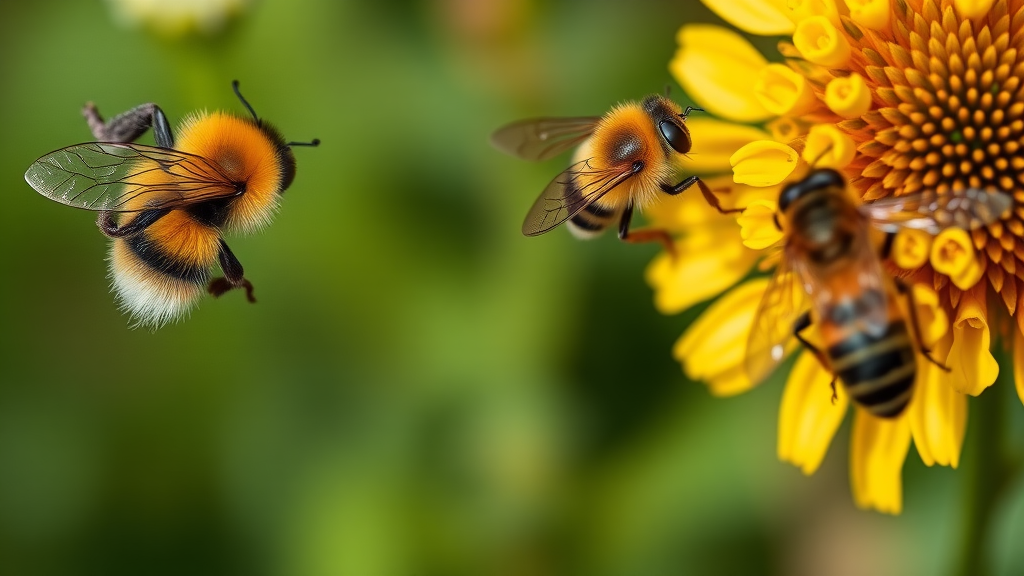
High in the Himalaya-Hengduan Mountains of southwestern China, the alpine meadows that blanket the slopes of Yulong Mountain undergo a complete transformation between May and October. Flowers bloom and fade in waves, insects emerge and vanish, and the web of pollination that ties the community together is rewired almost beyond recognition from one fortnight to the next. Yet new research shows that this apparent chaos conceals a hidden order, and that a small cast of ecological generalists—most notably the bumblebee Bombus friseanus and a suite of versatile flies—acts as the connective tissue that keeps pollination functioning from the first spring thaw to the final autumn frost.
The study, published in Ecology and Evolution, took advantage of an extraordinary dataset gathered at the Lijiang Forest Ecosystem Research Station. Over the 2012 flowering season, researchers conducted nine censuses at two-week intervals in four alpine meadows spread along an elevation gradient from 2,725 meters to 3,910 meters above sea level. Across 320 hours of observation, they recorded 5,369 pollination events linking 101 plant species with 335 insect pollinator species, each insect identified through a combination of morphology and DNA barcoding. Crucially, the team filtered out insects carrying no pollen, ensuring the network represented genuine pollination rather than mere flower visitation.
What makes the analysis novel is its treatment of time. Rather than slicing the season into disconnected snapshots, the researchers built temporal multilayer networks, a framework borrowed from network science in which each two-week census forms a layer and species are connected both to their interaction partners within a layer and to themselves across adjacent layers. The weights of these interlayer links reflect changes in abundance and phenology, effectively encoding how strongly a species persists from one period to the next. This architecture allowed the team to ask questions that static networks cannot answer: which species hold the community together through time, and what biological traits make them capable of doing so?
The first major finding concerns modularity. Ecological networks are typically organized into modules—clusters of species that interact strongly with one another but weakly with outsiders—and in static networks this modularity is thought to buffer disturbances. Using the Infomap algorithm, which compresses the description of flows through a network to detect its natural divisions, the researchers confirmed that all four temporal networks were significantly modular compared with randomized null models. But the modules themselves were startlingly ephemeral. No single module persisted across all nine time layers at any site, and at three of the four meadows, roughly 60 to 69 percent of modules lasted only one or two census periods. Early-season and late-season modules became entirely distinct communities.
Yet the turnover of species with different flowering and flight phenologies turned out to be only half the story. On average, 47.6 percent of pollinator species changed their module affiliation at least once during the season, a property the authors call adjustability. More striking still, the number of modules a pollinator occupied was tightly correlated with the number of time layers in which it remained active, with Spearman correlations ranging from 0.67 to 0.90 across sites. Long-persisting species do not simply sit in a stable niche; they actively track floral resources as the plant community shifts, rewiring their interactions and migrating between modules. The bumblebee B. friseanus exemplified this flexibility, occupying up to six different modules at the highest-elevation sites.
The second pillar of the analysis is versatility, measured through multilayer PageRank centrality—the same algorithm that underlies Google’s search rankings, adapted to rank species by their importance across the entire temporal structure. Most pollinators scored low, but a select few stood out: between 4 and 14 species per site, or roughly 5 to 15 percent of the local pollinator fauna, showed versatility significantly exceeding random expectation. These super-generalists were dominated by Diptera and Hymenoptera, with hoverflies and anthomyiid flies taking center stage at high elevations, consistent with the established importance of flies in cold, alpine environments. Intriguingly, a hemipteran of the genus Nysius emerged as highly versatile at two sites, hinting that true bugs may be underappreciated pollinators in alpine meadows.
Having identified the network’s temporal linchpins, the researchers turned to the mechanistic question: what makes these species versatile? Their hypothesis drew on classical niche theory, which holds that species exploiting a broader range of resources and conditions persist better in fluctuating environments. They quantified each pollinator’s trophic niche space as the volume of floral trait space—corolla depth, flower units per plant, and plant height—spanned by the plants it visited, and its environmental niche space as the volume of temperature and humidity conditions under which it foraged, using convex hull volumes in multivariate trait space. Body traits likely to underpin these niches were also measured: proboscis length, head width, and forewing index.
Structural equation modeling revealed a consistent hierarchical pathway across all four meadows. Trophic niche space exerted a significant positive effect on versatility at every site, with standardized coefficients climbing from 0.31 at the lowest meadow to 0.51 at the highest. Environmental niche space acted both directly on versatility at the lower sites and indirectly, through its strong positive association with trophic niche space, at all sites—suggesting that pollinators tolerant of a wide range of microclimatic conditions also access a wider variety of flowers. Trait effects were more context-dependent: proboscis length broadened the trophic niche at the lowest site and the environmental niche at mid-high elevation, while head width showed a negative direct effect on versatility at one site, possibly because smaller-bodied insects can access more floral morphologies. The models explained between 23 and 48 percent of the variation in versatility.
The team took considerable care to rule out statistical artifacts. Because richer communities naturally offer larger interaction pools, they resampled the networks 100 times with fixed species richness and confirmed that the observed path coefficients generally fell within the null distributions, indicating genuine ecological signal rather than richness-driven inflation. A parallel resampling that standardized the number of individuals per pollinator species showed that the niche-versatility relationships were not merely a byproduct of abundant taxa accumulating more records. The consistency of the results across a 1,200-meter elevation gradient, spanning meadows with 58 to 169 pollinator species, strengthens the case that niche breadth is a general determinant of temporal network roles.
The implications reach well beyond Yulong Mountain. As climate change disrupts phenology and drives mismatches between flowering times and pollinator activity, the species most capable of holding ecosystems together may be precisely these broad-niched, module-switching generalists. The authors argue that highly versatile pollinators, by sustaining interactions across shifting temporal and ecological contexts, are likely to persist in changing environments and should be treated as priority candidates for conservation and further research into their functional replaceability. The multilayer framework itself invites extension to other interaction types—seed dispersal, herbivory, predation—and to temporal scales from hours to years, offering a general lens for understanding how ecological networks endure, reorganize, and sometimes collapse in a rapidly changing world.
Subject of Research: Temporal dynamics of plant-pollinator networks and the traits driving pollinator versatility across seasons
Article Title: Trophic and Environmental Generalists Maintain Pollinator Network Functional Continuity by Switching Modules Through Time
Article References: Li, H.-D., Zhao, Y.-H., Holyoak, M., Tao, Z., Xu, K., Wu, Z., Wang, H., & Li, D.-Z. (2026). Trophic and Environmental Generalists Maintain Pollinator Network Functional Continuity by Switching Modules Through Time. Ecology and Evolution, 16(9), Article e74263. https://doi.org/10.1002/ece3.74263
Image Credits: AI Generated
DOI: 10.1002/ece3.74263
Keywords: pollination networks, multilayer networks, modularity, versatility, niche breadth, bumblebees, alpine meadows, phenology, structural equation modeling, ecological networks, Himalaya-Hengduan Mountains, pollinator conservation
Cite Scienmag News
Julie Wynn. (September 26, 2026). Bumblebees and Flies Keep Pollination Networks Alive by Switching Teams All Season. Scienmag. https://scienmag.com/bumblebees-and-flies-keep-pollination-networks-alive-by-switching-teams-all-season/
Julie Wynn. "Bumblebees and Flies Keep Pollination Networks Alive by Switching Teams All Season." Scienmag, 26 September 2026, https://scienmag.com/bumblebees-and-flies-keep-pollination-networks-alive-by-switching-teams-all-season/. Accessed 26 September 2026.
Julie Wynn. "Bumblebees and Flies Keep Pollination Networks Alive by Switching Teams All Season." Scienmag. September 26, 2026. https://scienmag.com/bumblebees-and-flies-keep-pollination-networks-alive-by-switching-teams-all-season/


