


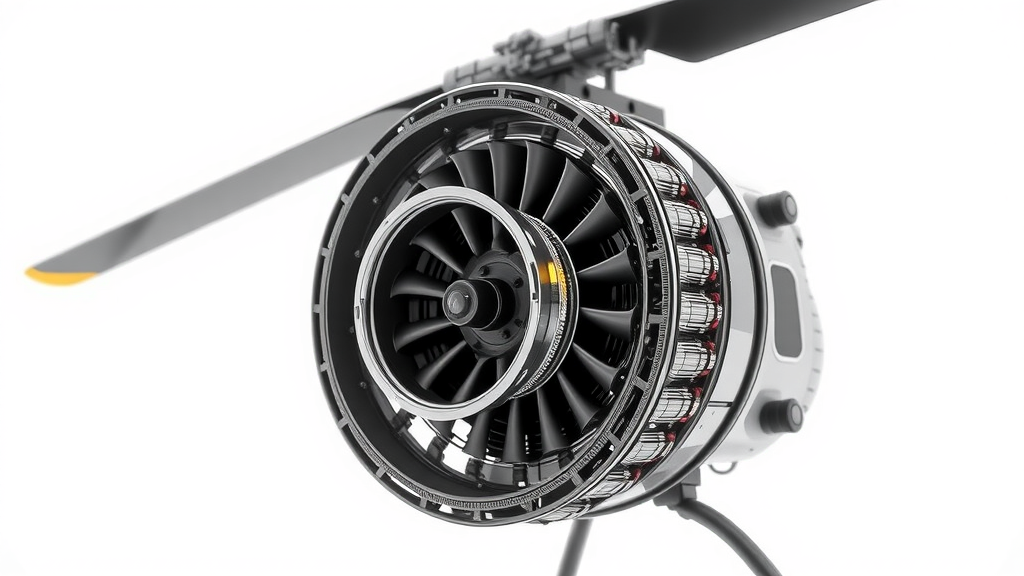
Helicopter engines live complicated lives. Unlike the relatively steady cruise of an airliner, a turboshaft engine powering a rotorcraft must swing, within seconds, from a hover to a dash, from a autorotative descent to a combat climb, across altitudes and temperatures that reshape its thermodynamic behavior at every turn. Keeping an accurate mathematical portrait of such an engine running in real time aboard the aircraft is one of the enduring challenges of aero-engine health management, because that portrait, known as an onboard model, is what allows the engine’s control and monitoring systems to detect a degraded compressor, a drifting sensor, or an incipient fault before it becomes a catastrophe. A new study published in the International Journal of Aeronautical and Space Sciences by Weihong Huang, Qiangang Zheng, Cheng Chen, and Haibo Zhang of Nanjing University of Aeronautics and Astronautics now reports a hybrid modeling strategy that delivers near-perfect predictive accuracy across the entire flight envelope while consuming only a tiny fraction of the flight data such models were previously assumed to require.
The core dilemma the researchers confront is a data scarcity problem that will be familiar to anyone working at the intersection of machine learning and safety-critical engineering. Data-driven models are hungry for examples, yet genuine steady-state flight data from a helicopter turboshaft are extremely scarce and unevenly distributed in practice. Most of a flight is spent in transient maneuvers, and the calm, stabilized segments from which a steady-state model can learn represent only a small and biased slice of the operating envelope. Train a conventional neural network on what little is available and it will excel at predicting the conditions it has seen while silently failing everywhere else, a dangerous property for a model that is supposed to serve as the reference against which engine health is judged. Physics-based component-level simulations, meanwhile, cover the whole envelope but inevitably deviate from the specific engine actually hanging beneath the airframe, because manufacturing tolerances, installed accessories, inlet distortions, and sensor calibration all introduce systematic offsets that no generic simulation can anticipate.
The team’s solution is to let each kind of knowledge do the job it is best at. First, they construct a baseline steady-state model using the mixture-of-experts architecture, a machine learning design that traces back to a seminal 1991 paper by Jacobs, Jordan, Nowlan, and Hinton and has recently become famous as a scaling strategy for large language models. In a mixture-of-experts system, multiple specialist networks each handle a different region of the input space, and a gating network learns to blend or select their outputs. The researchers trained their expert networks on component-level steady-state grid data, which are cheap to generate in bulk from the physics simulation. The result is a global prior: a complete mapping from flight condition to engine outputs covering the entire envelope, capturing the broad physics correctly but carrying the systematic deviations inherent in any simulation of a real installed engine.
Then comes the calibration step, and this is where the engineering judgment of the approach shows. Rather than retraining the model wholesale on the scarce flight data, which would risk destroying the generalization bought with the simulation data, the authors introduce a staged fine-tuning strategy. The limited real flight steady-state measurements are used only to correct the systematic offset between the baseline model and the actual onboard environment. The training proceeds in two stages with progressively smaller learning rates, first at one tenth and then at one hundredth of the original pre-training rate, a discipline that nudges the model toward the true engine without letting it overfit the handful of calibration points. The hyperparameter details, published in the paper’s appendix, show careful use of the AdamW optimizer with weight decay and gradient clipping, plus early stopping to halt training the moment validation performance stops improving.
The quantitative gains reported are striking. After calibration, the root-mean-square errors of three key engine parameters, gas generator speed, compressor discharge pressure, and power turbine inlet temperature, were reduced by 98.18 percent, 98.30 percent, and 95.23 percent respectively. The coefficient of determination for these outputs, which had actually been negative before calibration, meaning the uncorrected baseline predicted worse than simply guessing the mean, rose to above 0.99 after fine-tuning. Crucially, the authors demonstrate that this dramatic improvement on flight data did not come at the price of full-envelope generalization; the calibrated model retained its accurate coverage of operating conditions far from the sparse calibration points. That combination, extreme accuracy on real data plus preserved breadth, is precisely the trade-off that has stymied previous attempts at onboard modeling.
Steady-state accuracy, however, is only half the problem. Helicopter engines spend much of their lives in transient operation, where thermal inertia, rotor dynamics, and fuel system lag mean the engine’s instantaneous state depends on its recent history, not just its current operating point. To capture this, the team built a dynamic model they call MEL, a temporally gated mixture-of-experts in which each expert pairs a steady-state multilayer perceptron with a stacked long short-term memory network. LSTM units are recurrent neurons with internal gates that let them carry information across time, making them well suited to learning how an engine relaxes toward its steady state after a fuel change. An independent LSTM-based gating network watches the temporal evolution of the inputs and dynamically assigns weights to the experts, so the model effectively learns which specialist to trust as the engine sweeps through a maneuver.
On a dynamic flight test set, MEL achieved a coefficient of determination of 0.9923, outperforming both a global LSTM model trained without the expert structure, which scored 0.9899, and the pure steady-state mixture-of-experts baseline, which managed 0.9764. The margins look small in raw percentage points, but in the world of engine monitoring, where residuals of a fraction of a percent can distinguish a healthy sensor from a failing one, they are meaningful. The architecture also inherits a virtue of modular design: because each expert specializes, the model can represent operating regimes with genuinely different dynamics, such as a rapid spool-up versus a slow power trim, without one network compromising its accuracy across all of them.
The most consequential test, for practical health monitoring, is whether the model notices when something goes wrong. The authors injected artificial sensor bias faults into the data, a 5 percent bias on compressor discharge pressure and a 2 percent bias on power turbine inlet temperature, and watched the residuals, the differences between measured and predicted values. The MEL model’s residual distribution exhibited clear and quantifiable shifts under both fault conditions, providing exactly the statistical signature an onboard fault detection system needs to flag an anomaly. The conventional steady-state mixture-of-experts model, by contrast, showed almost no response to the injected faults, a sobering demonstration that a model which fits the steady data poorly in the first place cannot serve as a sensitive diagnostic reference.
The broader significance of the work lies in what it suggests about the future of engine health management and digital twins. Physics-informed and hybrid modeling has been a growing theme across aerospace research, with recent efforts spanning physics-based analysis combined with machine learning for real-time performance modeling, physics-informed neural networks for digital twin condition monitoring, and adaptive transfer learning to cope with domain shifts between simulated and operational data. The Nanjing team’s contribution is a clean, well-quantified recipe for a specific and difficult case: the turboshaft engine, with its brutal transients and its chronic shortage of steady flight data. By anchoring the model in component-level physics and using flight data surgically, the method sidesteps the false choice between models that are accurate but narrow and models that are broad but biased.
There are, of course, the usual caveats that accompany any single study. The results rest on the quality of the component-level simulation used to generate the prior, on the representativeness of the available flight calibration data, and on fault injections rather than naturally occurring failures, and the paper’s training details, while thoroughly documented, describe a workflow that other operators would need to replicate on their own fleets and engine marks. Still, the headline numbers speak plainly: determination coefficients above 0.99 across the envelope, error reductions exceeding 95 percent on every key parameter, and a dynamic model that visibly flinches when a sensor lies. For helicopter operators, engine manufacturers, and the engineers building the next generation of onboard monitoring systems, the study offers a credible path to high-fidelity engine models that fit aboard the aircraft, run in real time, and learn from the data flights actually produce, which is to say, very little of it.
Subject of Research: Hybrid onboard modeling of turboshaft engines using mixture-of-experts networks and flight data calibration for health monitoring
Article Title: Hybrid Onboard Modeling of Turboshaft Engines Integrating Component-Level Priors with Flight Data Calibration
Article References: Huang, W., Zheng, Q., Chen, C., & Zhang, H. (2026). Hybrid Onboard Modeling of Turboshaft Engines Integrating Component-Level Priors with Flight Data Calibration. International Journal of Aeronautical and Space Sciences. https://doi.org/10.1007/s42405-026-01264-x
Image Credits: AI Generated
DOI: 10.1007/s42405-026-01264-x
Keywords: turboshaft engine, onboard modeling, mixture-of-experts, LSTM, flight data calibration, fault diagnosis, health monitoring, digital twin, machine learning, aerospace engineering, sensor faults, hybrid modeling
Cite Scienmag News
Grant Pearson. (September 26, 2026). Helicopter Engine Digital Model Hits Near-Perfect Accuracy Despite Scarce Flight Data. Scienmag. https://scienmag.com/helicopter-engine-digital-model-hits-near-perfect-accuracy-despite-scarce-flight-data/
Grant Pearson. "Helicopter Engine Digital Model Hits Near-Perfect Accuracy Despite Scarce Flight Data." Scienmag, 26 September 2026, https://scienmag.com/helicopter-engine-digital-model-hits-near-perfect-accuracy-despite-scarce-flight-data/. Accessed 26 September 2026.
Grant Pearson. "Helicopter Engine Digital Model Hits Near-Perfect Accuracy Despite Scarce Flight Data." Scienmag. September 26, 2026. https://scienmag.com/helicopter-engine-digital-model-hits-near-perfect-accuracy-despite-scarce-flight-data/


