


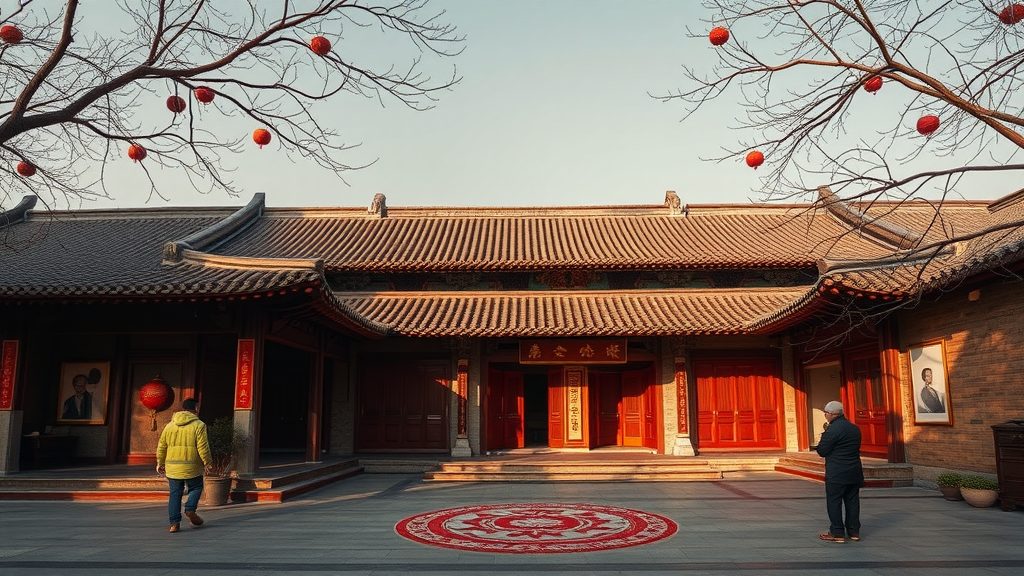
When the Beijing art house Rongbaozhai opened a branch in Hong Kong in 1987, it carried with it more than three centuries of accumulated prestige. Founded in 1672 as a stationery shop called Songzhuzhai during the Kangxi reign of the Qing dynasty, and rebranded in 1894 with a motto inscribed by a top imperial examination scholar, the institution had survived the collapse of the empire, the commercial art market of the Republican era, nationalization under the planned economy, and the market reforms launched after 1978. Yet within little more than a decade, the Hong Kong branch had suspended operations, and a second attempt after a 2013 reopening fared little better. A new study published in the International Journal of Anthropology and Ethnology argues that this failure was not primarily a matter of bad management. It was a structural collision between two social fields with fundamentally different rules about what counts as valuable.
The research, conducted by Ni Na Camellia Ng of Hong Kong Shue Yan University and Jingwei Chen of the Chinese Academy of Social Sciences, draws on the field theory of French sociologist Pierre Bourdieu and on a dual-structure model of Chinese social organization developed by anthropologist Zhang Jijiao. Bourdieu’s framework treats cultural, social, symbolic, and political capital as relational resources whose worth depends entirely on the specific social field in which they circulate. A reputation that commands deference in one institutional environment may be nearly worthless in another. Zhang’s model adds a distinctly Chinese dimension, distinguishing between an umbrella society, in which legitimacy and resources flow from hierarchical state authority, and a honeycomb society, sustained by decentralized networks of trust, reciprocity, and shared cultural norms. Rongbaozhai’s longevity, the authors contend, rested on the interaction of both structures.
The study’s central theoretical move is to reconceptualize brand authenticity. Marketing scholarship, most influentially the four-dimensional framework of Morhart and colleagues, has typically treated authenticity as a consumer perception built on continuity, credibility, integrity, and symbolism. Ng and Chen instead argue that these four dimensions function as structural conditions: institutional preconditions that determine whether cultural capital can be reproduced and converted into economic value. Continuity secures the intergenerational transmission of embodied expertise through apprenticeship and practice. Credibility establishes recognized authority among customers, experts, and the state. Integrity provides moral legitimacy. Symbolism transforms accumulated capital into socially acknowledged prestige. When all four hold, heritage becomes a durable economic asset; when any weaken, especially across field boundaries, convertibility collapses.
Integrity receives the most distinctive treatment. Rather than defining it as simple consistency between brand promises and behavior, the authors root it in the Confucian and Mohist principle of yi yi qu li, securing profit through righteousness. Under this moral logic, economic gain is legitimate only when pursued within culturally recognized ethical obligations: fair dealing, responsibility to employees and partners, and contribution to the wider society. Rongbaozhai’s donation of a Northern Song dynasty handscroll by the calligrapher Mi Fu to the Palace Museum exemplifies the principle in action. The authors argue that such adherence was not a moral cost but a source of institutional resilience, embedding commercial practice within a normative framework that preserved trust across generations and political regimes.
The historical narrative shows how these conditions were repeatedly rebuilt under radically different circumstances. In the late Qing, imperial patronage created an umbrella-style relationship in which state protection was exchanged for loyalty and service. The 1894 rebranding, endorsed by Lu Runxiang, a zhuangyuan scholar of the Tongzhi era, operated as cultural consecration within the literati field, converting scholarly prestige into commercial legitimacy. When hereditary family management proved inadequate, the proprietor appointed outside managers on merit, granting Zhuang Huchen operational autonomy and an unusual profit split. Under manager Wang Renshan, annual ceremonial performance reviews and a system of labor-based equity shares tied advancement to competence and integrity, with documented share adjustments rewarding and disciplining senior staff.
The Communist revolution of the late 1940s shattered the literati networks on which the firm depended. By 1948 and 1949 its national branches had collapsed and the Beijing headquarters was near bankruptcy. Prominent cultural figures, including the writer Zheng Zhenduo, rallied to save it, and government intervention followed: a public-private partnership in 1950 cleared its debts, and by 1952 the firm was fully nationalized. Under socialist governance its symbolic capital was redefined as national cultural heritage rather than a feudal relic. Its mastery of woodblock watermark printing, collaborations with artists such as Qi Baishi and Xu Beihong, and designation as one of the few cultural institutions open to foreign visitors made it a venue for cultural diplomacy, hosting figures ranging from Queen Margrethe II to Henry Kissinger.
Hong Kong exposed the limits of this capital portfolio. The branch faced escalating rents in prime commercial districts, competition from multinational auction houses such as Sotheby’s and Christie’s, and local tastes that increasingly favored contemporary and avant-garde art over traditional Chinese painting. More fundamentally, the mechanisms that had validated Rongbaozhai’s authority in Beijing simply did not operate in Hong Kong. Continuity lacked institutional support in a field where value derived from market visibility rather than historical lineage. Credibility was arbitrated by collectors, galleries, and auction houses rather than state institutions. Symbolism, rooted in literati aesthetics and Qing heritage, competed against a cultural scene shaped by colonial history, international biennials, and cross-cultural experimentation. After the death of branch leader Wang Dashan, successors lacked the social capital to adapt, and operations were suspended in 2000.
The 2013 reopening repeated the structural miscalculation. Relocating to the prestigious Cheung Kong Centre, the branch generated more than forty million dollars in sales at its inaugural exhibition of the painter Fan Yang, but momentum dissipated under unsustainable rents, dependence on mainland buyers, and headquarters-imposed prohibitions on auctions. The authors describe the resulting condition as disintegrated capital: symbolic capital effective in one field that cannot be converted into valued resources in another. They also trace the historical roots of the mismatch, arguing that Hong Kong’s colonial-era education system privileged Western modernism as a benchmark, marginalizing traditional Chinese culture and producing a field whose pluralism partly reproduced a colonial cultural order.
The study does not conclude that heritage is doomed. It points to Hong Kong’s modern ink movement, initiated by Lui Shou-kwan in the 1960s and carried forward by painters such as Wong Chiu-tong, whose 2017 urban ink exhibition at the Rongbaozhai branch adapted traditional techniques to contemporary cityscapes. Authenticity, the authors suggest, can be regenerated through creative reinterpretation rather than preserved through continuity alone. Comparative evidence from Chinese heritage brands such as Daoxiangcun and Wangzhihe, global firms like Hermès and LEGO, and institutions such as the Louvre indicates that sustainability requires a dynamic equilibrium between authenticity, innovation, and governance. Research on China Time-honored Brands also warns of a dark side: reputational prestige can conceal weak performance when oversight is lacking.
The broader lesson extends well beyond one art house. Capital, in Bourdieu’s sense, derives its value not from any intrinsic quality but from the field that recognizes it, and under certain conditions it may become structurally non-convertible. Rongbaozhai entered Hong Kong with enormous reserves of prestige and found that the local regime of legitimacy, shaped by market rationality, cosmopolitanism, and transnational networks, simply did not price them. For heritage institutions everywhere, the challenge is therefore not balancing tradition against innovation in the abstract, but sustaining the institutional conditions under which cultural resources acquire recognition in changing environments. Authenticity, on this account, is never a fixed asset. It is a fragile achievement that must be continually re-earned within whatever field an organization seeks to survive.
Subject of Research: How brand authenticity and cultural capital conversion shaped the survival and transregional expansion of the Chinese heritage firm Rongbaozhai
Article Title: When fields collide: brand authenticity, dual structures, and cultural capital conversion in the case of Rongbaozhai
Article References: Ng, N. N. C., & Chen, J. (2026). When fields collide: brand authenticity, dual structures, and cultural capital conversion in the case of Rongbaozhai. International Journal of Anthropology and Ethnology, 10(1), Article 16. https://doi.org/10.1186/s41257-026-00165-x
Image Credits: AI Generated
DOI: 10.1186/s41257-026-00165-x
Keywords: Rongbaozhai, brand authenticity, cultural capital, Bourdieu field theory, China Time-honored Brands, heritage management, Hong Kong art market, dual-structure model, symbolic capital, cultural sociology, yi yi qu li, institutional legitimacy
Cite Scienmag News
Courtney Benton. (September 25, 2026). Three Centuries of Prestige Could Not Cross One Border: What a Beijing Art House Reveals About the Limits of Authenticity. Scienmag. https://scienmag.com/three-centuries-of-prestige-could-not-cross-one-border-what-a-beijing-art-house-reveals-about-the-limits-of-authenticity/
Courtney Benton. "Three Centuries of Prestige Could Not Cross One Border: What a Beijing Art House Reveals About the Limits of Authenticity." Scienmag, 25 September 2026, https://scienmag.com/three-centuries-of-prestige-could-not-cross-one-border-what-a-beijing-art-house-reveals-about-the-limits-of-authenticity/. Accessed 25 September 2026.
Courtney Benton. "Three Centuries of Prestige Could Not Cross One Border: What a Beijing Art House Reveals About the Limits of Authenticity." Scienmag. September 25, 2026. https://scienmag.com/three-centuries-of-prestige-could-not-cross-one-border-what-a-beijing-art-house-reveals-about-the-limits-of-authenticity/


