


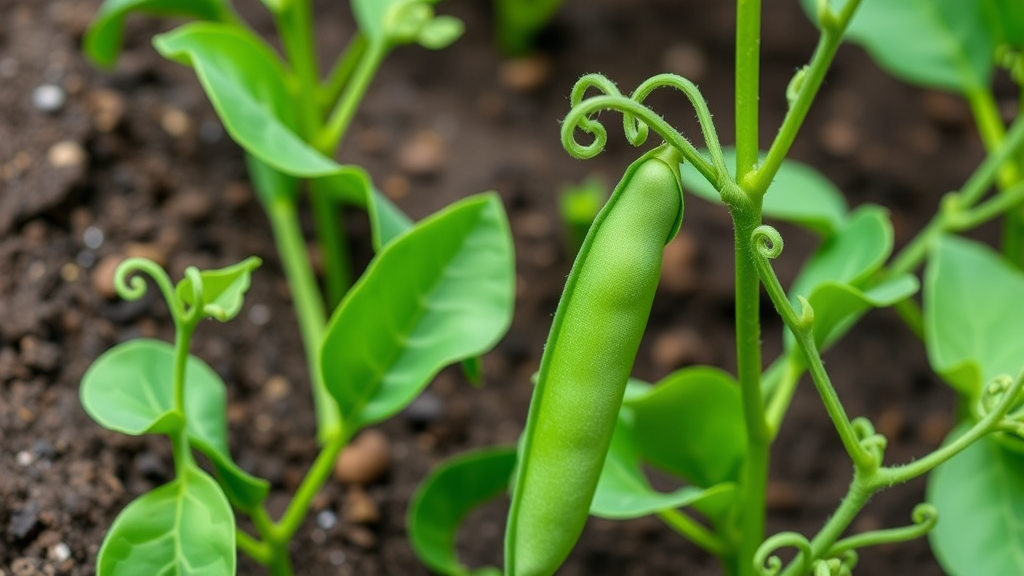
A field experiment in Punjab, India, has shown that pairing ordinary soil bacteria with zinc and iron nanoparticles can push garden pea plants to grow faster, yield more pods, and pack in more protein and vitamins, all while improving the soil they grow in. The study, conducted at Lovely Professional University in Phagwara during the 2024 to 2025 winter season, tested five varieties of garden pea against ten different treatment combinations of biofertilizers and nanoparticles. The results point to a specific recipe, combining the nitrogen-fixing bacteria Rhizobium and Azotobacter with foliar sprays of zinc and iron nanoparticles, that outperformed everything else in the trial, lifting total pod yield by roughly 27 percent over untreated controls and delivering the highest net profit per hectare.
Garden pea, Pisum sativum var. hortense, is a cool-season legume prized for its protein-rich pods, with fresh pods containing about 7.4 percent protein along with meaningful amounts of vitamin C, carotene, and B vitamins. India produces more than 6,130 thousand metric tonnes of peas annually across roughly 590 thousand hectares, yet conventional production relies heavily on bulk chemical fertilizers whose overuse degrades soil structure, leaches nutrients, and suppresses microbial life. The research team set out to test whether a smarter, lower-dose approach could match or beat conventional inputs. Their logic rested on a simple biological fact: peas already host bacteria in root nodules that pull nitrogen from the air, and the right micronutrients can make that partnership work harder.
The experiment followed a factorial randomized block design with three replications. Five pea varieties, including Him Palam Meethi Phali-1 and 2, Palam Triloki, PB-89, and Azad P-1, were crossed with ten treatments spanning single-agent combinations such as Rhizobium with zinc nanoparticles, up to four-way blends of both bacteria with both metal nanoparticles. Seeds were coated with bacterial cultures suspended in a jaggery solution before sowing, while zinc oxide and iron oxide nanoparticles, with particle sizes below 100 nanometers and purities above 99 percent, were sprayed onto foliage at 15-day intervals from germination through harvest. Concentrations ranged from 125 to 500 parts per million, and a surfactant was added to help the sprays stick to leaves.
The mechanism behind the synergy is subtle. Zinc is essential for enzyme activation, auxin synthesis, and protein metabolism, and it also regulates nodule functioning and symbiotic signaling during nitrogen fixation. Iron underpins chlorophyll synthesis and electron transport in photosynthesis, and it supports nitrogenase, the enzyme that actually converts atmospheric nitrogen into plant-usable forms. When delivered as nanoparticles, these metals offer enormous surface area and reactivity in tiny doses, improving nutrient delivery at the cellular level. Meanwhile, Rhizobium fixes nitrogen symbiotically inside nodules, contributing an estimated 40 to 50 kilograms of nitrogen per hectare, and Azotobacter fixes nitrogen free-living in the soil while producing growth hormones such as indole acetic acid, gibberellins, and cytokinins that stimulate root development.
Across growth traits, the four-way combination of Azotobacter, Rhizobium, iron nanoparticles, and zinc nanoparticles at 75 percent, 50 percent, 150 ppm, and 250 ppm respectively consistently produced the tallest plants, the largest leaf area index, and earlier flowering and picking dates. The variety Him Palam Meethi Phali-2 emerged as the strongest overall performer, leading in days to first flowering, plant height, pod yield per plant, total soluble solids, ascorbic acid, and chlorophyll content. When this variety was paired with the top treatment, the improvements spanned germination, pod size, number of pods per plant, seed weight, and total pod yield, which reached 27.28 percent above the untreated control.
Yield and quality data reinforced the pattern. The best treatment combinations produced wider pods, more pods per plant, heavier hundred-seed weights, and higher total pod yields per hectare. Biochemical analysis revealed that the winning combination also raised total soluble solids, protein, total sugar, reducing and non-reducing sugars, and dry matter content in the pods. Ascorbic acid and chlorophyll peaked under a slightly different blend, suggesting that different quality traits respond to somewhat different nutrient balances. The researchers attribute these gains to improved photosynthetic efficiency, better assimilate partitioning, and enhanced enzymatic activity driven jointly by the micronutrients and the microbial inoculants.
Soil chemistry shifted too. Treatments containing the bacterial duo and both nanoparticles increased soil nitrogen, phosphorus, potassium, and organic carbon, with the four-way blends generally performing best for phosphorus, potassium, and organic carbon. The microbes appear to have stimulated rhizosphere activity, releasing organic acids that mineralize nutrients, while the nanoparticles improved nutrient availability without the salt buildup associated with heavy chemical fertilization. Electrical conductivity, a proxy for salt stress, stayed favorable under the moderate-dose treatments.
The economics were striking. The highest gross return, 625,530 rupees per hectare, and the highest net income, 431,126 rupees per hectare, both came from Him Palam Meethi Phali-2 treated with the Azotobacter, Rhizobium, iron, and zinc nanoparticle blend. A benefit-cost ratio of 2.22 was recorded for that treatment and for a simpler Rhizobium plus zinc nanoparticle combination on the same variety. By contrast, the untreated control on variety PB-89 returned the lowest gross income and a benefit-cost ratio of just 0.80, meaning the crop barely paid for itself.
The study also carries a caution. Metal nanoparticles operate within a narrow window. At optimal doses they enhance plant-microbe interactions, nutrient availability, and redox balance in the rhizosphere, but excessive concentrations can generate reactive oxygen species, damaging cell membranes and killing the very bacteria the system depends on. Previous work has shown that high doses of nano-zinc oxide can alter root architecture and disrupt Rhizobium leguminosarum cells, delaying nodulation. The trial’s best results at moderate concentrations, and weaker results at 500 ppm, fit that dose-dependent picture precisely.
The findings position integrated biofertilizer-nanoparticle management as a credible route toward precision horticulture, cutting reliance on bulk chemicals while raising both yield and nutritional quality. The authors note that longer-term studies are still needed to track nanoparticle persistence in soil and any cumulative effects on soil ecosystems. For now, the message for pea growers is concrete: seed-treat with Rhizobium and Azotobacter, spray moderate doses of zinc and iron nanoparticles through the season, and choose a responsive variety such as Him Palam Meethi Phali-2 to capture the full synergy.
Subject of Research: Synergistic effects of biofertilizers and zinc and iron nanoparticles on growth, yield, biochemical quality, soil health, and economics of garden pea
Article Title: Synergistic effect of biostimulants and nanoparticles on morphophysiological traits of garden pea (Pisum sativum var. hortense L.)
Article References: Sakshi, Thakur, V., Johar, V., Singh, P., & Premdeep (2026). Synergistic effect of biostimulants and nanoparticles on morphophysiological traits of garden pea (Pisum sativum var. hortense L.). Discover Plants, 3(1), Article 422. https://doi.org/10.1007/s44372-026-00849-w
Image Credits: AI Generated
DOI: 10.1007/s44372-026-00849-w
Keywords: garden pea, biofertilizers, nanoparticles, Rhizobium, Azotobacter, zinc nanoparticles, iron nanoparticles, nitrogen fixation, crop yield, soil health, sustainable agriculture, nanofertilizers
Cite Scienmag News
Alan Morgan. (September 24, 2026). Microbes and Nanoparticles Team Up to Boost Garden Pea Yields by 27 Percent. Scienmag. https://scienmag.com/microbes-and-nanoparticles-team-up-to-boost-garden-pea-yields-by-27-percent/
Alan Morgan. "Microbes and Nanoparticles Team Up to Boost Garden Pea Yields by 27 Percent." Scienmag, 24 September 2026, https://scienmag.com/microbes-and-nanoparticles-team-up-to-boost-garden-pea-yields-by-27-percent/. Accessed 24 September 2026.
Alan Morgan. "Microbes and Nanoparticles Team Up to Boost Garden Pea Yields by 27 Percent." Scienmag. September 24, 2026. https://scienmag.com/microbes-and-nanoparticles-team-up-to-boost-garden-pea-yields-by-27-percent/


